Happiness is not something you postpone for the future; it is something you design for the present.
Jim Rohn
Friday, October 23, 2026
The Eight Doors Rule: 7 Powerful Ways To Get Started
The Eight Doors Rule: Why One Question Deserves More Than One Answer Discover
How one question can open eight useful learning opportunities, helping retirees turn their lifetime of experience into practical action without becoming overwhelmed by technology.
One Question Can Open Eight Useful Doors
Imagine finding the guidance you need through a connected series of practical answers, each with a clear explanation of what it can help you achieve.
Your Lifetime Experience Is The Starting Point
See how familiar knowledge, practical AI assistance and a guided learning journey can help you make progress without having to understand everything at once.
George had spent forty-two years working as a plumber and heating engineer. He could walk into a house, listen to a customer describing a problem and usually know which questions to ask before opening his toolbox. Experience had taught him that the first complaint wasn’t always the real problem. A cold radiator might have several explanations, and replacing parts before understanding the cause could waste everyone’s time. Retirement had finally arrived, and George now had something he’d rarely enjoyed during his working life. Time to think about what came next. One morning, sitting at his kitchen table, he opened his laptop and typed a perfectly reasonable question into a search engine. “How can I turn my plumbing experience into a little online income?” Within seconds, the screen filled with websites, videos, advertisements and conflicting advice. Unfortunately, none of them seemed to know where George should begin.
One article insisted he needed a website. Another suggested making videos, while a third recommended selling digital products. Somebody wanted him to start a YouTube channel, and another enthusiast promised that artificial intelligence would do practically everything for him. George wasn’t short of practical intelligence, and he’d managed employees, customers and complicated installations for decades. Nevertheless, he felt strangely out of his depth. The problem wasn’t that he couldn’t understand the individual suggestions. No one had explained how they fit together. Every answer appeared to be the beginning of a completely different journey. George had asked one question and received a collection of unrelated opportunities, each requiring more research. The Eight Doors Rule offers a different way to approach that situation. Instead of presenting eight competing answers, it connects eight useful decisions into one understandable journey.
The Eight Doors Rule Changes How We Find Answers
Here’s the distinction that changes everything. Finding information and getting useful guidance aren’t the same. A search engine can show you ten articles with words similar to your question, but those articles might offer ten opinions without helping you make a decision. Imagine asking an experienced foreman how to install a central heating system and receiving eight catalogues of boilers, radiators and electrical controls. Those catalogues might contain accurate information, but they wouldn’t explain which job comes first or why one decision affects another. A competent foreman begins by understanding the property, identifying the heating requirements and planning the installation before ordering equipment. The same principle applies when somebody wants to turn personal experience into a useful digital resource. Information becomes far more manageable when it’s arranged around the decisions the person needs to make.
The Eight Doors Rule begins with the question someone actually asks. That question becomes the entrance to a guided journey, where each door performs a different job. One might help the visitor recognise useful experience. Another identifies a problem that experience could solve. A third explains how an AI assistant can help organise the information, while another helps the reader choose a practical outcome. Later doors can explore creating the resource, checking its usefulness, helping interested people discover it and understanding whether a suitable income opportunity exists. The number eight gives our workshop a consistent structure, but it’s nothing magical. If a question needs only three worthwhile steps, three are better than eight padded answers. Every door must earn its place by moving the reader towards a clearer understanding, a better decision or a useful action.
For retirees, that difference can be especially valuable because they’re often bringing considerable real-world experience into an unfamiliar digital setting. Someone who spent forty years managing a small business might understand customer service, stock control and bookkeeping but struggle to recognise those skills as possible subjects for online teaching. A retired gardener may know how to rescue struggling plants without knowing what a downloadable checklist is. A former secretary could explain office organisation beautifully yet have little experience creating digital guides. Their difficulty isn’t necessarily a shortage of useful knowledge. More often, they need help translating what they already understand into a format somebody else can use. Instead of asking them to learn every available technology, a guided workshop can start with familiar situations, plain language and one manageable decision. The reader uses existing strengths instead of pretending those strengths no longer matter.
Return to George and his original question about earning a little money online. It’s tempting to treat the phrase “online income” as the most important part and immediately recommend affiliate marketing, blogging or digital products. But George hasn’t yet explained what he wants to do, who might benefit or whether he enjoys writing, speaking or teaching. An income method is a possible destination, not automatically the correct first step. The more useful starting question is what George knows that other people regularly struggle to understand. Perhaps he spent years explaining household maintenance to customers who were nervous about calling a tradesperson. Maybe he became particularly good at helping apprentices organise their work. Those experiences suggest different opportunities, and the sensible choice depends on the intended reader’s needs as well as George’s abilities.
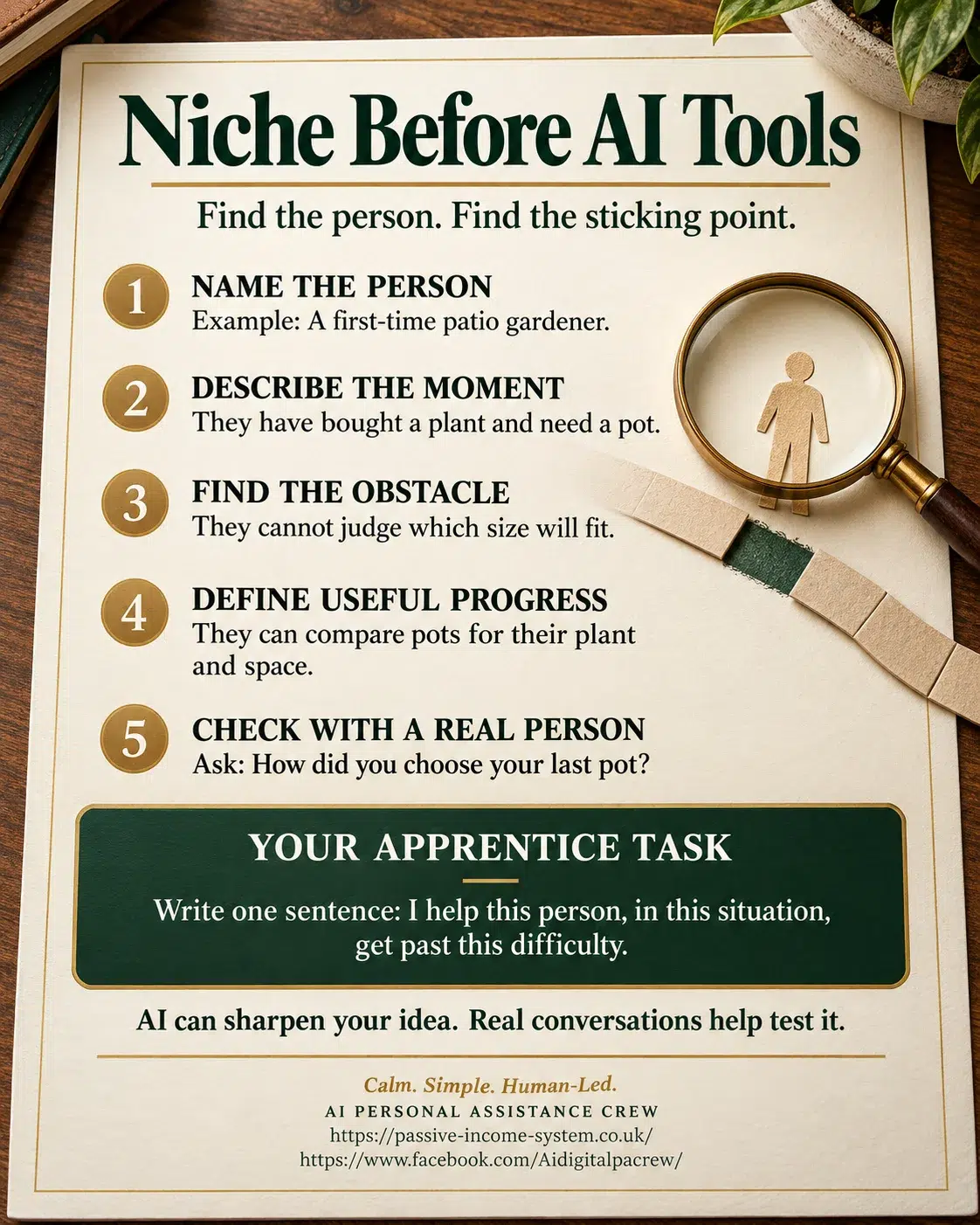
Keep the exercise manageable. You don’t need to decide how to sell anything, build a complete training course or choose a new business model. The objective is to finish one small piece of thinking properly. Once you’ve identified the experience, you can explore who might benefit and what kind of resource could help them. If the answer isn’t immediately obvious, that’s useful information too. You may need to choose a more specific example rather than forcing a broad subject into an unsuitable product. The Eight Doors Rule is designed to reduce unnecessary decisions, not create another eight jobs you must complete before lunchtime. A worthwhile first result might be as simple as one sentence: “I can help first-time homeowners understand what information to prepare before calling a qualified heating engineer.” That sentence gives the next stage something concrete to work with.
Today’s Apprentice Task: Build One Front Door
Open to See This Video, And This Is What’s Already Built, Trained & Waiting For Your First Command.
One Question Can Become A Clearer Route Forward
George’s journey began with the same confusion many people experience when they first investigate online opportunities. He had valuable experience, a working knowledge of his trade, and a genuine desire to stay useful, but he lacked a clear way to connect those strengths to the digital world. By following eight related decisions, he moved from a vague ambition towards a practical resource with an identifiable purpose. He still has work to do before claiming commercial success, and he may discover that some assumptions need changing. That’s a normal part of developing something worthwhile. The key achievement is that he can now identify the next sensible action without reopening the entire internet to search for another miracle solution. His experience provides the substance, while suitable digital tools help organise, present and distribute it.
The Eight Doors Rule begins with one genuine question, connects the decisions that matter and helps the reader complete one useful job at a time.
And perhaps that’s the most valuable lesson of all. There is no need to understand every AI tool, marketing platform or online income method before your experience becomes useful to somebody else. You need to recognise a real problem, understand who needs help and take the first practical step towards providing it. Open the door that matches the job you’re ready to do. You can leave the others closed until you need them.
The Eight Doors Rule 7 Powerful Ways To Get Started
The Eight Doors Rule: 7 Powerful Ways To Get Started: The Eight Doors Rule: Why One Question Deserves More Than One Answer Discover
How one question can open eight useful learning opportunities, helping retirees turn their lifetime of experience into practical action without becoming overwhelmed by technology.
 Here’s the distinction that changes everything. Finding information and getting useful guidance aren’t the same. A search engine can show you ten articles with words similar to your question, but those articles might offer ten opinions without helping you make a decision. Imagine asking an experienced foreman how to install a central heating system and receiving eight catalogues of boilers, radiators and electrical controls. Those catalogues might contain accurate information, but they wouldn’t explain which job comes first or why one decision affects another. A competent foreman begins by understanding the property, identifying the heating requirements and planning the installation before ordering equipment. The same principle applies when somebody wants to turn personal experience into a useful digital resource. Information becomes far more manageable when it’s arranged around the decisions the person needs to make.The Eight Doors Rule begins with the question someone actually asks. That question becomes the entrance to a guided journey, where each door performs a different job. One might help the visitor recognise useful experience. Another identifies a problem that experience could solve. A third explains how an AI assistant can help organise the information, while another helps the reader choose a practical outcome. Later doors can explore creating the resource, checking its usefulness, helping interested people discover it and understanding whether a suitable income opportunity exists. The number eight gives our workshop a consistent structure, but it’s nothing magical. If a question needs only three worthwhile steps, three are better than eight padded answers. Every door must earn its place by moving the reader towards a clearer understanding, a better decision or a useful action.For retirees, that difference can be especially valuable because they’re often bringing considerable real-world experience into an unfamiliar digital setting. Someone who spent forty years managing a small business might understand customer service, stock control and bookkeeping but struggle to recognise those skills as possible subjects for online teaching. A retired gardener may know how to rescue struggling plants without knowing what a downloadable checklist is. A former secretary could explain office organisation beautifully yet have little experience creating digital guides. Their difficulty isn’t necessarily a shortage of useful knowledge. More often, they need help translating what they already understand into a format somebody else can use. Instead of asking them to learn every available technology, a guided workshop can start with familiar situations, plain language and one manageable decision. The reader uses existing strengths instead of pretending those strengths no longer matter.
 Here’s the distinction that changes everything. Finding information and getting useful guidance aren’t the same. A search engine can show you ten articles with words similar to your question, but those articles might offer ten opinions without helping you make a decision. Imagine asking an experienced foreman how to install a central heating system and receiving eight catalogues of boilers, radiators and electrical controls. Those catalogues might contain accurate information, but they wouldn’t explain which job comes first or why one decision affects another. A competent foreman begins by understanding the property, identifying the heating requirements and planning the installation before ordering equipment. The same principle applies when somebody wants to turn personal experience into a useful digital resource. Information becomes far more manageable when it’s arranged around the decisions the person needs to make.





No comments:
Post a Comment