Before you build anything, look for signs that real people already care.
Validate Your Audience Demand That Leaves Footprints
Searches, questions, comments, and repeated frustrations are evidence worth following.
Stop Guessing What People Want
The market usually tells you what matters long before anybody buys from you.
Most beginners start with an optimistic question: “Could people be interested in this?” That sounds reasonable, but almost any idea can look promising if you like it enough. Validate Your Audience Demand by asking something tougher: “What evidence can I already see that people care?” Real demand usually leaves footprints before money changes hands. People search for answers. They ask the same questions. They complain about the same problems. They compare options, watch videos, join discussions, and keep returning to the subject. None of those signs guarantees a sale, but together they tell you something valuable. The topic is alive. Instead of trying to convince yourself that an audience might exist, you begin looking for evidence outside your own head.
Think about a retiree considering a topic such as helping older people use AI with more confidence. The idea may sound sensible, but that is still only opinion. Now look at what happens when you search. You find videos about AI for beginners. Comments contain questions about prompts, tools, writing, side income, and everyday use. Forums contain people asking whether they are too old to learn. Books, courses and communities already exist around AI and retirement. That doesn’t prove everyone will buy from you, but it does something more useful right now. It confirms real people are paying attention. Validate Your Audience Demand by following several of those small footprints rather than waiting for one giant piece of proof.
The important word is repeated. One comment proves very little. One popular video can be misleading. One viral post may have caught a moment. What matters is whether the same signals keep appearing. Are similar questions being asked in different places? Do people keep mentioning the same frustrations? Are several creators publishing around the topic? Are there communities discussing it? Are products already being sold? Repetition turns isolated noise into something more useful. A simple rule: don’t look for one big proof; look for several small footprints pointing in the same direction. That gives beginners a practical way to judge a topic without expensive research software or complicated spreadsheets.
Validate Your Audience Demand First
Repeated behaviour gives you a safer starting point than enthusiasm alone.
Your own zeal can easily fool you. You may love a subject, have years of experience in it, and think it would help other people. That does not automatically mean enough people are actively looking for help. Validation is not an insult to your experience. It is simply a reality check. Suppose you have spent forty years restoring old tools. The knowledge may be excellent, but an extremely narrow angle could attract very little visible discussion. That does not mean the subject is worthless. It may mean the frame needs widening. “Traditional workshop skills” or “restoring old tools for beginners” may reveal much stronger activity. Validate Your Audience Demand before you throw away the idea. Sometimes the experience is right, and only the audience angle needs changing.
This is where validation becomes more useful than a simple yes-or-no decision. When you study comments, searches and conversations, you also discover the language people use. You begin noticing what bothers them, what they misunderstand, and what they keep asking for. That information can reshape the way you describe your topic. Maybe nobody searches for your clever phrase, but they keep asking questions about the same problem. That is not failure. It is guidance. The market may be showing you a better doorway. Instead of building around the words you invented, you can build around the problems people already recognise. That makes future articles, videos, products and offers easier to understand because they begin with the audience’s language rather than yours.
Another useful distinction is between curiosity and persistence. People may click something because it is new, surprising or fashionable. That does not always mean they care enough to keep looking. Stronger demand appears when people return to the subject. They ask follow-up questions. They compare solutions. They look for examples. They complain that current options are excessively technical, too expensive, too vague or too complicated. Persistence gives a problem weight. For a retiree building something small, you do not need millions of people. You need enough real people with a repeated reason to pay attention. That is a much calmer target. First find the footprints. Then decide whether the road is worth following.
What’s In This For You?
You stop wasting months on topics that only sounded promising in your own head.
You gain clearer evidence, better language, stronger direction and a better chance of building around something people already want help with.
You do not need perfect proof.
You need enough repeated evidence to justify the next useful step.
How To Validate Your Audience Demand
Attention, activity and spending give you a better understanding than one exciting clue.
Once you can see the footprints, sort them into three useful signals. First comes attention. Are people searching, watching, asking, commenting or conversing about the subject? Second comes activity. Are creators, communities, newsletters, businesses, or services already serving that audience? Third comes spending. Are people buying books, courses, coaching, software, products or services connected to the problem? Validate Your Audience Demand by looking for all three together. One signal alone can fool you. Attention without activity may be temporary curiosity. Activity without spending may be a hobby space. Spending without visible discussion may still be viable, but you need to understand why. The strongest picture appears when all three signals point in the same direction.
Today’s Apprentice Task: Build One Front Door
Your Apprentice Task Today
Open to See This Video, And This Is What’s Already Built, Trained & Waiting For Your First Command.
Pick one topic and find real evidence before you build anything around it.
Search the topic on YouTube and Google. Read several comments. Look for repeated questions. Find at least one active creator, community or business serving the space. Then check whether books, courses, products, software, coaching or services already exist around the problem.
Do not count one lucky example.
Look for repetition.
Then make one decision:
Keep investigating. Reposition the angle. Or drop it.
That is enough for today.
You are not trying to predict the future.
You are simply refusing to build on guesswork.
Follow repeated evidence, not hopeful imagination.
Add a simple evidence scorecard. Make the three signals more actionable.
Validate Your Audience Demand: 7 Powerful Signs That Sell
Validate Your Audience Demand: 7 Powerful Signs That Sell: Validate Your Audience Demand
Before you build anything, look for signs that real people already care.
Validate Your Audience Demand That Leaves Footprints
Searches, questions, comments, and repeated frustrations are evidence worth following.
One AI can help. A well-managed crew can take different jobs off your plate.
Why An AI Digital PA Crew Works
The easiest way to make AI harder is to give one assistant too many different jobs.
Give Every AI One Clear Trade
Start with the work you repeat, then match each job to the AI that handles it best.
For most people, an AI Digital PA Crew doesn’t start as a Crew at all. It begins with one AI assistant. You ask it to write something. Then research something. Then create a headline. Then help with an image. Then organise a document. Before long, the same AI is being treated like the plumber, electrician, plasterer, decorator, and foreman all rolled into one. It may still produce useful work, but the system becomes difficult to judge because every job is mixed. If the writing is strong but the design is weak, where exactly is the problem? If the research is good but the finished post needs half an hour of repairs, what should change? An AI Digital PA Crew starts working properly when each assistant has one clear responsibility first.
Think about how a tradesman learns a job. You do not give the apprentice every tool in the van and say, “Have a go at everything.” You show him what each tool is for. You give him one job. You watch the result. If he does that job well, you give him more responsibility. AI should be managed the same way. One assistant might be strongest at helping you think through an idea and turn it into clear writing. Another might be better when you are working inside documents or spreadsheets. A specialist image tool may handle visuals better. A video tool may be the obvious choice once the script is finished. The aim is not to prove one AI can do everything. The aim is to discover which AI deserves which trade.
This is where the One-Trade Rule becomes useful. When you first bring an AI into your Crew, give it one primary job and judge it on that job. If it writes, let it write. If it researches, let it research. If it creates visuals, let it create visuals. Do not keep changing the role before you have enough evidence to know whether it is good at the first one. That doesn’t mean the AI can’t do anything else. It means you are building a reliable starting point. Once each worker has a clear trade, you stop wondering which tool to use every time a job appears. The decision becomes simpler because the Crew already has a shape.
Build Your AI Digital PA Crew
Your jobs should decide the Crew, not the latest software somebody is trying to sell you.
The wrong way to build an AI Digital PA Crew is to start with the tools. You see a new AI, watch a demonstration, hear that everybody is using it, and then try to invent a reason to add it to your workflow. The better approach is the opposite. Start with the work you already repeat. Do you write articles? Research topics? Create graphics? Make videos? Check SEO? Organise PDFs? Work inside spreadsheets? Manage websites? Those are the real jobs. Once you can see them, you can ask whether somebody on the Crew already owns each one. If the answer is yes, use that worker. If the answer is no, you have found a genuine gap rather than another shiny object.
Imagine a retiree building useful digital content from forty years of work experience. One AI helps him identify the strongest lesson hidden inside an old story and turn it into an article. That article is then handed to a visual AI, whose only job is to turn the central idea into a strong social graphic. A third tool takes the finished article and helps shape it into a short video. Nothing is being duplicated. Nobody is reopening the original lesson. Each worker continues the job where the previous worker left off. That is the difference between having several AI tools and having an AI Digital PA Crew. The Crew has roles, boundaries and a direction.
The human remains the gaffer. That matters. AI can help organise, write, research, design and produce, but somebody still has to decide what is worth doing. The human chooses the idea, judges whether the work feels right, and decides when the result is good enough to move forward. That human judgement stops the Crew from becoming a collection of machines producing more work for its own sake. A good Crew should take jobs off your hands, not create another management burden. If an AI constantly needs rescuing, repeats work another tool already does, or produces something you would never use, it has not earned that role yet.
The simplest test is one you already understand from the trades.
Would you give this worker the same job again?
If the answer is yes, keep the role.
If the answer is no, change the assignment before you buy another tool.
That is how an AI Digital PA Crew starts becoming personal, practical and manageable.
One worker.
One trade.
One result worth keeping.
Give Every AI A Proper Role
The right AI is the one that repeatedly helps you finish its job with the least unnecessary repair.
This gives you a practical way to manage the Crew without getting lost in technical comparisons. Score the finished job. Did the AI understand what you needed? Did it save meaningful effort? How much repairing did you have to do afterwards? Would you happily give it that same task tomorrow? If the answer keeps being yes, that worker has earned its trade. If the answer keeps being no, change the role. Don’t spend weeks trying to force one AI to become something it isn’t just because you already pay for it or because somebody online says it should be brilliant. An AI Digital PA Crew grows from your own evidence, not somebody else’s league table.
That can also save money. Many people solve every new problem by buying another tool. Another subscription arrives, another login is created, and another monthly payment quietly joins the pile. But if you first give the tools you already own clear roles, you may discover the missing ingredient was management, not software. Two assistants may be duplicating the same work. One may sit unused because you never found the job where it shines. Another may not earn its keep. A useful Crew should become smaller and clearer as you learn, not endlessly larger. Add a worker only when there is a real job nobody on the existing Crew can perform well enough.
Riley’s Wisdom Drop – The Tool Must Earn Its Trade
Do not keep an AI because it is fashionable.
Do not give it every job because it is familiar.
Give it one useful role and let the finished work decide whether it stays there.
The skill isn’t owning the AI tools. The skill is knowing which AI tool can do the job.
That is the advantage an experienced person brings to this new world. You have already spent a lifetime learning that tools do not create good work on their own. Judgment does. You learn when to use a tool, when not to, how far to trust it, and when the job needs something different. AI does not remove that experience. It makes that experience more valuable. Someone who has spent years solving practical problems can often see quickly when a result looks clever but doesn’t actually do the job.
Open to See This Video, And This Is What AI Digital PA Crew Already Built, Trained & Waiting For Your First Command.
Today’s Apprentice Task: Build One Front Door
Your Apprentice AI Digital PA Crew Task Today
Turn the AI tools you already use into the beginning of a real Crew.
Write down the three or four AI tools you use most often. Beside each one, write the single job you would most happily give it again tomorrow. Do not list everything the tool claims it can do. Write the job where your own experience says it has been most useful.
Then look for overlap.
If two workers own the same trade, decide which one produces the stronger finished result with less repair.
If an important repeated job has nobody beside it, you have found a genuine gap.
And if a tool has no clear job at all, ask the uncomfortable question:
Why am I still paying for it?
That is how you begin building an AI Digital PA Crew that suits your work instead of somebody else’s.
Right worker.
Right trade.
Right handoff.
Right result.
And once those roles are working, the next job becomes obvious.
Someone still has to manage the Crew.
AI Digital PA Crew 7 Smart Roles For Better Results
AI Digital PA Crew: 7 Smart Roles For Better Results: AI Digital PA Crew
One AI can help. A well-managed crew can take different jobs off your plate.
Why An AI Digital PA Crew Works
The easiest way to make AI harder is to give one assistant too many different jobs.
Experience Before AI Answers: Questions Come From Experience.
The Knowledge Behind Experience Before AI Answers
Some of your most useful knowledge may be hiding inside the things you no longer have to think about.
Why Experience Before AI Answers Changes What You Notice
The beginner sees the problem. The experienced person notices the clues surrounding it.
Experience Before AI Answers starts with recognising the useful knowledge that years of practice have made automatic; consider what years of doing the job have already taught you to notice. The front door opens, and before the customer finishes saying, “The heating’s not right,” the experienced engineer is already looking around. Not dramatically; no Sherlock Holmes hat, no magnifying glass, and no solemn announcement of a clue.
There was the valve you shouldn’t have touched first. The customer who forgot to mention that their brother-in-law had “fixed” something yesterday. The twenty-mile wasted journey because nobody asked one simple question on the telephone. The job that looked expensive until somebody noticed the obvious thing hiding in plain sight. Some mornings, a strange noise told you more than ten minutes of manual reading; other afternoons, the problem turned out to be nothing like what the caller described when the call first came in. None of those lessons arrived with a brass plaque saying, “Important Knowledge Acquired Today.” They accumulated. After enough years, the separate lessons joined together until you walked into a room and almost automatically knew where to look first, what to leave alone and which question needed asking before the toolbox even opened.
How Experience Before AI Answers Becomes Instinct
That is one of the strange tricks experience plays on us. The better you become at something, the easier it is to forget that you ever had to learn it. A new apprentice watches an experienced tradesman decide in seconds and assumes the answer was obvious. It was not obvious thirty years earlier. It became obvious after hundreds of situations had been compared, mistakes remembered, patterns noticed and consequences stored away. What looks like instinct is often experience compressed into judgement. The same thing happens to gardeners, shopkeepers, administrators, mechanics, cooks, salespeople, carers, builders and people who have spent decades running homes, clubs or small businesses. The knowledge has not disappeared. It has simply sunk below the level where you consciously notice yourself using it.
Experience Before AI Answers Reveals The Beginner Gap
That matters enormously now that AI sits on the desk, ready to answer almost anything we type. Request ten ideas, and you will receive ten. Ask for fifty, and the machine will not even complain that its tea has gone cold. Ask it to explain plumbing, gardening, bookkeeping, cooking, selling or running a small business, and within seconds you can have enough information to fill the screen. The danger is not necessarily that the information is poor. The danger is that the answer may never contain the little thing you learned on a wet Tuesday afternoon twenty-five years ago when the textbook met a real customer, a real problem and a job that declined to behave itself. AI can supply information remarkably quickly. Experience tells you which information matters in this particular situation.
That difference creates what I call the Beginner Gap. It is the distance between what a newcomer sees and what an experienced person notices while looking at the same thing. A beginner gardener walks into a garden centre and sees a beautiful plant covered in flowers. The experienced gardener sees the same plant but almost immediately looks beyond it. Where will it stand? How many hours of sun does that spot get? Will the wall behind it trap heat? How quickly will the container dry out during summer? How large will the plant eventually become? Can the owner still move the pot once it contains compost and water? The beginner has not failed. They have not learned which questions matter yet. The experienced gardener has, and those hidden questions may be far more useful than another list of attractive patio plants.
What Experience Before AI Answers Makes Visible
This is where experienced people often sell themselves short. Ask somebody who has spent forty years doing a job what they could teach, and you may get a shrug followed by, “Nothing special. Everybody knows that.” That sentence deserves a second look because most people don’t know it. The retired shopkeeper may automatically recognise the difference between someone browsing and somebody ready to buy. The office manager may spot the missing detail that will cause a form to come bouncing back later. The mechanic hears a noise and knows three places not to waste time looking. Someone who ran a small business may read one sentence in a customer enquiry and immediately know the job needs explanation before a price is mentioned. To the experienced person, these things feel ordinary. To a beginner, they can remove hours of confusion.
Useful knowledge is often not the big fact you find in a textbook. It is the small decision hiding underneath the fact. Which do you check first? Why are you suspicious? Signals telling you to slow down. Which items can safely be ignored? Something that seems cheap at first but becomes expensive later? Which question saves ten questions further down the line? Experience gradually teaches these things, and beginners struggle to see them because they haven’t had enough situations to compare. That is why a lifetime of experience can become useful digital material. You are not trying to claim that nobody else knows what you know. You are helping somebody starting today notice something that took you years to learn.
Let Experience Before AI Answers Guide The Machine
This is the working relationship worth protecting. The human provides the experience, examples, judgement and boundaries. AI helps with structure, explanation and presentation. Once you see the difference, the blank screen becomes much less intimidating because you no longer have to ask a machine to invent the valuable part. Start with one real lesson from your own life and let the machine help you package it. A warning sign can become a short post. A sequence of checks can become a checklist. A decision you make automatically can become a beginner guide. Three mistakes you learned to avoid can become a worksheet. A five-minute explanation can become a short video. The finished asset may be digital, yet the raw material is human. That is why Experience Before AI Answers works best as an order of work, not just a phrase.
There is another advantage. When your content begins with something you have genuinely seen, done or learned, you are far less likely to sound like everybody else asking AI the same broad question. The difference will not necessarily be fancy language. It will be specificity. One should mention the detail another person would overlook. Explain the condition under which a rule changes. We warn against the tempting mistake. Show why the obvious answer is sometimes the wrong place to begin. Those small pieces of judgement give content its usefulness. AI can help make them clearer, but it cannot know which ones mattered in your working life until you bring them to the table.
Open to See This Video, And This Is What’s Already Built, Trained & Waiting For Your First Command.
Today’s Apprentice Task: Build One Front Door
Your Apprentice Task Uses Experience Lessons
So today’s job is not to create a product, write a twenty-page guide or prove that you are an expert. Choose one activity you have done repeatedly over the years and look for three pieces of hidden knowledge inside it. First, write down one decision you can now make quickly that used to confuse you. Second, write down one warning sign you notice that a beginner might miss. Third, write down one shortcut that saves time without lowering the job’s quality. Do not dress the answers up. Write them as though you were explaining them to a new apprentice standing beside you. If one answer makes you think, “Surely everybody knows that,” put a circle around it. That may be the strongest one of the three.
Then take that single lesson to the AI you already use and ask it to help you unpack the thinking, not replace it. Let it organise your explanation into something a beginner could follow, but check every step against what you actually know. Remove anything that sounds clever but does not match your experience. Add the little detail the machine could not possibly have known. By the end, you should have one useful piece of teaching built from something you once had to learn yourself. That is today’s job test: did your experience decide what mattered before AI helped shape the answer? If the answer is yes, you have not simply used AI. You have started turning a lifetime of judgement into digital value.
Experience Before AI Answers: 7 Hidden Secrets In Your Experience
Experience Before AI Answers 7 Awesome Hidden Lessons: The Knowledge Behind Experience Before AI Answers
Some of your most useful knowledge may be hiding inside the things you no longer have to think about.
Why Experience Before AI Answers Changes What You Notice
Control Your AI Crew Before The Crew Controls Your Day
Freedom starts when the Gaffer decides the rules before handing over the job.
The Expensive Mistake Is Delegating Before You Decide What Good Looks Like
AI can carry the workload, but it should never be left guessing what matters.
Give The Crew Boundaries Before You Give It Work
The goal isn’t to supervise AI all day. The object is to make supervision unnecessary.
Somewhere in Britain this morning, a bloke will be standing at the kitchen window, watching his new robotic lawn mower wander solemnly around the garden. He bought it because the advertisement promised freedom from mowing the grass. Yet there he is, mug of tea in hand, following every turn of the little machine with the anxious concentration of a foreman watching a first-day apprentice connect a gas boiler. When it reaches the flower bed, he leans forward. When it pauses beside the shed, he frowns. When it changes direction, he relaxes again. The machine may technically be cutting the grass, but the human has not been released from the job. He has exchanged pushing the mower for supervising it. Something wonderfully British about the whole performance, but a warning also hides in the begonias. Many of us are beginning to use artificial intelligence in precisely the same way. We buy the labour-saving machine, give it a job, then stand beside it for the rest of the morning making sure it is labour-saving properly.
That is how a supposed AI assistant quietly turns its owner into the assistant. You ask it to write an article, then sit there approving each section. You ask for an image, inspect every detail, correct the hands, change the person’s age, remove the mountaineer who has inexplicably appeared on a retirement website, and send it back again. Then comes the SEO title, meta description, social post, email version, image description, Facebook copy and whatever else the day has managed to breed while you were not looking. AI may have produced something at every stage, but you have still carried the workflow from one bench to the next. By lunchtime, you have used some of the most advanced technology ever made to recreate the old factory system, where every unfinished job waits outside the Gaffer’s office for permission to continue. That is why today’s four-word job matters: Control Your AI Crew. Not dominate it. Not mistrust it. Not sit beside it waving a red pen. Control means setting the rules of the job before it begins, then letting the Crew work inside those rules without needing you every five minutes.
Rule One: Decide What Finished Looks Like Before The Crew Starts
An old tradesman would understand this before breakfast. You would never send a young apprentice into Mrs Thompson’s airing cupboard and say, “Do something useful with the heating while I pop down the road.” You would tell him why you were there, what the customer had reported, what he was allowed to check, what a satisfactory result looked like and, most importantly, where his authority ended. If he found the pump isolated, perhaps he knew what to do. If he discovered something outside his experience, he came back and fetched the Gaffer. Nobody regarded that as failure. That was how a proper job worked. The apprentice had enough freedom to perform useful work because the boundaries were understood. He did not need the boss standing over his shoulder holding the spanner, but he also was not expected to make decisions that belonged to somebody with twenty years more experience. The result was not less control. It was better control, because everybody understood which decisions had already been made and which ones still required judgement.
AI needs exactly that sort of clarity. “Write me a good article” sounds like an instruction until you examine what the word good is hiding. Good for whom? Should the article entertain, teach, persuade or sell? Is it allowed to invent examples? May it change the central argument if it thinks it has a better one? Should it leave the reader with a practical action?
How much marketing language is acceptable before an experienced retiree begins wondering whether somebody is about to sell him a Lamborghini lifestyle from a rented villa in Dubai? None of those questions is really about writing. They are decisions about the job. If the human has not made them, AI has only two options. It can keep coming back to ask what you meant, or it can make a reasonable guess.
Modern AI is very good at the second option, which is precisely why the problem can remain hidden. The output arrives polished enough to edit, so the human starts fixing sentences without noticing the real fault occurred before the first sentence was written.
AI needs exactly that sort of clarity. “Write me a good article” sounds like an instruction until you examine what the word good is hiding. Good for whom? Should the article entertain, teach, persuade or sell? Is it allowed to invent examples? May it change the central argument if it thinks it has a better one? Should it leave the reader with a practical action? How much marketing language is acceptable before an experienced retiree begins wondering whether somebody is about to sell him a Lamborghini lifestyle from a rented villa in Dubai? None of those questions is really about writing. They are decisions about the job. If the human has not made them, AI has only two options. It can keep coming back to ask what you meant, or it can make a reasonable guess. Modern AI is very good at the second option, which is precisely why the problem can remain hidden. The output arrives polished enough to edit, so the human starts fixing sentences without noticing the real fault occurred before the first sentence was written.
That gives us the first proper working rule for anyone trying to Control Your AI Crew: decide what “finished” means before you delegate the production. For one of our own articles, finished might mean that an experienced reader understands one useful idea, sees how it applies to ordinary life, knows what to do next and hasn’t been promised wealth, freedom and seventeen passive-income streams by next Tuesday. Once those standards are settled, the Crew can make hundreds of small decisions without disturbing the Gaffer. It can choose sentence structure, organise supporting points, create variations and prepare the production pieces because the destination has already been marked on the map. The human is no longer needed to approve every turn in the road. He has already decided where the road is supposed to end.
Rule Two: Control Your AI Crew By Stopping Dangerous Guesswork
We have covered a fair bit of ground, so let us put the whole lesson back on the bench in the language of a job rather than a technology seminar. The first rule is to decide what finished looks like before anybody starts. The second is to tell the Crew what it must never guess. The third is to stop correcting the same mistake and turn recurring corrections into reusable instructions. The fourth is to establish the Gaffer Point, the place where routine execution ends and genuine human judgement begins. The fifth is to remove unnecessary human touchpoints. The sixth is to make every useful correction improve tomorrow’s job as well as today’s. And the seventh is the rule holding the lot together: keep the why human and give the repeat to AI.
Notice what those rules do not ask you to do. They do not require you to become an AI engineer. They do not ask you to learn fifteen new platforms before lunch. They do not assume you want to hand your life over to software. They ask you to start treating AI the way any sensible Gaffer would treat a working crew. Define the job. Establish the standard. Mark the boundaries. Let capable workers continue inside those boundaries. Then bring the Gaffer back when his judgement genuinely earns its place.
That is a much calmer way to use artificial intelligence because the goal is no longer to discover every clever thing the technology can perform. The goal is to build a dependable working relationship between human judgement and machine execution. Once that relationship becomes clear, the technology fades into the background, and the job comes back into focus.
Your Apprentice Task: Control Your AI Crew On One Real Job
Do not redesign the whole business today. That is exactly the kind of grand project that looks impressive on Monday morning and is quietly abandoned behind a folder marked “SORT LATER” by Thursday afternoon. Pick one job you already repeat. It might be writing your daily article, preparing an email, creating an image, researching an idea, publishing on social media or turning something you know into a small digital product. One real job is enough because today we are not trying to prove that AI can run an empire. We are trying to discover whether one piece of work can travel farther through the Crew without dragging the human back into unnecessary production.
Write four lines on a piece of paper. Nothing fancy. No software required. First write THE JOB: what are we actually trying to finish? Then write GOOD LOOKS LIKE: what must be true when the job is genuinely complete? Next write NEVER GUESS: what must the AI not invent, assume or decide without evidence? Finally write GAFFER POINT: which decision in this job genuinely needs your experience, judgement or approval?
Now hand the work over and see how far it can travel.
When it comes back, do not immediately start correcting it. Ask a different question first: has the Crew brought me a genuine decision, or has it merely brought me more work? If it is a genuine decision, make it. That is what the human is there for. If it has merely brought back routine work that a rule should have settled, you have discovered something useful. Write the missing rule. Add it to the job. Then run the process again.
That is how control gradually becomes freedom. Not by walking out of the workshop and hoping the machines behave themselves. Not by checking everything forever. And certainly not by pretending AI is infallible. Freedom comes from making the system clearer each time you use it until fewer routine decisions need to climb back onto your desk.
CONTROL YOUR AI CREW
Keep The Judgement. Delegate The Repetition.
Open to See This Video, And This Is What’s Already Built, Trained & Waiting For Your First Command.
Today’s Apprentice Task: Build One Front Door
Today’s Job
Choose one repeated job and define its rules before delegating it. Write down the job, the standard, what AI must never guess, and the point where human judgement genuinely belongs. Then let the Crew carry the work as far as those rules allow before it comes back to you. JOB → GOOD RESULT → NEVER GUESS → GAFFER POINT. Don’t measure success by how many words AI produced, how many tools you used, or how clever the workflow looked on screen. Measure it by something far more useful: how little unnecessary human intervention the finished job required.
Carry This Forward: Today we have decided how to Control Your AI Crew. The Crew knows what a good result looks like, understands what must never be guessed and knows where the Gaffer Point sits. That immediately raises the next question: once the rules are clear, why should the human keep touching every stage out of habit? So when tomorrow’s job lands on the bench, the question is no longer, “What else can AI do?”
HOW MANY TIMES SHOULD THE GAFFER STILL HAVE TO TOUCH THE JOB?
Control Your AI Crew: 7 Powerful Rules For Freedom: Control Your AI Crew Before The Crew Controls Your Day
Freedom starts when the Gaffer decides the rules before handing over the job.
The Expensive Mistake Is Delegating Before You Decide What Good Looks Like
AI can carry the workload, but it should never be left guessing what matters.
Choose One Useful Problem Before You Decide What To Sell
Your experience becomes valuable when it helps make somebody else’s problem easier.
Start With Their Friction, Not Your Filing Cabinet Of Knowledge
The problem tells you which piece of your experience is worth bringing to the bench.
Choose One Useful Problem Small Enough To Solve Properly
You do not need to package your whole life. You need one useful result another person can recognise.
Experienced people are almost invited to make a particular mistake when somebody tells them they could earn online from what they know. They sit down with a cup of tea, look back across forty or fifty years of work, family life, hobbies, mistakes, victories and assorted bits of practical wisdom, and immediately ask themselves the biggest question possible: “What could I sell from all that?” It sounds sensible. It is also enough to make a perfectly capable person shut the laptop again before the tea has gone cold. A lifetime is not a product brief. It is a warehouse. Somewhere inside may be dozens of useful little solutions, but standing at the entrance shouting “What shall I turn all this into?” is rather like walking into B&Q and asking which item in the entire building you ought to buy. We need a smaller question.
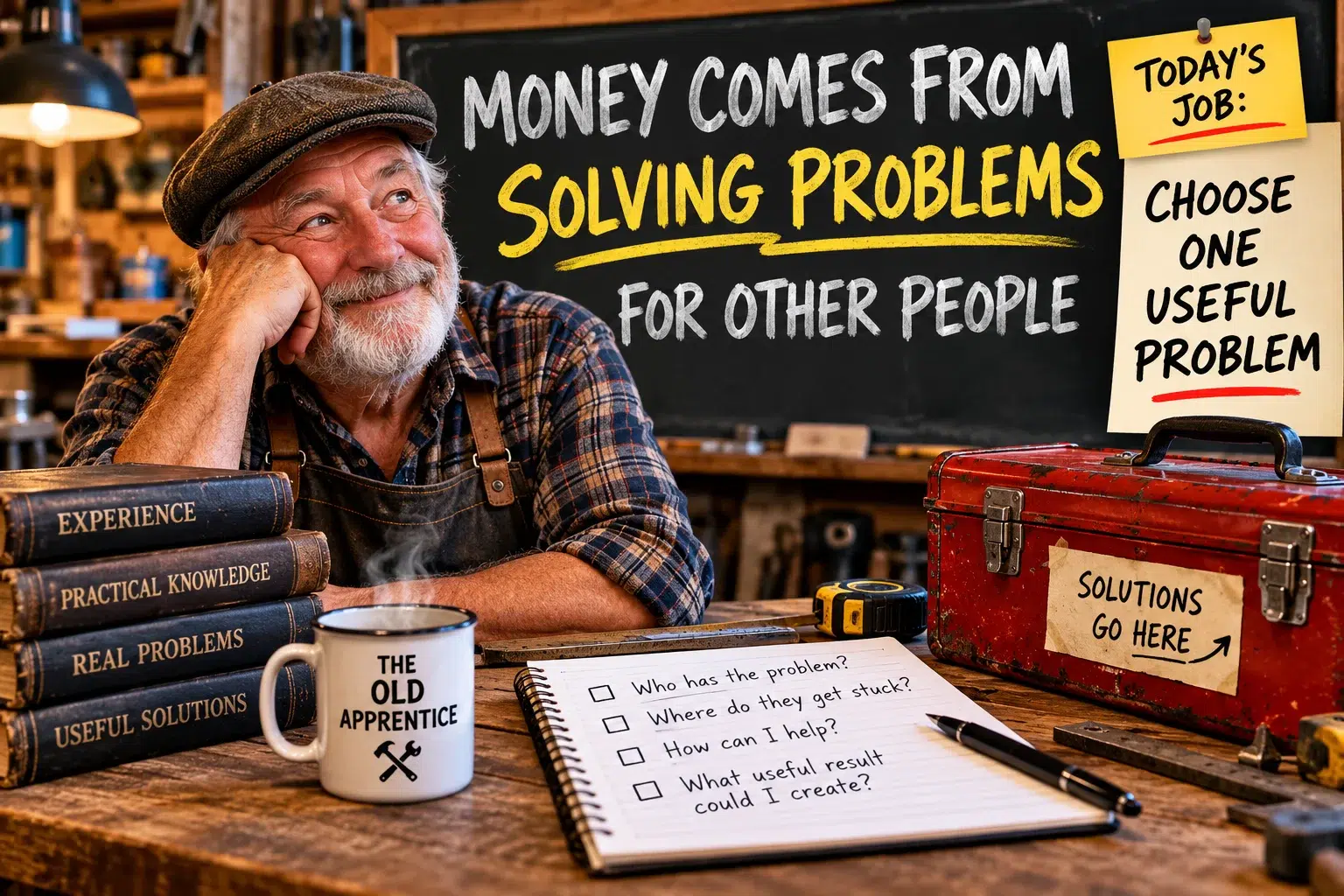
That is why the mantra sitting above today’s work matters: Money Comes From Solving Problems For Other People. Notice what it does not say. It does not say money comes from having the longest CV, the biggest collection of certificates, the cleverest AI tool, or the most impressive pile of knowledge. Knowledge matters, of course, but knowledge sitting inside your head is inventory. It becomes useful when another person has a difficulty, and some part of what you know helps reduce it. Confusion becomes clearer. A mistake becomes easier to avoid. A job takes less time. A decision becomes safer. A beginner stops staring at six choices and finally knows which one to try first. That is where experience stops being history and starts becoming value.
The Problem Chooses Which Experience Comes Off The Shelf
Take an old heating engineer. Ask him what he knows, and you may get forty years of material before breakfast. Boilers. Pumps. Radiators. Controls. Water treatment. Pipe sizes. Fault finding. Quoting. Customers. Apprentices. Suppliers. Bad installations. Good installations. Jobs that should have taken two hours and somehow became a three-day siege involving a floorboard, a dog, and a compression fitting last seen rolling towards the skirting board. All of that experience is real. None of it, by itself, tells him what digital product to make. Then somebody asks, “Why is one radiator cold when all the others are hot?” Suddenly the warehouse becomes useful. The problem has walked in carrying a shopping list.
The engineer no longer needs to explain everything he knows about heating. He only needs the small part of that knowledge that helps somebody understand this particular problem. The useful answer is a simple sequence of checks. It may become a homeowner checklist explaining what they can safely notice before calling a professional. It may be a short guide to describing the symptoms clearly so an engineer arrives with better information.
The format can come later. The important shift is that the problem has chosen the relevant experience. Instead of squeezing forty years into a product, we pull one useful drawer open because somebody actually needs what is inside.
That is the first reason to Choose One Useful Problem. It gives your experience a job. Without the problem, you are selecting knowledge because it feels important to you. With the problem, you select knowledge because it helps produce a useful result for somebody else.
Repeated Questions Are Little Flags Stuck In The Ground
If you are wondering where these problems are hiding, don’t start by searching the internet for “100 profitable niches for retirees.” Begin with your own history. Think about the questions that have followed you around. What did customers ask? What did new workers ask? What do friends still ring you about? What does the family say, “Ask him, he knows about that,” or “She’ll know what to do”? Those repeated questions are not automatic proof that somebody will pay. We should never pretend they are. But they are clues that your knowledge overlaps with someone else’s uncertainty, and that is a far more promising place to start than inventing a product first and hoping a problem appears later.
A retired administrator might remember people constantly asking how she kept paperwork organised. A gardener might repeatedly be asked why seedlings fail. A former shop owner might be the person friends ask when they cannot work out what to charge. A keen caravan owner might get questions about what to check before a first long trip. A grandmother who has organised family affairs for years might be the person everyone turns to when important documents need finding. None of these people has to declare themselves an expert guru. They need to identify where others experience friction and learn how to reduce it.
There is a useful sentence to complete here: “People keep asking me how to…” Do not polish it. Do not make it sound marketable. Write the real questions. “People keep asking me how to organise all the household paperwork.” “People keep asking me how to know which old tools are worth keeping.” “People keep asking me how to start using AI without getting overwhelmed.” “People keep asking me how I decide what to write about every day.” Those sentences contain more commercial information than a fancy product name because they start with a recognisable struggle rather than a container we are desperate to fill.
And this is the part I particularly like about making this the first exercise of the new journey. We are not beginning with technology. We are not beginning with “how to make money online.” We are not asking a retiree to learn six tools before they have a reason to use any of them. We start where they already have an advantage: lived experience. Then we turn that experience around and look at it from the perspective of another human being who is stuck. That keeps the whole system human-led from the start. AI can help us organise ideas, test wording, create graphics, build pages and multiply content later, but AI does not decide which problems we care enough to solve. That judgment stays with the person.
It also changes the meaning of the money. The seven-pound sale we have discussed is not the objective, because seven pounds is a magnificent financial achievement. It matters because it would represent a small exchange of value: “You had a problem. I knew something useful. I packaged the relevant part so you could use it. You decided it was worth paying for.” That is a much healthier foundation for the journey than chasing a commission before we have decided who we are helping or why.
So keep today’s mantra above the bench: Money Comes From Solving Problems For Other People
And underneath it, today’s working job: CHOOSE ONE USEFUL PROBLEM
Before finishing, check your work against five simple Choose One Useful Problem questions. Can you name the person? Can you describe the problem without mentioning your future product? Can you explain where they get stuck? Can you identify which part of your experience might help? Can you describe one small useful improvement they could reasonably achieve?
If those five answers are clear, stop.
Do not write the ebook tonight.
Do not build the course.
Do not order the imaginary brass plaque for your new digital empire.
You have completed today’s job.
The Apprentice Carry-Forward
Save three things before you leave the workshop: the person, the problem, and the smallest useful change. Those three pieces become tomorrow’s raw material. The problem tells us what needs fixing. The useful change begins telling us what the solution must accomplish. Only then can we decide what the first small product should actually do.
Open to See This Video, And This Is What’s Already Built, Trained & Waiting For Your First Command.
Today’s Apprentice Task: Build One Front Door
APPRENTICE CTA: DO THE JOB TODAY: PERSON → PROBLEM → FRICTION → USEFUL CHANGE
Write it down. Keep it small. Carry it forward.
The new journey does not begin by asking, “What can I sell?”
It begins with a better question:
“Whose problem can something I already know help make easier?”
Answer that properly, and tomorrow we can decide what useful result the first solution should create.
Next Job: Choose One Useful Result.
Choose One Useful Problem Before Building A Product
Choose One Useful Problem Before Building A Product: Choose One Useful Problem Before You Decide What To Sell
Your experience becomes valuable when it helps make somebody else’s problem easier.
Start With Their Friction, Not Your Filing Cabinet Of Knowledge
The problem tells you which piece of your experience is worth bringing to the bench.
 Repeated behaviour gives you a safer starting point than enthusiasm alone.Your own zeal can easily fool you. You may love a subject, have years of experience in it, and think it would help other people. That does not automatically mean enough people are actively looking for help. Validation is not an insult to your experience. It is simply a reality check. Suppose you have spent forty years restoring old tools. The knowledge may be excellent, but an extremely narrow angle could attract very little visible discussion. That does not mean the subject is worthless. It may mean the frame needs widening. “Traditional workshop skills” or “restoring old tools for beginners” may reveal much stronger activity. Validate Your Audience Demand before you throw away the idea. Sometimes the experience is right, and only the audience angle needs changing.

 Riley’s Wisdom Drop – The Tool Must Earn Its Trade