Priorities Shape Better Choices When Everything Seems Important
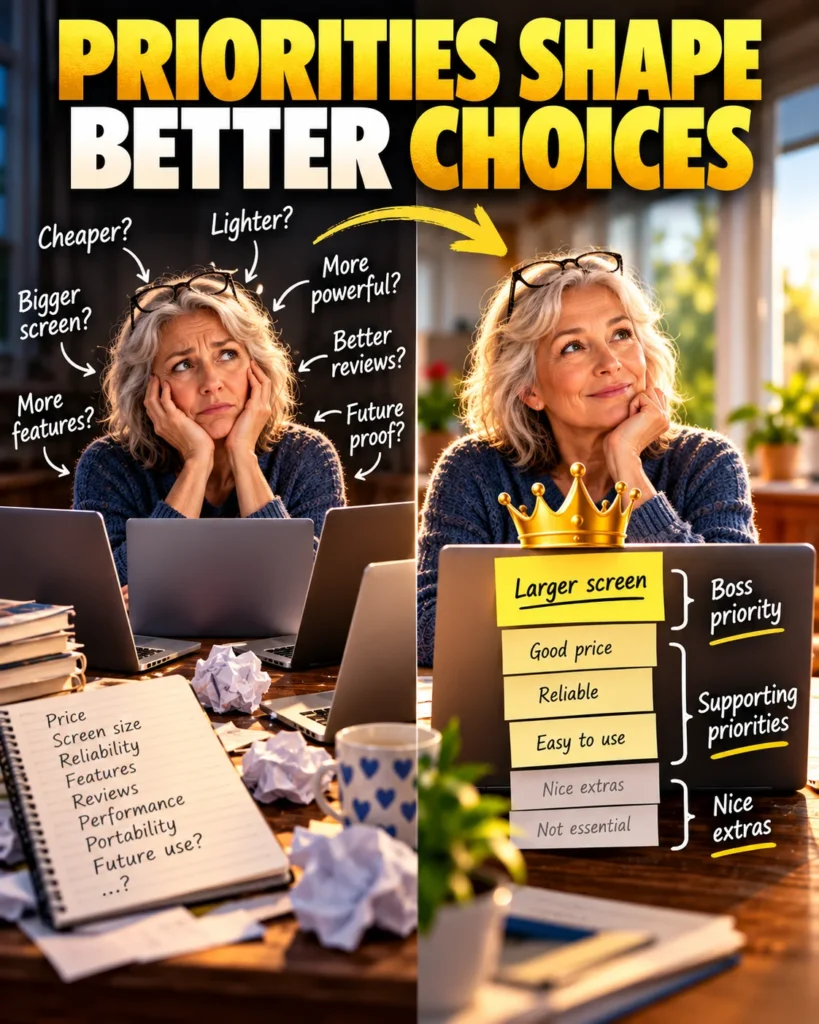
A difficult decision often becomes easier when you let one important need carry more weight than the rest.
Make The Important Trade-Off Clear
The strongest option is not always the one with the most advantages. It is often the one that best serves the most important priority.
Make The Important Trade-Off Clear
Once you know what must win, you can judge price, features, convenience and other benefits in their proper place.
Picture a kitchen table on a Tuesday morning. A laptop sits open beside a mug of tea, three browser tabs show three different computers, and each one seems to have something going for it. One is cheaper. One has a larger screen. One is lighter. Another review praises battery life. Somebody in a Facebook group recommends a different brand altogether. Nothing is obviously wrong with any of the choices, which is precisely why the decision refuses to settle. The buyer isn’t short on information. The buyer has too many advantages competing for equal attention. Price matters. Screen size matters. Reliability matters. Ease of use matters. Future usefulness matters. Yet until one of those priorities carries more weight, every new comparison can keep the decision alive instead of helping it finish.
That is the mechanism underneath Priorities Shape Better Choices. Difficult decisions often remain difficult because several sensible priorities are being treated as though they all deserve the same authority. The buyer keeps asking which option has the most advantages, but that question can create more confusion than it solves. If Laptop A wins on price, Laptop B on screen comfort, and Laptop C on portability, counting category victories doesn’t tell you which one fits the person best. It simply produces three different reasons to hesitate. A shortlist can tell you which options are acceptable. It cannot always tell you which one should win. For that, the decision needs an order. One priority has to become the boss, while the others move into supporting roles.
Riley’s Wisdom Drop #22: Give One Priority The Boss’s Chair When several choices are good enough, stop counting advantages and decide which advantage deserves the final say.
Suppose our buyer says the laptop will mostly stay at home. They’ll use it for email, online banking, Facebook, photos, Zoom and writing. The buyer also says smaller screens are becoming harder to read comfortably. That one detail changes the comparison. Portability no longer deserves the same weight because the machine rarely travels. High-end graphics matter less because the buyer does not play games. Extra processing power may help, but it is no longer impressive enough to justify a higher price on its own. Screen comfort moves to the top. The other priorities do not disappear. Price still matters. Reliability still matters. The machine still needs enough performance to do the job properly. But now those factors have an order, and the larger-screen laptop has a much clearer reason to win.
This is where people sometimes get nervous about choosing a single priority. Real life, after all, rarely contains only one consideration. Nobody buying a laptop wants to say price doesn’t matter. Nobody booking a holiday wants to say the hotel can be terrible as long as the beach is nearby. Naming a boss priority does not mean abandoning common sense. It means deciding what breaks the tie after the essential requirements are met. An unsuitable option should still be removed. A machine that cannot run the software you need becomes acceptable only because it has a lovely screen. A hotel without a lift becomes suitable for someone who cannot manage stairs simply because breakfast is excellent. The boss priority only decides among choices that already do the basic job.
That distinction makes the method far more useful. First comes suitability. Then comes priority. Imagine a retired couple choosing a hotel for a week away. Their essential requirements might include the right dates, an acceptable price, a decent location and a lift. Once those boxes are ticked, the final choice can still be difficult. One hotel is closer to the beach. Another has quieter evenings. A third is cheaper. A fourth has better views. If the couple keeps every benefit equal, the comparison expands again. But suppose easy walking and quiet evenings matter more than everything else. Suddenly the attractive hillside hotel loses some of its shine, and the lively hotel beside the bars drops down the list. The “best” hotel has not changed. The couple has finally decided what “best” means for them. This is another reason
Priorities Shape Better Choices After You Decide
The same option can move up or down a shortlist without changing at all. What changes is the weight placed on the features. A lightweight laptop sounds impressive until you realise it never leaves the spare room. A hotel beside nightlife sounds ideal until you discover the traveller wants quiet evenings. A software package with fifty features seems powerful until the user wants one simple, easy-to-operate tool. Features do not carry their own importance. People assign them importance based on the job they need done. Once that is understood, comparisons become less about collecting advantages and more about deciding which advantages deserve attention.
Riley’s Wisdom Drop #23: More Advantages Do Not Automatically Mean Better Fit Ten minor benefits shouldn’t outweigh the one advantage that matters most for the job you actually need done.
This is also why one person’s brilliant choice can be another person’s mistake without either person being foolish. Two neighbours can buy different laptops after looking at the same three models. One chooses the lighter machine because they travel every week. The other chooses the larger-screen version because they stay at home. Both decisions can be sensible because their priorities differ. One retired couple can choose a lively hotel near the centre, while another chooses a quieter place farther out. The answer changes with the job. When people forget that, they start arguing over which choice is objectively better when the more useful question is, “Better for what?” Priorities Shape Better Choices because different people can reasonably give different priorities the most weight.
That phrase belongs beside almost any comparison. Better for what? Cheaper for what? Faster for what? More powerful for what? More flexible for what? Once those questions are answered, many apparently impressive features lose some of their grip. A product or service does not need to beat every competitor at everything. It needs to perform the job you are actually buying it to perform. That is where priority and context meet. Context tells you the situation. Priority tells you what deserves the most weight inside that situation. Together, they turn “best” from a vague label into a reasoned choice.
The method is simple enough to use without spreadsheets, scores or complicated decision charts. Start with the options that genuinely meet the basic requirements. Then name the one priority you most want to protect. Put the other important factors underneath it. Move the pleasant extras to the bottom. Now compare again. If the leading option serves the boss priority while remaining acceptable on the supporting ones, you probably have a strong candidate. If another option wins only because it collects more minor benefits, ask whether those benefits deserve enough weight to overturn the priority you already chose. Priorities Shape Better Choices after the decision too, because the reason for choosing remains clear when another option later catches your eye.
Today’s Practical Task: Give One Priority The Boss’s Chair
Choose one decision that is currently sitting open in your mind. It could involve a purchase, a holiday, an AI tool, a service, a tradesperson or something as ordinary as choosing between two subscriptions.
First, write down the basic requirements every acceptable option must meet.
Then choose the one advantage you would least want to compromise.
That becomes the boss priority.
Place the other important factors underneath it as supporting priorities.
Put anything that would merely be pleasant to have in the nice-extras pile.
Now look at the strongest options again. Priorities Shape Better Choices when you compare those options against the priority you decided should matter most.
Ask one final question: “Which choice protects what matters most without failing anything essential?”
Today’s Apprentice Task: Build One Front Door
Open to See This Video, And This Is What’s Already Built, Trained & Waiting For Your First Command.
If you are using AI, give it the same priority order and ask it to explain whether its recommendation genuinely follows that order.
Do not ask which option collects the most victories.
Ask which option wins where your real life says winning matters.
Because Priorities Shape Better Choices when the human decides what deserves the most weight before the features, rankings and recommendations start competing for attention.
Priorities Shape Better Choices For Better Results
Priorities Shape Better Choices For Better Results: Priorities Shape Better Choices When Everything Seems Important
A difficult decision often becomes easier when you let one important need carry more weight than the rest.
Make The Important Trade-Off Clear. The strongest option is not always the one with the most advantages. It is often the one that best serves the most important priority.
Blinking In The Dark: 3 Powerful Ways To Get Found
Discover why good websites go unnoticed and how search, social sharing and trusted recommendations help interested readers find your work.
Your Website Needs More Than Visitors
Learn why publishing useful content is only the beginning and how reaching the right audience makes your work more valuable.
The Three Doors Rule Opens New Opportunities
Explore three practical routes to website discovery and choose one manageable way to help the right people find your articles.
Blinking In The Dark: Why Good Websites Go Unnoticed
Discover why publishing a website doesn’t automatically attract visitors, and how to give interested readers a reason and a route to find your work.
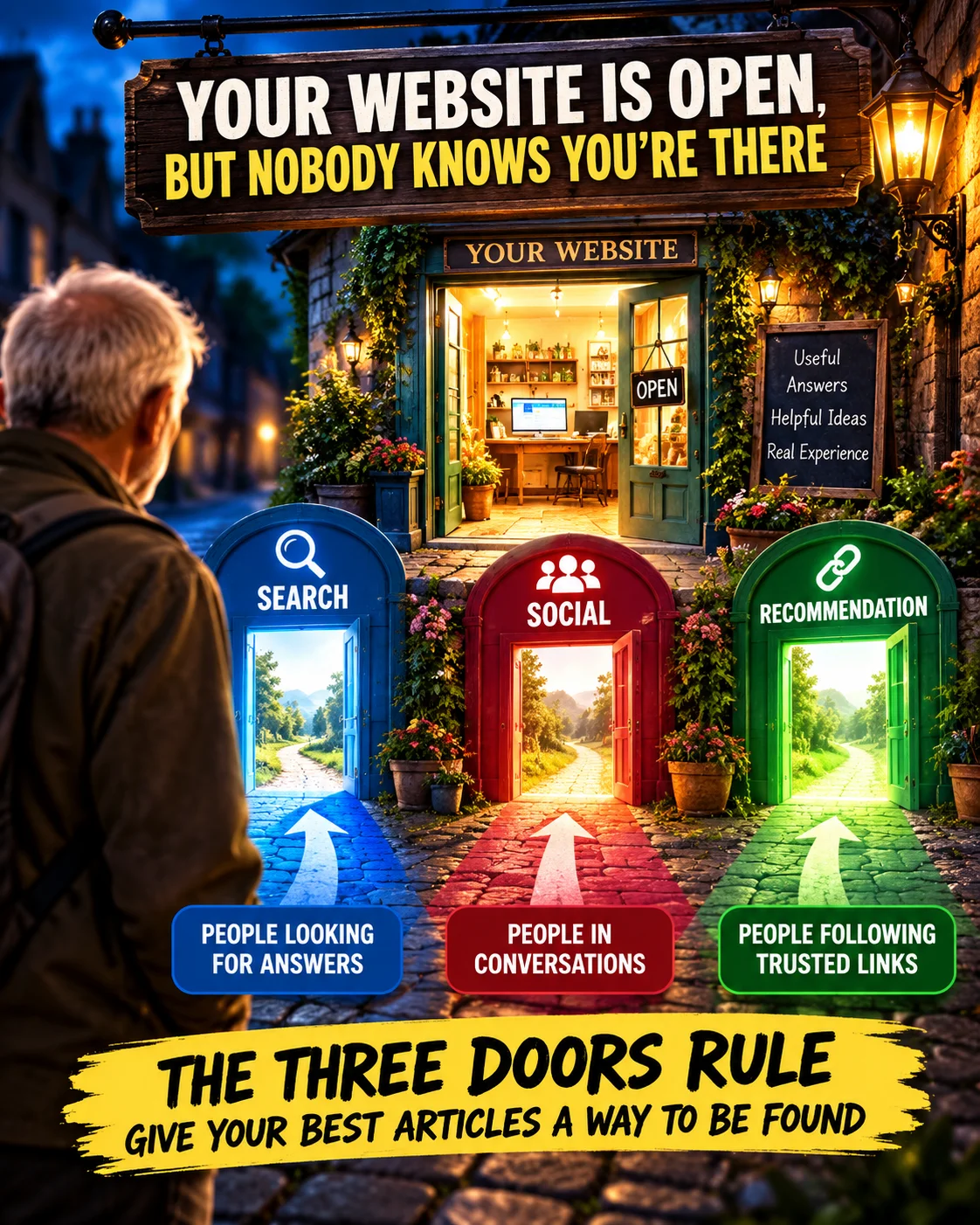
The shopkeeper arrived shortly after seven, polished the front window, straightened the displays and switched on the lights. Everything was ready for opening day. He had spent weeks arranging his little business, choosing his products and making the place look welcoming. By lunchtime, however, something rather worrying had become obvious. Nobody had walked through the door. At three o’clock, he made himself another cup of tea, adjusted a display that didn’t need adjusting and waited for the afternoon rush. There wasn’t one. When closing time arrived, the till was exactly as he’d left it that morning. The shop wasn’t necessarily the problem. Neither were the products. Unfortunately, he’d opened halfway down a quiet backstreet without telling anybody he was there. He had created a perfectly respectable destination but forgotten to provide customers with a reason and a route to visit.
Move that shopkeeper into retirement, give him a laptop instead of a shop counter, and you’ve described a familiar problem in today’s digital world. Our enthusiastic newcomer has bought a domain name, chosen a WordPress theme, written several helpful articles and spent a small fortune in patience trying to make everything look respectable. Perhaps he’s even managed to get his first green light from an SEO plugin. That’s quite an achievement for somebody who may have spent most of his working life with a toolbox rather than a keyboard. Yet something remains missing. The website is online, the articles are published, and the photographs appear exactly where they should. Unfortunately, the visitors haven’t arrived. Blinking In The Dark is a remarkably accurate description of what happens when a website exists, but nobody has been shown how to find it.
When Publishing Means Blinking In The Dark
Here’s where the misunderstanding begins. When you publish an article, you make it available on the internet. You don’t automatically arrange for interested readers to discover it. Those are two different jobs, although beginners often treat them as one. Think of a television programme that has been recorded, edited and made ready for broadcasting. The production team may have done wonderful work, but if nobody knows when or where to watch it, the programme may attract little attention. A website follows a similar principle. Its articles provide the information, while search engines, social conversations and relevant recommendations provide possible routes towards that information. Without at least one realistic route, even excellent material can remain largely unseen. The lesson isn’t that creating content is unimportant. Publishing completes the first job and creates the need for a second.
For retired people beginning their digital journey, that distinction can save an enormous amount of unnecessary work. Imagine someone who spent forty years working as a plumber, electrician, gardener or bookkeeper. They have a lifetime of practical knowledge others could benefit from, and retirement finally lets them share it. Perhaps they create a website explaining ordinary household repairs, sensible gardening practices or ways to organise a small business. After publishing twenty useful articles, they discover that hardly anybody is reading them. Their first reaction might be to change the website design, buy another plugin or rewrite everything they’ve already produced. However, before making any expensive decisions, they should ask one question. Is the website failing to help people, or have the people who need that help never discovered it? The answers require very different solutions.
Today’s Reader Task: Give One Article An Entrance
Before opening another blank page in WordPress, choose one useful article you’ve already published. Read it as though you’re somebody encountering the subject for the first time. Write one sentence describing the person who would benefit and another explaining the problem your article helps them solve. Then apply the Three Doors Blinking In The Dark Rule. Consider whether that person might search for the answer, encounter it during a relevant social conversation or discover it through a helpful recommendation. Choose just one entrance and make one improvement today. That might mean clarifying your search title, contributing a genuinely helpful social explanation or adding a natural link from another relevant article. Record what you’ve done so you can return later and judge whether it helped.
If you’re unsure which entry point deserves your attention, use the AI prompt that comes with this lesson. Describe your website, the article you’ve published and the difficulty you’re having attracting readers. Ask your AI assistant to compare the three possible routes, identify the most realistic starting point, and explain one manageable action you can take without buying another tool. Treat its answer as a practical suggestion to evaluate, not a guarantee. You remain the person who understands your experience, your audience and how much effort you want to invest. AI can help organise the possibilities, but the final decision should remain yours. That’s the advantage of combining lifetime experience with modern digital assistance. You don’t surrender your judgement. You use new tools to make that judgement more informed.
Today’s Apprentice Task: Build One Front Door
Stop Blinking In The Dark By Giving Your Work A Purposeful Route
Open to See This Video, And This Is What’s Already Built, Trained & Waiting For Your First Command.
Return for a moment to the little shopkeeper who opened his business on that quiet backstreet. Imagine that instead of repainting the walls or buying more stock, he put up a clear sign where interested customers could see it, explained what the shop offered, and made the entrance easier to find. He still wouldn’t be guaranteed a queue outside the door, but he’d finally addressed a problem that polishing the shelves could never solve. Your website deserves the same practical thinking. The articles you’ve already written may contain knowledge someone else genuinely needs, and that work shouldn’t be dismissed just because it hasn’t attracted attention yet. Give one useful page one realistic route to its intended reader. Observe what happens, learn from the evidence and improve the connection.
A website doesn’t become useful to its audience simply because it’s online. It becomes discoverable when the right people have a reason and a route to find it.
That’s the difference between spending another evening Blinking In The Dark and finally letting someone see what you’ve been building.
And once the right person arrives, an equally important question begins: can they recognise what’s in it for them before they decide to leave?
Section 2 complete, Gaffer. We’ve kept the newspaper treatment, carried the four-word keyword through both sections, included the practical Three Doors decision rule and given readers a proper task instead of another sales pitch.
Your Website Needs More Than An Online Address: Understanding the difference between creating useful content and helping the right people discover it.
The Missing Link Between Publishing And Being Discovered: An attractive digital shop window needs a clear entrance before it can start welcoming customers.
Blinking In The Dark 3 Powerful Ways To Get Found
Blinking In The Dark Is A Discovery Problem
Blinking In The Dark: 3 Powerful Ways To Get Found The Missing Link Between Publishing And Being Discovered: An attractive digital shop window needs a clear entrance before it can start welcoming customers.
People Want Better Decisions, Not More Information. Why?
More facts can increase confusion when the real problem is unresolved uncertainty.
People Want Better Decisions When Too Many Choices Create Doubt
Narrowing the field makes it easier to compare what actually matters.
People Want Better Decisions When The Tradeoffs Become Clear
A useful choice becomes easier when the gains, drawbacks and next step are visible.
Why People Want Better Decisions Instead Of More Information
More information can help, but real relief often comes when someone finally feels confident enough to stop searching and choose.
People Want Better Decisions When Too Many Choices Create Doubt
The internet can answer almost any buying question, yet too many answers can leave the buyer less certain than when they started.
People Want Better Decisions Because Information Alone Does Not Finish the Job. A useful digital assistant should help narrow the field, highlight the key trade-offs, and guide the person toward a decision they can understand and act on.
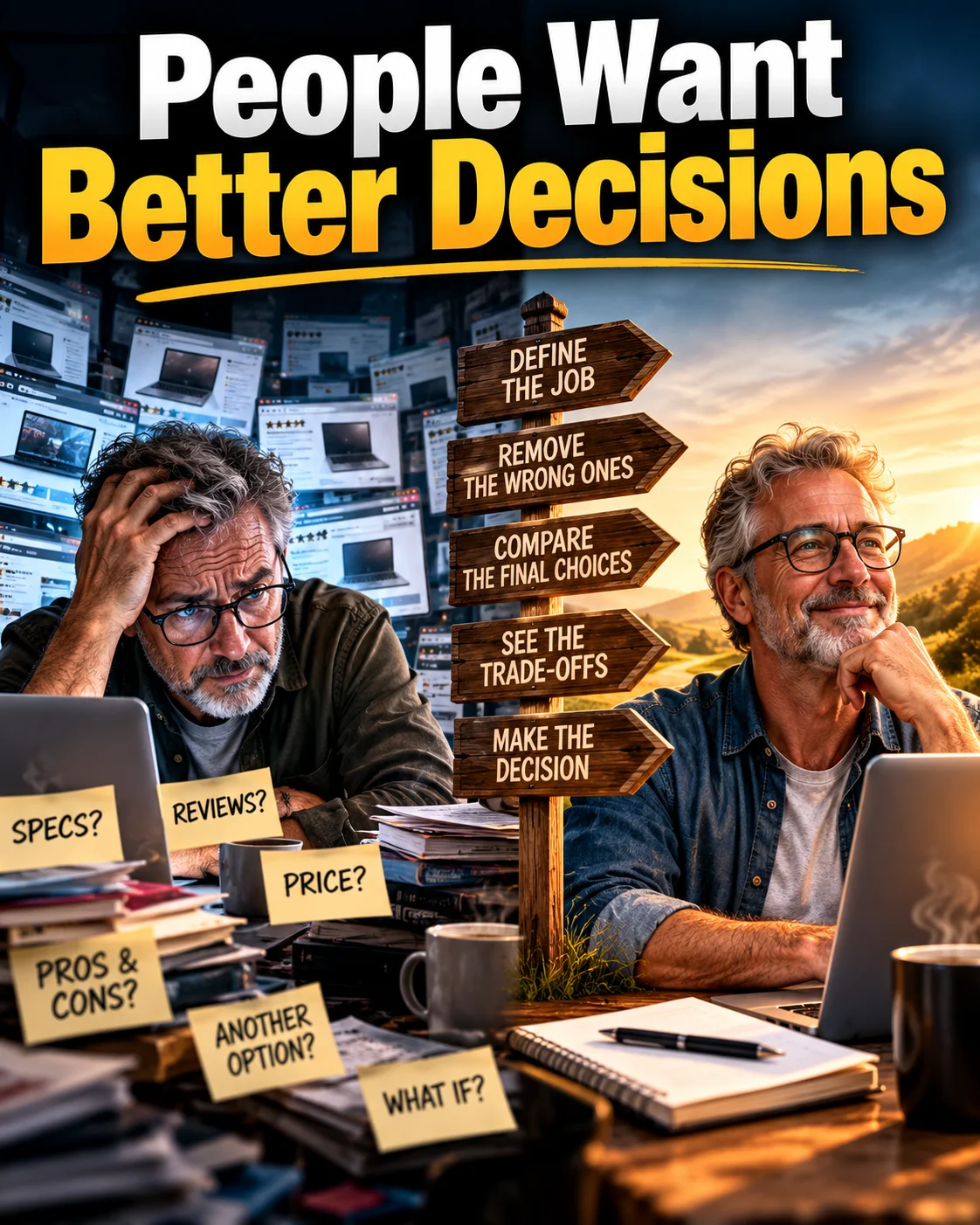
A familiar scene plays out in homes every evening. Somebody sits down after tea intending to spend ten minutes choosing a new laptop, booking a weekend away, comparing broadband or finding a decent local tradesman. An hour later, the tea has gone cold, twelve browser tabs are open, three YouTube reviewers disagree, and the person who started with a simple question now knows far more than they ever wanted to. They have processor numbers, star ratings, contract lengths, prices, special offers and opinions coming out of their ears. What they still lack is a decision. That’s where the modern internet reveals one of its strangest weaknesses. It is exceptionally good at providing information. It isn’t automatically good at helping a person know when they have enough.
That matters because People Want Better Decisions, not an endless supply of additional facts. A search engine can return another hundred pages. A retailer can offer another twenty alternatives. A review site can display another comparison chart. None of those things guarantees that the buyer feels any closer to choosing. In fact, the opposite can happen. A new option can bring another regret. Every extra feature raises another question. Every recommendation makes the buyer wonder whether the recommender noticed something the previous reviewer missed. The search keeps moving because the buyer assumes the unfinished feeling means they have not researched enough. Yet very often the research is already sufficient. What remains unfinished is the uncertainty. Once you see that distinction, the job changes completely.
A man looking for a laptop for ordinary home use does not need to become a part-time computer engineer. Suppose he wants email, online banking, Facebook, Zoom, photographs and some writing. His budget is around £700, and he prefers a larger screen because it is easier on his eyes. Those are useful facts. Yet after half an hour online, he may compare graphics processors, refresh rates, storage technologies and specifications designed for games he will never play. The industry has given him more information, but much of it is about jobs he doesn’t need the machine to do. The real breakthrough comes when somebody asks a much simpler question: What does this laptop actually need to do for you? That one question can remove half the market before another review is opened.
This is where a useful AI assistant earns its keep, not by producing a longer list, but by narrowing it. When the buyer expects the computer to sit mostly on a desk, extreme portability matters less. When gaming is irrelevant, move the expensive graphics power down the list. If photographs matter, storage matters more. If a larger display reduces eye strain and makes everyday use easier, screen size becomes more valuable than shaving a few hundred grams off the weight. Notice what has happened. No magical new information appeared. The assistant connected the facts that mattered to the human being making the decision. That is the difference between information retrieval and decision support.
Riley’s Wisdom Drop #14: More Information Is Not Always More Progress When the buyer already understands the main options, another page of facts may add noise instead of confidence. Progress begins when the information is connected to the job the person actually needs done.
The easiest way to spot the problem is to watch the questions change. At the beginning of a search, somebody asks useful factual questions. What is the price? How large is the screen? How long is the contract? Does the hotel have parking?
The Decision-Finished Test
This is where the process earns its finish line. Before searching again, run the decision through four checks.
First: Do I understand the main options? If not, more research may be justified.
Second: Do I know what matters most to me? If not, the problem is not lack of product information. The priorities need clarifying.
Third: Can I explain the main trade-off between the final choices? If not, compare the survivors more carefully.
Fourth: Is there any missing fact that could realistically change my choice? If not, the research phase is probably over.
That final question is the brake pedal. It stops curiosity disguising itself as necessity. There is always another article to read, another review to watch, another product to discover or another opinion to collect. The internet has no natural finishing point. The buyer has to create one.
Imagine a retiree choosing between three laptops after narrowing the market. It costs £579 for Laptop A and offers the largest screen plus adequate performance. Laptop B costs £649, has more storage and slightly better battery life. Laptop C costs £749 and is considerably more powerful. The buyer mainly works at home, prefers a larger screen, stores photographs but also uses cloud backup, and does not play games. At this stage, another review of processor benchmarks probably will not change the decision. The real choice is between saving money, paying more for storage and battery life, or buying performance that may never be used. Once framed that way, the decision becomes understandable.
A useful AI assistant might say: “I would choose Laptop A. It performs the work you described, gives you the larger screen you value, and avoids paying for power you are unlikely to use. Laptop B is worth considering if local photo storage matters more than the extra £70. Laptop C appears unnecessary for the job you described.” That is a much stronger answer than a generic ranking because it connects the recommendation directly to the buyer’s priorities. If the buyer suddenly says, “Actually, I am starting video editing next month,” the recommendation can change. That new fact genuinely changes the job. Good decision support remains flexible when the circumstances change.
This is exactly where AI should be useful without pretending to be infallible. The assistant can organise information, expose trade-offs, narrow the field and explain its reasoning. The human still decides whether the priorities are correct and whether the recommendation feels right. That division of labour matters. People Want Better Decisions, but they do not need to hand over responsibility for their choices. AI’s useful role is to reduce unnecessary complexity and make the reasoning easier to inspect. Humans still know what matters in their own lives.
There is another advantage. Once the buyer can explain why they chose something, the decision becomes less fragile. Without clear reasoning, a new advert tomorrow can reopen the whole process. A competitor drops the price. A reviewer praises another model. A friend says they bought something different. Suddenly the buyer starts doubting again. But if the decision was built around clear priorities and visible trade-offs, the new information has to pass a higher test. Will it change the job? Does it change one of the important criteria? Does it expose a serious drawback we missed? If not, you can keep the decision closed.
Riley’s Wisdom Drop #17: A Finished Decision Has Reasons If you can explain why the choice fits your job, another shiny option has to bring genuinely new evidence before it deserves to reopen the case.
This principle reaches far beyond buying products. It works when choosing a traffic source, deciding which AI tool should join a digital crew, selecting a blog topic, planning a holiday, comparing a local service or deciding whether an online offer is worth pursuing. The pattern is the same. Define the job. Remove what clearly does not fit. Compare the survivors against personal criteria. Make the trade-offs visible. Check for one decision-changing missing fact. Then choose. The subject changes. The thinking process survives.
That is why today’s four-word phrase has more weight than it first appears. People Want Better Decisions because information has become cheap and abundant. The scarce part is judgment. People can open another tab. Anyone can ask for another list. Anyone can collect more specifications, recommendations or opinions. The useful person, tool or Digital PA is the one that helps turn those facts into a clear next move.
Today’s Apprentice Task: Build One Front Door
Open to See This Video, And This Is What’s Already Built, Trained & Waiting For Your First Command.
Today’s Apprentice Task: Finish One Real Decision
Choose one decision you are currently delaying. It could be something you want to buy, a piece of software you are considering, a service you need, a holiday choice, a traffic platform, or even a small business decision.
Do not begin by searching again.
Write down the job the choice needs to perform. Remove anything that clearly fails that job. Reduce the remaining options to the strongest three.
Choose up to five things that genuinely matter to you.
Look at the main trade-off between the finalists. Then ask one final question: What information am I still missing that could realistically change my decision? If you can name something important, find that fact.
If you cannot, stop searching. Make the decision. Because the internet will always offer you another option. A better decision begins when you know you no longer need one.
People Want Better Decisions Make Choices With Confidence
Why Distribution Should Produce Evidence After Every Click The first response shows attention, but the next action reveals whether the journey is actually working.
Follow The Signal Closest To The Job
Measure the action that best reflects what the asset was built to achieve, not just the biggest number on the screen.
Distribution Should Produce Evidence That Changes Your Next Move
Use the response to find the weak point, change one thing and learn from what happens next.
Why Distribution Should Produce Evidence Beyond Big Numbers
A dangerous moment in online marketing is when a number appears on the screen and makes us feel clever. Forty-two clicks. Ninety-seven views. Twelve people opened the email. Somebody even pressed the Like button. For a few seconds, the machinery seems to work beautifully. We sent something out, people reacted, and the dashboard moved. That feels like proof. But the dashboard may only be showing us the first footprint in the mud. A click tells us somebody noticed the doorway. It does not tell us whether they liked the room behind it, understood what they found, trusted the message, took the next step or quietly backed out again. That is why Distribution Should Produce Evidence rather than merely numbers. A signal is useful only when it helps us understand what happened next.
This matters because yesterday we gave our useful content roads. Today we need to ask whether those roads are actually carrying the right people in the right direction. That is a different job. Distribution is not complete because Facebook accepted the post, Opus scheduled the video, or AWeber sent the email. Those actions prove that the road exists. They do not prove the journey worked. Useful information begins when someone encounters the message and decides. Users may stop. Readers may scroll past. They may click. People may stay. One may read. One may subscribe. They may move to another page. Every one of those movements tells us something different. The trick is learning not to ask one number to answer a question it was never meant to answer.
Imagine the old market stall again. A man walks past, glances at the display and slows down. The stall holder notices. Good sign. Then the man picks up an item, turns it over, reads the label and puts it back. Another person asks a question. Someone else buys. Three people showed interest, but they did not provide the same evidence. The glance proved the display caught attention. Picking up the item showed deeper curiosity. Asking the question suggested genuine consideration. Buying showed that, for that person at that moment, the product, price and need lined up well enough to act. Online distribution works in much the same way. The mistake is treating every glance as though somebody has already reached the till.
Riley’s Wisdom Drop #8: The Click Opens The Case
A click is not the verdict. It is permission to investigate what happened next.
That one distinction can save a lot of unnecessary rewriting. Suppose we publish a post for retirees about turning lifetime work experience into a simple digital asset. We share it on Facebook with a question that strikes a nerve: “What did forty years of work teach you that somebody younger would gladly avoid learning the hard way?” People click because the question recognises something they have lived through. The doorway has done its job. But if those visitors arrive at the article and leave almost immediately, the click doesn’t prove the article worked. It only shows that the doorway created enough curiosity to get them through.
At that point, it’s tempting to call the whole idea a failure. That would be like blaming the workshop because the sign outside attracted people who did not stay. The fault may sit somewhere else.
The article may take too long to reach the promise made in the Facebook post. The headline may change direction. The introduction may discuss AI tools even when visitors expect practical help based on their experience. Perhaps the audience was curious about the question but not ready to build anything. One result cannot tell us which explanation is correct. It can, however, tell us where to start looking.
This is where the simple Click, Stay, Act, Continue sequence becomes useful. It gives us four clues instead of one headline number. Click asks whether the doorway earned attention. Stay asks whether the destination looked relevant enough to keep exploring. Act asks whether the person did the job the asset was built to support. Continue asks whether the next step was clear enough for them to keep moving. The sequence does not require complicated analytics. It simply trains us to look at the journey in order rather than jumping from one number to a grand conclusion.
If people don’t click, the problem may lie before the destination. The hook might be weak. The wrong people may have seen it. The channel may be a poor fit. When people click but do not stay, the doorway and destination may not match. Should they stay but fail to act, the teaching remains useful, yet the next step remains unclear. When they act but stop short, the next stage of the journey may require attention. None of those conclusions is automatic, but the sequence helps us narrow the investigation. That’s why Distribution Should Produce Evidence. Evidence should reduce guessing.
A Big Number Can Still Answer The Wrong Question
Another trap waits inside most dashboards. The biggest number usually grabs your attention first. Views. Reach. Impressions. Clicks. They look important because they are visible and easy to compare. But the largest number is not always the most useful signal. The best signal is the one closest to the job the asset was built to do. When a short video is created to teach one useful lesson, watching enough of it to learn that lesson may matter more than how many people saw the thumbnail. Designing an email to start a conversation may mean that replies matter more than clicks. If a page exists to collect subscribers, sign-ups become more useful evidence than raw page views.
This is where we stop letting the dashboard decide what success means. The creator decides first what job the asset is meant to perform. Then the evidence is judged against that job. Otherwise, the numbers can flatter us while the actual job remains unfinished. Ten thousand views sound impressive until we remember the purpose was to get interested readers to download a worksheet, and nobody did. Fifty views may look disappointing until several people watch carefully, visit the article and continue to the next useful step. Smaller evidence can be stronger evidence when it sits closer to the job.
Evidence Should Earn The Right To Change Something
This is where we need a final bit of discipline. Not every number deserves a reaction. The sample is often too small. Occasionally information proves insufficient for drawing conclusions. At times, the result is mixed. Sometimes nothing obviously needs fixing. The temptation to fiddle can be just as damaging as ignoring evidence entirely.
So before changing anything, ask three questions.
What does this evidence actually show?
State only what you can reasonably see. Users clicked. Visitors stayed. They replied. They did not continue. Do not turn observation into invention.
What is the smallest likely fault this evidence points towards?
Hook, audience, road, destination or next step.
What is the smallest useful change I can make to test that idea?
One new hook. One clearer opening. One better next step. One different road.
That is enough.
If you cannot answer the first question clearly, you probably do not have enough evidence to change anything yet.
If you can answer it, but the second remains uncertain, gather another clue.
When the first two are reasonably clear, implement the smallest change that could confirm or challenge your diagnosis.
This turns analytics into practical judgment.
It also stops AI from becoming the enthusiastic apprentice who keeps repainting the workshop every time somebody looks through the window. AI can generate ten new headlines, twenty new hooks and five complete rewrites in seconds. That speed is useful when we know what needs changing. It becomes dangerous when we do not. The human job is still diagnosis.
That is where this whole lesson lands.
Distribution is not simply the final stage after publication.
It is the return pipe.
We send the asset out.
People respond.
Evidence comes back.
We inspect it.
Then we decide.
The better we become at reading that return signal, the less time we waste rebuilding good work because one number looked disappointing.
Open to See This Video, And This Is What’s Already Built, Trained & Waiting For Your First Command.
Today’s Apprentice Task: Build One Front Door
Apprentice Task
Choose one asset you have distributed recently.
It could be an article, video, email, social post, guide or landing page.
Now follow the evidence in order.
Click: Did enough people show curiosity to enter?
Stay: Once they arrived, did they remain long enough to engage with the asset?
Act: Did they do the job the asset was designed to encourage?
Continue: Was there evidence that some people moved to the next useful step?
Don’t worry if you don’t have every number.
Use only the evidence you genuinely have.
Then identify the first point where the journey appears to weaken.
Ask whether the likely fault sits with the hook, audience, road, destination or next step.
Finally, choose one change.
Not five.
One.
Run it again and see whether the evidence moves.
Because Distribution Should Produce Evidence, and evidence should earn the right to change the next move.
That is how the workshop gets smarter.
Not by creating more noise.
By learning from what comes back.
Distribution Should Produce Evidence Read Better Signals
Distribution Should Produce Evidence: Read Better Signals: Follow The Signal Closest To The Job Measure the action that best reflects what the asset was built to achieve, not just the biggest number on the screen. Distribution Should Produce Evidence That Changes Your Next Move Use the response to find the weak point, change one thing and learn from what happens next. Why Distribution Should Produce Evidence Beyond Big Numbers
 Suppose our buyer says the laptop will mostly stay at home. They’ll use it for email, online banking, Facebook, photos, Zoom and writing. The buyer also says smaller screens are becoming harder to read comfortably. That one detail changes the comparison. Portability no longer deserves the same weight because the machine rarely travels. High-end graphics matter less because the buyer does not play games. Extra processing power may help, but it is no longer impressive enough to justify a higher price on its own. Screen comfort moves to the top. The other priorities do not disappear. Price still matters. Reliability still matters. The machine still needs enough performance to do the job properly. But now those factors have an order, and the larger-screen laptop has a much clearer reason to win.