AI Digital PA Crew
Why An AI Digital PA Crew Works
The easiest way to make AI harder is to give one assistant too many different jobs.
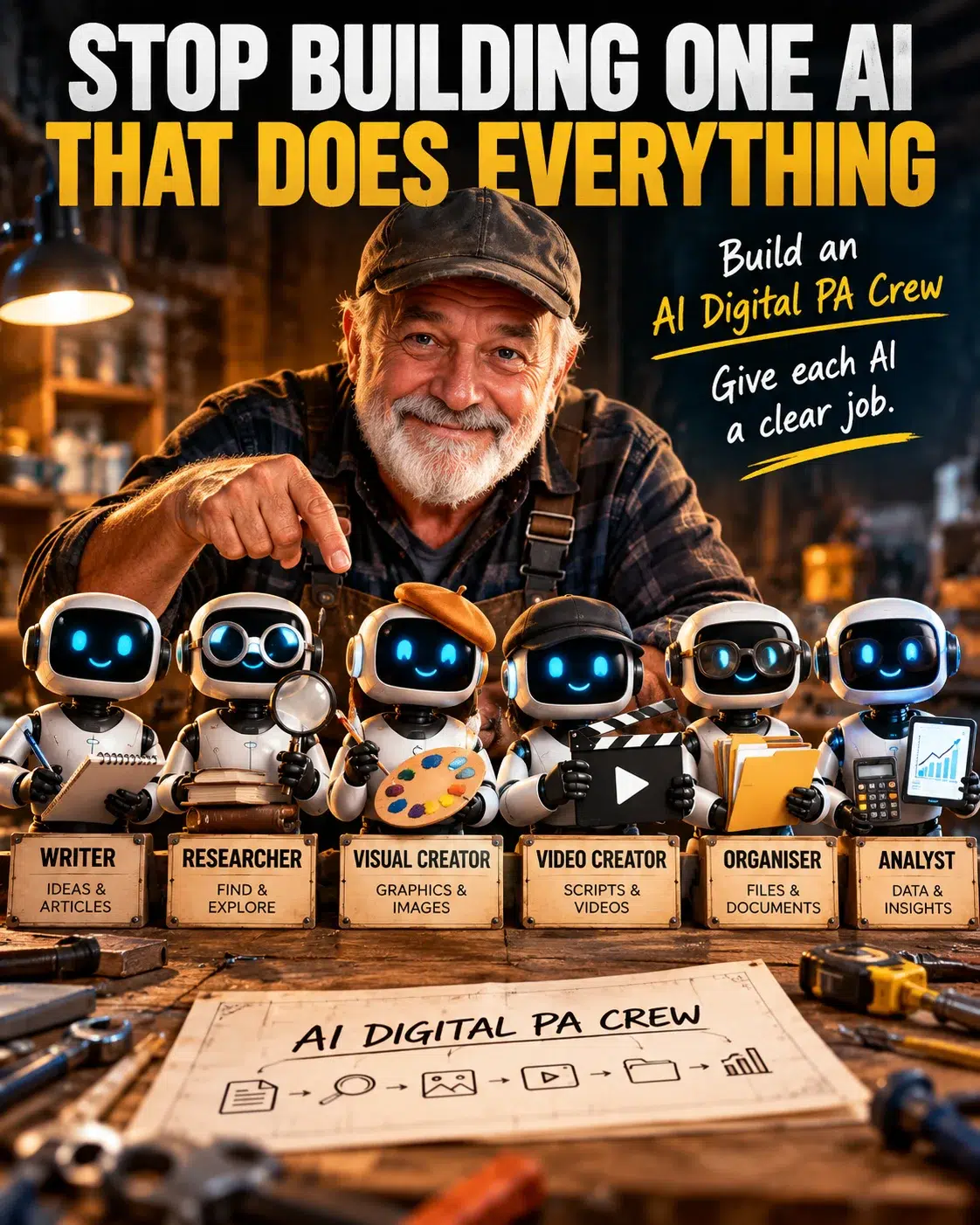
Give Every AI One Clear Trade
Start with the work you repeat, then match each job to the AI that handles it best.For most people, an AI Digital PA Crew doesn’t start as a Crew at all. It begins with one AI assistant. You ask it to write something. Then research something. Then create a headline. Then help with an image. Then organise a document. Before long, the same AI is being treated like the plumber, electrician, plasterer, decorator, and foreman all rolled into one. It may still produce useful work, but the system becomes difficult to judge because every job is mixed. If the writing is strong but the design is weak, where exactly is the problem? If the research is good but the finished post needs half an hour of repairs, what should change? An AI Digital PA Crew starts working properly when each assistant has one clear responsibility first.Think about how a tradesman learns a job. You do not give the apprentice every tool in the van and say, “Have a go at everything.” You show him what each tool is for. You give him one job. You watch the result. If he does that job well, you give him more responsibility. AI should be managed the same way. One assistant might be strongest at helping you think through an idea and turn it into clear writing. Another might be better when you are working inside documents or spreadsheets. A specialist image tool may handle visuals better. A video tool may be the obvious choice once the script is finished. The aim is not to prove one AI can do everything. The aim is to discover which AI deserves which trade.This is where the One-Trade Rule becomes useful. When you first bring an AI into your Crew, give it one primary job and judge it on that job. If it writes, let it write. If it researches, let it research. If it creates visuals, let it create visuals. Do not keep changing the role before you have enough evidence to know whether it is good at the first one. That doesn’t mean the AI can’t do anything else. It means you are building a reliable starting point. Once each worker has a clear trade, you stop wondering which tool to use every time a job appears. The decision becomes simpler because the Crew already has a shape.
Build Your AI Digital PA Crew
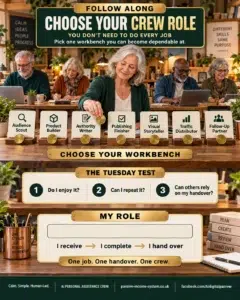 Your jobs should decide the Crew, not the latest software somebody is trying to sell you.
The wrong way to build an AI Digital PA Crew is to start with the tools. You see a new AI, watch a demonstration, hear that everybody is using it, and then try to invent a reason to add it to your workflow. The better approach is the opposite. Start with the work you already repeat. Do you write articles? Research topics? Create graphics? Make videos? Check SEO? Organise PDFs? Work inside spreadsheets? Manage websites? Those are the real jobs. Once you can see them, you can ask whether somebody on the Crew already owns each one. If the answer is yes, use that worker. If the answer is no, you have found a genuine gap rather than another shiny object.
Imagine a retiree building useful digital content from forty years of work experience. One AI helps him identify the strongest lesson hidden inside an old story and turn it into an article. That article is then handed to a visual AI, whose only job is to turn the central idea into a strong social graphic. A third tool takes the finished article and helps shape it into a short video. Nothing is being duplicated. Nobody is reopening the original lesson. Each worker continues the job where the previous worker left off. That is the difference between having several AI tools and having an AI Digital PA Crew. The Crew has roles, boundaries and a direction.
The human remains the gaffer. That matters. AI can help organise, write, research, design and produce, but somebody still has to decide what is worth doing. The human chooses the idea, judges whether the work feels right, and decides when the result is good enough to move forward. That human judgement stops the Crew from becoming a collection of machines producing more work for its own sake. A good Crew should take jobs off your hands, not create another management burden. If an AI constantly needs rescuing, repeats work another tool already does, or produces something you would never use, it has not earned that role yet.The simplest test is one you already understand from the trades.Would you give this worker the same job again?If the answer is yes, keep the role.If the answer is no, change the assignment before you buy another tool.That is how an AI Digital PA Crew starts becoming personal, practical and manageable.One worker.One trade.One result worth keeping.
Your jobs should decide the Crew, not the latest software somebody is trying to sell you.The wrong way to build an AI Digital PA Crew is to start with the tools. You see a new AI, watch a demonstration, hear that everybody is using it, and then try to invent a reason to add it to your workflow. The better approach is the opposite. Start with the work you already repeat. Do you write articles? Research topics? Create graphics? Make videos? Check SEO? Organise PDFs? Work inside spreadsheets? Manage websites? Those are the real jobs. Once you can see them, you can ask whether somebody on the Crew already owns each one. If the answer is yes, use that worker. If the answer is no, you have found a genuine gap rather than another shiny object.
Imagine a retiree building useful digital content from forty years of work experience. One AI helps him identify the strongest lesson hidden inside an old story and turn it into an article. That article is then handed to a visual AI, whose only job is to turn the central idea into a strong social graphic. A third tool takes the finished article and helps shape it into a short video. Nothing is being duplicated. Nobody is reopening the original lesson. Each worker continues the job where the previous worker left off. That is the difference between having several AI tools and having an AI Digital PA Crew. The Crew has roles, boundaries and a direction.
Give Every AI A Proper Role
 Riley’s Wisdom Drop – The Tool Must Earn Its Trade
Open to See This Video, And This Is What AI Digital PA Crew Already Built,
Trained & Waiting For Your First Command.
Today’s Apprentice Task: Build One Front Door
Your Apprentice AI Digital PA Crew Task Today


No comments:
Post a Comment