Happiness is not something you postpone for the future; it is something you design for the present.
Jim Rohn
Thursday, October 15, 2026
Useful Content Needs Distribution For Your Better Results
Useful Content Needs Distribution After You Press Publish Creating the asset finishes one job, but helping the right people find it starts the next.
When Useful Content Needs Distribution, One Asset Can Travel Further
Give strong content more than one road instead of replacing it with something new too quickly.
Better Distribution Shows Why Useful Content Needs Distribution
The right road helps useful content meet people who already have a reason to care.
Useful Content Needs Distribution After The Publish Button
Creating something useful finishes the production job. Helping the right people discover it begins the marketing job.
There is a surprisingly satisfying moment when the WordPress screen finally stops fighting back. The headline analyser is green. The focus phrase is sitting where it belongs. The featured image looks respectable. Grammarly has stopped waving its little red flag at every second sentence. You take one last look down the page, press Publish, and there it is. Another useful article sitting proudly on the internet. For a few seconds, it feels like the day’s work is finished. Kettle on. Feet up. Job done. Except the uncomfortable truth is that nobody outside the workshop knows the thing exists yet. Publishing has made the asset available. It has not created an audience for it. That is why Useful Content Needs Distribution. The Publish button closes one job and opens another.
The distinction sounds small, but it changes the way we think about daily content. If you treat publishing as the finish line, tomorrow morning begins with another blank page. A further article. Another image. Another SEO score. Before long, the website contains dozens or hundreds of perfectly respectable assets that received one Facebook share, perhaps one email mention, then disappeared underneath everything created afterwards. The problem is not necessarily poor content. The problem may be that production kept moving while distribution was left standing still. A carpenter would not keep making tables if the finished ones were stacked floor to ceiling at the back of the workshop with no route to a customer. Online, we can do exactly that without noticing because digital stock does not take up physical space.
Riley’s Wisdom Drop #5: Publishing Opens The Door
Publishing puts the stall in the market. Distribution opens the doors and lets people walk past it.
That old market-hall picture keeps earning its place because it strips away the technical language. Imagine spending all morning arranging a beautiful stall. The stock is clean. Prices are visible. Everything has been placed carefully. Then, instead of opening the shutters, you sit behind the counter, waiting for customers who don’t know the market is open. That would look ridiculous in the real world. Online, it can look perfectly normal. We publish an article and quietly hope that search, social media, good fortune or an algorithm will eventually discover it for us. Sometimes that happens. Often, it doesn’t happen quickly enough to teach us anything useful. Useful Content Needs Distribution because a finished asset still needs roads connecting it with people who may care.
This is where those old Article Marketing videos from the hard drive became unexpectedly useful. The machinery belonged to another internet. Article directories, resource boxes and some of the old backlink tactics have aged. But beneath them sat a job that hasn’t disappeared. Create something relevant. Put it somewhere people interested can find it. Give those people a sensible route towards the fuller asset. The old system used the roads available at the time. We now have Facebook, YouTube, email, short video, internal links, communities, digital stalls and whatever useful platform comes next. The road changes. The distribution job remains.
One Asset Can Have A Home And Several Roads
The article stays in one place, while different introductions help the right readers discover it elsewhere.
Consider a post written for a recently retired heating engineer called “How To Turn Forty Years Of Plumbing Experience Into A Simple Digital Guide.” The full article belongs on the website. That is its home. But the idea inside doesn’t need to stay trapped there. A Facebook post could ask, “What did your working life teach you that somebody younger would gladly avoid learning the hard way?” A short video could tell one memorable story from the trade and point towards the article. An email could introduce the lesson to subscribers who already know the writer. A newer article about earning a little retirement income could link naturally to it. The article has not been rewritten four times. One useful asset has been given several roads.
That distinction matters because people often confuse distribution with creating more content. They are not the same job. Creating another article adds another asset. Distribution gives an existing asset another opportunity to meet the right person. Once that clicks, the daily workload looks different. The question is no longer automatically, “What shall we create next?” Sometimes the better question is, “What have we already created that still deserves another journey?” This is one reason Useful Content Needs Distribution fits so neatly into our current Crew system. AI can help us turn one strong lesson into a Facebook introduction, a video script, an email angle or a short clip without losing the original lesson.
Riley’s Wisdom Drop #6: Don’t Confuse More With Further
Another piece of content gives you more. Better distribution helps what you already have travel further.
An asset doesn’t become old simply because yesterday’s publishing date has passed.
Online, there’s a strange habit of treating content as though it has an expiry date printed on the bottom. Yesterday’s post feels old because today’s post exists. Last month’s video disappears beneath newer uploads. An article from last year can feel ancient even if the lesson inside it has not changed. This is another place where a workshop mindset helps. A useful spanner does not become worthless because it was bought twelve months ago. If it still fits the job, it stays in the toolbox.
Content should be judged the same way.
Will the article still answer a useful question?
Can the video still explain something clearly?
Does the guide still help somebody take a sensible step?
If yes, it may deserve a new path.
This does not mean endlessly reposting the same material. The new distribution should make sense. A newer post can create a natural internal link. An older article may include a section that could become a short video. Perhaps a question raised by a reader gives you a better Facebook hook. Perhaps a seasonal moment makes the lesson relevant again. Useful Content Needs Distribution when the underlying job remains useful, not merely because the calendar says it is time to repost something.
This also gives us a better way to think about repurposing. Repurposing isn’t changing the words to fill another channel. It is carrying the same useful lesson into a format that suits another doorway. The full article remains the detailed explanation. The short video becomes the introduction. The email becomes the personal nudge. The social graphic becomes the curiosity trigger. The internal link becomes the signpost. One lesson, several forms, one connected journey.
That structure also protects us from content exhaustion. A retiree building a small online system shouldn’t have to invent seven unrelated ideas every week to stay visible. One strong article can provide several sensible distribution pieces if the lesson has enough substance. That is where AI can help without taking over the thinking. AI can extract a question, identify a short video angle, draft an email introduction or suggest a social hook. The human decides whether those pieces still represent the original lesson accurately.
The goal is not maximum output.
The goal is useful circulation.
Useful Content Needs Distribution That Leads Somewhere
Every road should have a destination and every destination should offer a sensible next step.
One final danger in distribution remains. Attention can scatter just as easily as it can gather. A Facebook post points somewhere else. A YouTube description points somewhere unrelated. An email sends the reader elsewhere. The website offers three different calls to action. The asset is moving, but the journey has become confusing.
This is why every distribution road should have a clear destination.
When a social post introduces a lesson from the article, direct readers to the article.
When the video expands that same lesson, connect it to the related page.
Should the email continue the reader’s interest, provide one obvious next step.
If the article belongs inside a wider workshop journey, make that connection visible.
Distribution works best when the parts feel connected. The reader should not need to understand the whole business model. They only need to recognise the next useful step.
This matters particularly for our own system because we now have several moving parts. Daily posts. Facebook. YouTube. Opus. HeyGen. Digital stalls. The workshop. AWeber. Each one can be a useful road, but only if we know where it’s supposed to lead. Otherwise, we risk building a motorway network with no town at the end.
That brings us back to the original point.
Pressing Publish is not the finish line.
It is the moment the asset becomes ready to travel.
Before creating the next piece, ask:
A home has been found for today’s asset?
Have one or two suitable roads been identified?
Has each road given someone a reason to care?
Does the road lead to a clear next step?
What did the response teach us?
Those questions turn distribution from random promotion into a working system.
Open to See This Video, And This Is What’s Already Built, Trained & Waiting For Your First Command.
Today’s Apprentice Task: Build One Front Door
Apprentice Task
Choose one useful asset you have already published.
Do not create anything new yet.
Write down:
The asset’s home is where it resides.
The roads are two suitable places where the intended reader may already spend time.
The reason to travel is a question, mistake, story, distinction, or useful result that introduces the asset on each road.
Its next step: what should happen when somebody follows the road home?
Then check whether the asset has distribution debt.
If it was published once, shared once, and forgotten, give it one new road before creating another asset.
Because Useful Content Needs Distribution long after the Publish button has been pressed.
The workshop does not need more finished stock hidden in the back room.
It needs more of the useful stock already made finding its way to the people it was built to help.
Useful Content Needs Distribution For Your Better Results
Useful Content Needs Distribution For Your Better Results: Useful Content Needs Distribution After You Press Publish
Creating the asset finishes one job, but helping the right people find it starts the next.
When Useful Content Needs Distribution, One Asset Can Travel Further
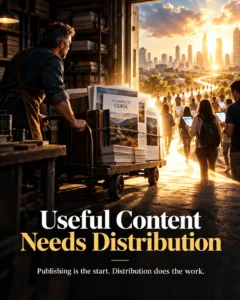 Publishing puts the stall in the market. Distribution opens the doors and lets people walk past it.




No comments:
Post a Comment