Create One Buyer Path Before Scattered Links Lose The Reader
Too many choices can make a useful route harder to follow.
Create One Buyer Path From Attention To One Useful Destination
The next click should continue the thought that earned the first one.
Create One Buyer Path You Can Walk, Test, And Improve
A simple route makes weak hand-offs easier to find and repair.
Create One Buyer Path Before You Chase More Traffic. More places to post do not automatically create more buyers. One understandable route gives the reader somewhere useful to go next.
Twelve Open Doors Can Be More Confusing Than One Clear Entrance. The buyer shouldn’t have to inspect your entire digital workshop to discover where you want them to go.
Create One Buyer Path You Can Actually Follow And Inspect. When the route is simple enough to draw in one line, it becomes simple enough to test, repair, and eventually multiply.
Paragraph 1: Picture the typical online workshop after some years of activity. There is a Facebook page here, a YouTube channel there, a website full of articles, an email form on another page, perhaps Threads and Instagram, and half a dozen accounts opened when a YouTube influencer declared that this was the platform everyone should use before Thursday. None of these elements is necessarily wrong. Individually, they can all perform useful functions. The problem appears when a prospective buyer arrives and finds every door in the building open at once.
That is why today’s job is to create One Buyer Path. Not a giant funnel. Not a map containing every website, social account, email sequence, and digital asset we have ever created. We want one understandable route that begins where the person already is and carries them towards one useful destination. The idea sounds almost too simple until you remember what we have actually built during this apprenticeship. We chose one useful outcome. We packaged the experience. Our promise became clearer. Here is one safe step. Our team built the sales page. We put the offer live and checked that somebody could find it, understand it, pay for it, and receive it. The machinery now exists. Today’s question is different: how does the right person reach that machinery without getting lost among everything else we own?
More Links Can Create More Decisions Instead Of More Opportunity
Creators naturally like options because options feel generous. If somebody lands on your Facebook post, why not give them the website, YouTube channel, email list, latest article, and product page? Surely one of those links will suit them. That makes sense from the creator’s side of the desk because we know what every destination contains. We understand why the blog exists, which video explains the idea, and where the £7 product fits. The visitor doesn’t have that map in their head. Every extra option creates another decision before they have decided whether they care enough to continue. Choice has quietly become work.
Imagine a retired reader sees one of our Facebook posts saying that something learned over forty years of work, family life, or a serious hobby could be turned into a small, useful digital product. That thought catches them because it feels familiar. They have often thought, “I know a thing or two about that.” Right now, they aren’t asking to see our entire digital estate. They are asking one question: “What could something I know actually become?” The best next destination is therefore something that answers that question. Today’s teaching article may be the answer. It may be a practical worksheet. Perhaps, once enough understanding already exists, it is the £7 offer itself. The right next step isn’t determined by which page we most want people to visit. It is determined by what the person naturally needs to understand next.
That gives us one of the most useful rules in the whole buyer-path job: the next click should answer the question created by the previous step. If a Facebook post raises curiosity about turning experience into digital value, the next page should continue that thought. If the article then shows how one piece of experience becomes a simple product, the £7 offer can logically help the reader do that job for themselves. The movement feels natural because every stage belongs to the same conversation. Contrast that with sending the same reader from the Facebook post to a general homepage containing articles on AI tools, traffic, email marketing, video, passive income, and half a dozen other subjects. All of those things may eventually matter, but we have interrupted the thought that earned the click in the first place.The Buyer Path Is Really A Chain Of Hand-Offs
One Route Can Have Several Front Doors Later
Now we can bring the bigger Crew plan into the picture without making today’s job bigger than it needs to be. We already know one 4-word teaching unit can become a Fleet Street article, hero image, AI prompt, Follow-Along graphic, video, Facebook post, email, YouTube Community post, and other useful formats. That does not mean each asset needs its own unique sales system. Quite the opposite. Once one buyer path works, several pieces of content can become different front doors into the same underlying route.
For example, today’s Create One Buyer Path article might eventually be discovered from a Facebook post, a YouTube Community image or a short video. Those are three entrances. Once the person arrives, the same useful destination can continue the journey. That is much easier to understand than building a separate maze behind every platform. The Crew can multiply the content without multiplying the confusion. This is what makes our new 7-day multiplication system practical rather than merely busy. One teaching unit keeps appearing in different useful forms, but the person does not get thrown into a different commercial universe every time they meet it.
That distinction also makes measurement easier. If three front doors eventually feed the same article and offer, we can compare which entrances actually move without changing the rest of the route every time. We are beginning to separate traffic from conversion, content from hand-off, and interest from buying action. Those sound like marketing terms, but underneath they are simply workshop questions: Where did the person arrive? Where were they meant to go next? Did they get there?
Open to See This Video, And This Is What’s Already Built, Trained & Waiting For Your First Command.
Today’s Apprentice Task: Build One Front Door
The danger with twelve social accounts is not having twelve social accounts. We already have them. The danger is feeling obliged to invent twelve different journeys because they exist. That is how digital work grows arms and legs. One Facebook link points to one article. YouTube points to a homepage. Threads points to another landing page. An old bio sends people to something we stopped promoting six months ago. An email footer contains an affiliate link nobody remembered was still there. Before long, the system looks active but nobody, including the owner, could draw the intended buyer route without opening six browser tabs and making a pot of tea.
So today’s rule is deliberately restrictive:
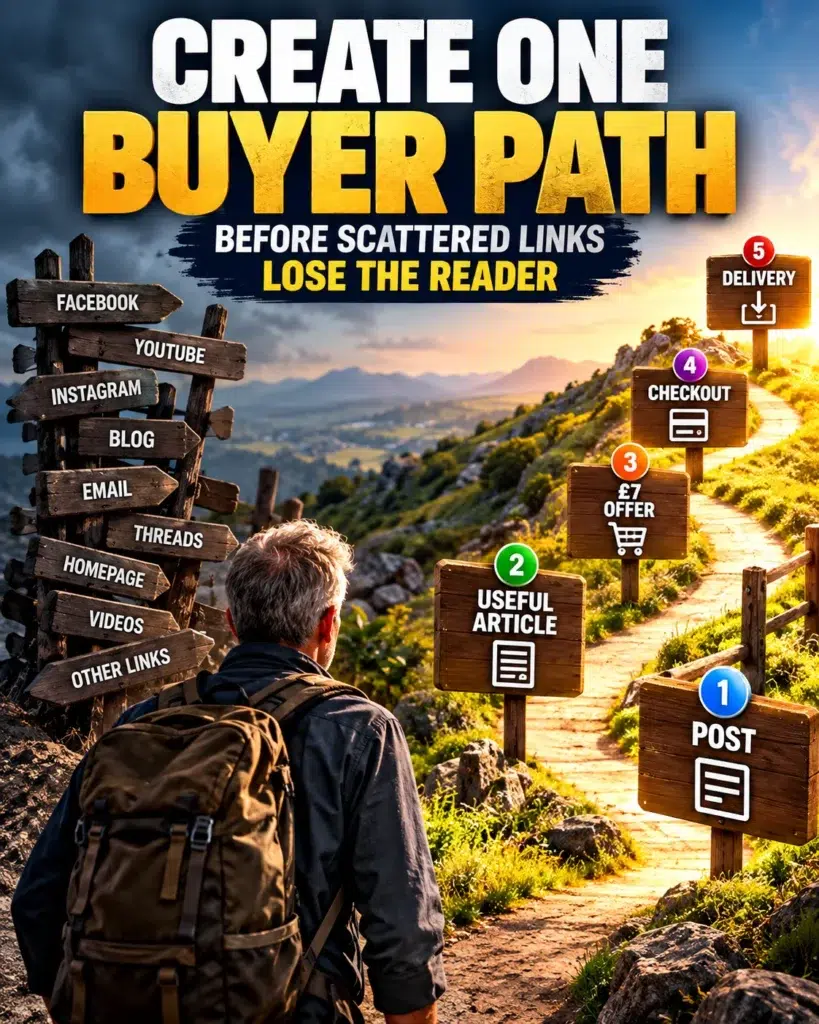
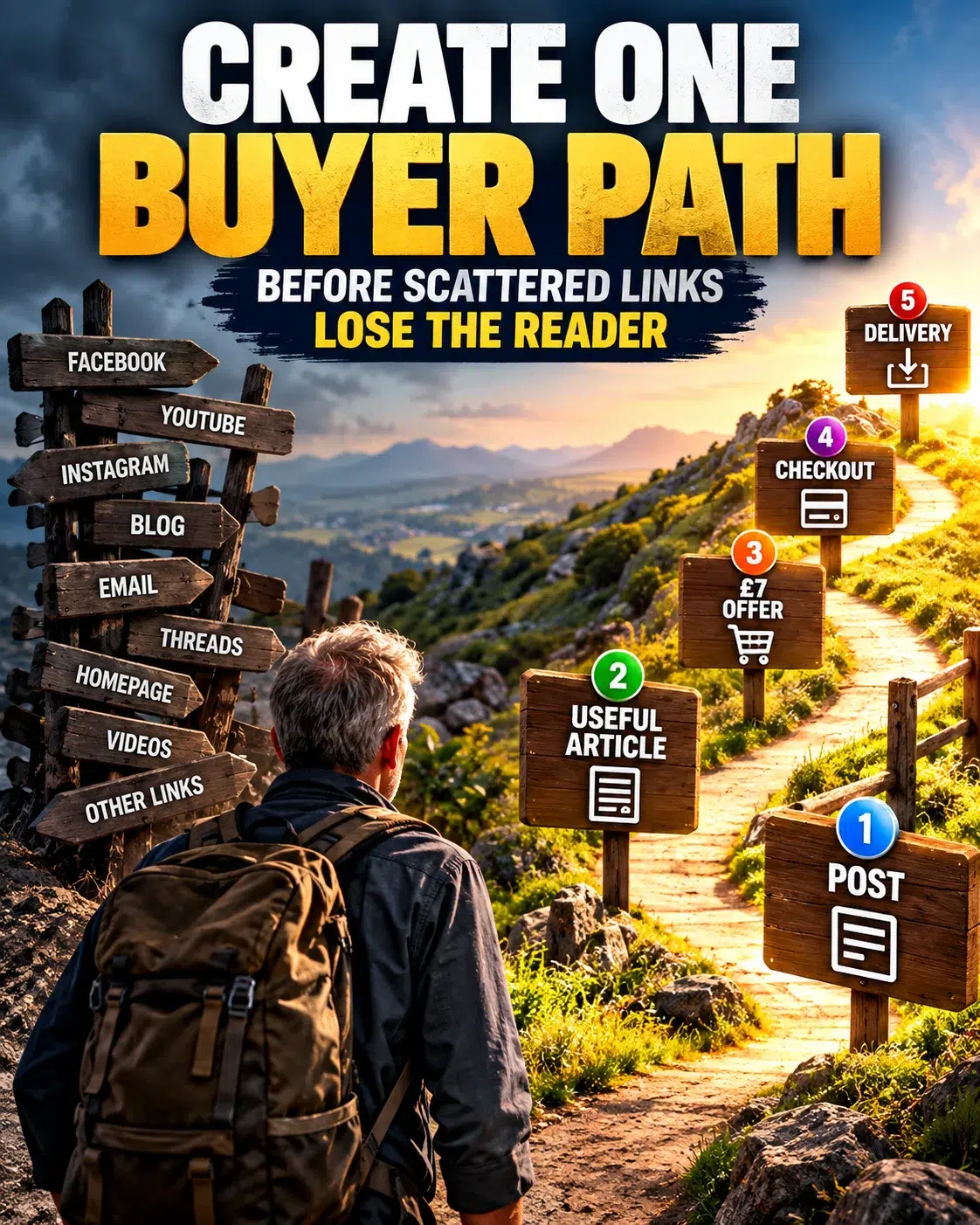
Do not multiply what you cannot yet explain. If you can say, “Facebook post to useful article to £7 offer to checkout to delivery,” we have a route. Suppose we can walk it ourselves; even better if another human can follow it without instruction; better still. At that point, adding YouTube as another front door may make sense. Adding an email may make sense. Putting the article into our seven-day multiplication calendar makes sense because we know what those assets are feeding.
Do Not Multiply A Route You Cannot Explain.
This is also the difference between distribution and scattering. Distribution takes one useful idea and places it where more of the right people can encounter it. Scattering throws links everywhere and hopes somebody eventually wanders into the right room. Our new Crew system should be designed for distribution. One 4-word phrase creates the lesson. The lesson creates the assets. The assets create entrances. The entrances feed a route we understand. The route leads towards a useful offer. That is a system the Apprentice can copy because the logic remains visible.
Now perform the simplest diagnosis of the day. Start with the entry point and imagine one real person moving through the route. Did they see enough reason to leave the social platform? If yes, move to the article. Does the article continue the same thought? If yes, find the offer hand-off. Does the offer feel like the logical next action, or does it arrive like a salesman jumping out from behind a hedge? If it feels logical, continue to the sales page. Is the price visible? Does the promise match what brought them here? Can they reach checkout? Can they receive the product?
The instant you reach a stage where you have to say, “Well, they should probably know what to do,” circle it. That is today’s weak hand-off. The Apprentice does not have to repair every conceivable problem. Repair the first meaningful break in the route. Then walk it again. This is the same working principle we have already used with AIOSEO and our sales pages: make the smallest repair that solves the actual problem, then retest before rebuilding the rest.
The Buyer Path Test: Where Did The Person Stop Moving?
And if the complete path works? Leave it alone long enough to learn from it. A system that has finally become testable should not be redesigned every morning because another clever idea arrived overnight. Good ideas can go on the shelf. Today’s route has earned the chance to produce evidence.
Take one piece of paper or open a blank document. Write your route in one line. Nothing fancy. For example: Facebook Post → Useful Article → £7 Offer → Checkout → Delivery. If your real route begins somewhere else, use that. The important thing is that these are genuine pages and links you can use today, not things you hope to build someday. Then begin at the first point and walk the path exactly as a stranger would. Click every link. Read every transition. Notice every decision. Test the route on your phone and, where possible, on your computer.
At each hand-off, ask two questions. First: “Why would I take the next step?” Second: “Does the next page continue the thought that brought me here?” If both answers are clear, move on. If either answer is weak, make a note. Do not immediately add more content. First decide whether the problem is the message, the link, the destination or the number of choices being offered.
When you reach delivery, draw a tick beside the route. You have now created something you can observe rather than imagine.
Today’s Apprentice Job: Draw One Route And Walk It
This is where today’s work connects directly to the new direction we are building. The Crew won’t create endless content just because AI makes endless content possible. Each 4-word teaching unit can become several useful pieces, but those pieces need a job. Some attract attention. Some teach. Some answer a question. Some demonstrate. Some invite the next step. And when appropriate, several of them can feed the same tested buyer path.
That means our twelve social accounts no longer look like twelve separate jobs. Over time, they can become twelve possible places where somebody first encounters one useful idea. The underlying logic remains the same: one thought, one sensible next step, one route.
Draw it. Walk it. Find the weakest hand-off. Repair that one connection before adding another traffic source.
By the end of today’s job, the Apprentice should not have a giant funnel diagram. They should have something better: one route another person can genuinely follow.
Because once somebody reaches the offer, another practical question appears immediately. Buying should not suddenly become the hardest part of the journey.
Create One Buyer Path: 5 Powerful Steps To Sales: Create One Buyer Path From Attention To One Useful Destination
The next click should continue the thought that earned the first one.
Create One Buyer Path You Can Walk, Test, And Improve
A simple route makes weak hand-offs easier to find and repair.
Put Your Offer Live And Find Out Whether The Route Really Works
A finished product is only half the job. Today we test whether a stranger can actually buy it.
The Workshop Door Has To Open From The Outside
Your buyer should be able to find the offer, understand it, pay for it, and receive it without needing you by their side.
Today Is An Inspection, Not A Performance
The first job is not to make a sale. The first job is to prove the buying route works from beginning to end.
At the end of any project, there is a curious moment when everything seems finished, but no one has flipped the switch. The pipework is in place, the boiler sits where it should, and the controls are wired. The radiators are filled, and the client stands behind you with that hopeful look: “Well then?” You can polish the casing until it gleams, but eventually someone must activate the system. That is where we are today. We have spent days selecting one useful outcome, packaging experience, clarifying the promise, and offering one safe step while building the sales page around the buyer’s decisions. The pieces rest on the bench, looking respectable. But today we stop admiring them. Today we launch your offer and see whether the route works when approached from outside.
That distinction matters: it is easy to confuse ‘I have a product’ with ‘I have an offer somebody can buy’. They are not the same. A PDF in a folder is a product. A WordPress sales page saved as a draft is a page. A checkout account with a button inside it is a payment tool. An email with a download link is a delivery method. An offer becomes real only when these pieces connect into a single path buyers can follow. The route must let a person discover the door, decide, pay, and receive.
Put Your Offer Live With The Four-Part Test
Start where the buyer will, not where you assume they will. Do not rely on memory to locate the sales page. If the plan uses Facebook, open the Facebook post and click the actual link. Start from the path the buyer follows, not from internal shortcuts. If you use YouTube Community images, begin at the link tied to that route. If an email points to the offer, use the email link. Do not cheat by opening another tab and typing the sales-page URL from memory. The buyer lacks your memory; they rely on your signpost. Test the experience by checking whether the link works and leads to the correct offer. Does it open properly on a phone? Does it lead readers to a homepage where they must navigate to your product? Remember: the front door should always open when you publish.
Begin with a fresh frame for the reader. Speak to the newcomer and identify who benefits. Show the problem solved, the result promised, and the next step clearly. Avoid relying on prior materials; the offer must stand on its own for first-time visitors.
A Buy Button Is Not Proof That Somebody Can Buy
The third test is Pay For It, where creators can become dangerously optimistic. We see a nice button labeled “Buy Now” and assume the financial plumbing behind it is misworking. That is like fitting a shiny new tap and deciding there must be water behind it because the chrome looks lovely. Click the thing. Follow the journey. Look at the price. Make sure the checkout still describes the same product as the sales page. Notice whether the buyer is suddenly transported into a different-looking system with different wording, a different price, or a strange instruction you forgot was there. If you can safely run a genuine test transaction in your setup, do so. If not, inspect every stage available to you and make sure nothing important depends on knowledge that only you possess.
This is also the right moment to stop thinking like the person who built the route and start thinking like the person who is slightly nervous about spending money online. They may be wondering whether this is a one-off payment, what currency they are paying in, whether they need an account, whether they will receive something immediately, and what happens after they click. Not every page needs a lecture answering questions nobody has asked, but anything that actually affects the decision should be clear before money changes hands. Good selling is not the art of keeping ordinary information mysterious until the final moment. Good selling reduces unnecessary uncertainty so the buyer can decide with their eyes open.
Then comes the fourth test, often forgotten because sellers understandably get excited when the payment goes through. Receive It. The job isn’t complete just because the till rang. What did you promise? A guide? A workbook? A download? Access to a page? An email? Whatever it is, make sure the buyer can actually get it. Follow the delivery route yourself. Open the email. Click the download. Open the file. Read the first instructions. If the buyer reaches the other side of payment and wonders whether anything happened, we have merely moved the confusion from the sales page to the delivery room.
Put Your Offer Live Without Turning Launch Day Into Theatre
This is where I want our Apprentice to think differently from much of the “launch” culture surrounding online business. Not hiring a brass band defines our stance. We are not putting a countdown timer on the town hall. We are not expecting five thousand people to gather outside the website at nine o’clock waiting for the ribbon to be cut. Today is an inspection. That mindset removes enormous unnecessary pressure. The question is not, “Will I get my first sale before lunch?” The question is, “Could somebody buy if they wanted to?” Those are completely different measurements.
If nobody buys today, that does not automatically mean the offer is wrong. It does not automatically mean the price is wrong. It certainly doesn’t mean we should throw the guide away, change the niche, rebuild the website, buy three more pieces of software, and announce that digital products don’t work. First,t prove the route. If the route works, real-world behavior begins to provide useful clues. Somebody may reach the page and ask a question. Good. Somebody may click from Facebook but leave before checkout. Interesting. Somebody may understand the offer but ask how it is delivered. There is another connection to inspect. Once we put your offer live, we stop improving entirely from imagination and start collecting evidence from the actual journey.
That is the real milestone today. The product no longer belongs only to the creator’s head. Another person can now approach it. They can accept it, reject it, misunderstand it, ask about it, or buy it. Every one of those reactions tells us more than another evening spent changing the cover.
Here’s the job in plain workshop English. First, follow the route yourself from the public entry point. Do not skip ahead. Click the same link the buyer will click. Check the page on a computer and a phone. Read the promise. Find the price. Use the button. Inspect the payment stage. Confirm what happens after payment. Open the product. Make sure the first instruction is understandable. Then, once the route works, publish the link somewhere a real prospect can see it. One channel is enough for today. We are not trying to flood the system with traffic. We are proving that the workshop door is open.
Then make one simple note. Record what happened. Did the link work? Did the page load? Has anyone clicked? Has anyone asked anything? Did anyone reach checkout yet? Was there a sale? Was delivery successful? Do not turn today’s note into a thirty-column analytics dashboard. We only need enough information to know what to inspect next. Tomorrow’s work becomes much easier when today’s evidence has been written down rather than left floating around in memory.
The Job Is Finished When A Stranger Could Complete The Route
Open to See This Video, And This Is What’s Already Built, Trained & Waiting For Your First Command.
Today’s Apprentice Task: Build One Front Door
The finishing line is not perfection, and it is not applause. Today’s job is complete when another person can discover the offer, understand what it does, decide whether to buy, complete payment, and receive the promised product without you having to step in to explain the machinery. That is a serious milestone. A few days ago, we had an idea and a lifetime of experience. Then we turned it into a useful outcome, shaped the product, clarified the promise, offered one safe step, and built the sales page. Today those separate pieces become a working route outside the workshop.
From here, the nature of the apprenticeship changes. Until now, most of our effort has focused on building the asset and establishing the sales channel. Once the offer is live, the next question becomes movement. How does the right person travel from first contact to this working offer without getting lost among twelve social accounts, hundreds of old posts, and a pile of unrelated links?
APPRENTICE CTA: PUT YOUR OFFER LIVE TODAY
Find It → Understand It → Pay For It → Receive It
Test the route. Publish the door. Record what happens. Repair only what the evidence shows needs attention.
Do that,t and you have moved beyond only learning how digital products are made. You now have a real offer on the marketplace that another person can choose to buy.
Next Job: Create One Buyer Path.
Put Your Offer Live Before Broken Links Cost The Sale
Put Your Offer Live Before Broken Links Cost The Sale: Put Your Offer Live And Find Out Whether The Route Really Works
A finished product is only half the job. Today we test whether a stranger can actually buy it.
The Workshop Door Has To Open From The Outside
Build Your Sales Page Around Decisions, Not Decorations
A sales page is not a digital brochure. It is a guided decision.
Build Your Sales Page By Answering The Buyer’s Next Question
Every section should remove one doubt and earn the next scroll.
Build Your Sales Page So The Button Feels Like The Natural Next Step
The page should earn the click before the button asks for it.
Picture the scene. You finished the £7 product and the guide sits ready. The cover looks respectable, the prompts work, and the checklist does what it should do. You spent days tightening the promise, making sure the offer does not claim to rebuild someone’s entire financial future before lunchtime. Now you face the part that often trips up first‑time digital sellers: building the sales page. Do not rush to a page template with a headline here, a picture there, and a green button. Resist the urge to add a testimonial box before you have a real one, and avoid listing features to look good. The result is a page that looks busy and polished but still begs the central question: why should the right person keep reading? Keep the focus tight and answer that question clearly to guide readers toward taking action.
The page should guide buyers, not just list information. Often, content is stacked in the creator’s preferred order rather than in the order that best serves the buyer’s needs. The reader wants to know what matters and why, in the sequence that helps them decide. The aim is guidance, not persuasion through layout. That is the difference between a brochure and a guided decision. A brochure says, “Here is everything we have.” A sales page should quietly say, “You have a question. Let me answer it.” And if another question comes, answer that too.
Build Your Sales Page One Buyer Question At A Time
Suppose an Apprentice creates a simple £7 guide for retirees. It helps turn one useful life experience into a first digital product. The temptation is to open with a long list. Fourteen pages, five worksheets, three AI prompts, and a bonus checklist. All of it can be true, but the buyer hasn’t decided its value. Before anyone cares what is inside, they must see why it belongs here. A stronger opening serves one clear purpose. It shows how experience becomes value for others. This guide helps retirees turn it into a simple idea. Then the reader can decide if it is right for them. Aye, this might actually be for me.
That first answer naturally creates the second question: “All right, but what will I have when I finish?” Good. Now the next section has a job. Explain the useful result. The reader may finish with one clear product idea, one person it could help, and a simple outline showing what should go inside. Once that is understood, another question usually appears: “Can I really do this if I am not good with technology?” Excellent. That gives the third section its job. Explain that the process begins with what they already know, not complicated software. Show the simple steps. Give them a small example. Address the doubt while it is still fresh, rather than hoping they reach a giant FAQ cemetery at the bottom of the page.
This is how we build your sales page as a decision chain rather than a collection of copy blocks. The page follows a natural route: Is this for me? What result will I get? Can I do it? What exactly do I receive? What might stop me? After payment, what happens? Am I ready to act? That sequence gives every paragraph, image, example, and button a reason to exist. It also gives the Gaffer something far more useful than a page template. He has an inspection drawing. When a section cannot answer one of those questions, we can ask why it is taking up space. If answering one question creates three new doubts, the hand-off needs repair. If two sections do the same job, one may be unnecessary. Suddenly we are not decorating a sales page. We are installing a route.
This is where one simple rule becomes worth keeping beside the laptop: every section must earn the next scroll. Refrain from shouting. Not by adding fake urgency. Not by promising the moon because the page feels a bit flat. It earns the next scroll by resolving enough uncertainty that the reader wants the next answer. If they reach the end of the opening and still don’t know whether the offer suits them, we haven’t earned section two. Even if they understand who it is for but cannot picture the useful result, we have not earned the product-details section. If they reach the price before knowing what happens after purchase, the checkout button is being asked to do work the page has not yet completed.
Think of it like one of those old jobs where every trade depended on the previous one leaving the work ready. The plumber cannot sensibly finish the connection if the pipe has been left six inches short. The decorator cannot rescue a wall that was never properly prepared. Digital selling is no different. Each section hands something to the next. Recognition hands to result. Result hands to belief. Belief hands to content. Content hands to value. Value hands to action. When that chain is clean, the page feels easy. When the hand-offs are poor, even attractive copy starts to feel like hard work.
That gives us Apprentice’s first inspection test today. Open the rough sales page, or even a blank piece of paper if the page does not exist yet, and stop asking, “What section should come next?” Instead ask: “What is the buyer likely to need answered next?” Write that question down. Then write one section that answers it properly. When you have finished, ask what uncertainty remains. That becomes the next section. Keep going until the buyer reaches the point where taking action no longer feels like being suddenly asked for money, but like the sensible next step in a conversation that has already answered the important questions.
Answer Buyer Doubts Before You Start Decorating
When you build your sales page around the doubts a real buyer may have, each section gets a clearer job and the whole route becomes easier to follow. Another trap appears once the decision chain is clear. The page builder tempts with visuals: colours, fonts, buttons, boxes, borders. A smiling photo of someone earning money while the keyboard stays idle may appear. Don’t decorate until you address the buyer’s core doubts about the offer. For the £7 retiree guide, identify the natural uncertainties that would stop a buyer from proceeding. Questions like: Is this for someone my age? Do I need technical skills? What exactly will I make? Seven pounds—what value does it offer? What happens after payment? These are not annoyances; they point to the next steps.
Once those doubts are visible, the page becomes much easier to build because each one needs a home. When readers worry about technology, address it before discussing the price. If they wonder what the finished result looks like, show a simple example. Address concerns that readers worry they are buying into a sprawling online business program by showing that this small product does one job and doesn’t pretend to do the whole lot. If they are wondering what happens after checkout, tell them plainly. There is no prize for making the buyer guess. In fact, one of the most useful habits an Apprentice can learn is to address doubts as they arise. Do not save everything for the bottom of the page and hope the reader survives long enough to reach it.
Let The Button Arrive After The Decision
Build your sales page so the buyer reaches the button after the important questions have already been answered. This is where the famous Buy Now button starts behaving differently. Beginners often treat the button as though it has magical powers. They make it larger. Then greener. Then orange because somebody said orange converts better. They add a button halfway down, near the price, and one at the top for readers who haven’t understood yet. But a button cannot repair missing decisions. If the reader doesn’t know whether the product is for them, doesn’t understand the result, cannot see what they receive, and doesn’t know what happens after payment, the button is merely a brightly coloured interruption.
A much better rule is this: the page should earn the click before the button asks for it. By the time the reader reaches the main call to action, most of the important thinking should already have happened. They should be able to say, “This is for someone like me. I understand what it helps me do. Readers can see what they receive. I know what it costs. You understand what happens next. At that point, the button is no longer shouting “BUY SOMETHING!” It is simply giving the reader a place to act on a decision they have already reached.
That also changes how we write the words on and around the button. We do not need fake urgency, countdown clocks, or breathless warnings that the internet may close in seven minutes. For a small first offer, calm clarity can do far more useful work. “Get The £7 Guide” tells the reader what happens. “Start With Your First Product Idea” can connect the action back to the promise. A short line underneath might confirm that they receive immediate access after payment, if that is genuinely how delivery works. The point is not to make the button clever. The point is to remove the final uncertainty between understanding and action.
Build Your Sales Page As Version One Of A Working Installation
The aim when you build your sales page is not to force the sale, but to give the right buyer enough clarity to make their own decision. This matters because our job isn’t to push everybody through checkout. Some people should decide the offer is not for them. That is not failure. A clear sales page helps the right reader understand the offer and helps the wrong reader move on without confusion. Both outcomes are better than creating a page so vague that nobody quite knows what they are being asked to buy.
That’s the real difference between persuasion and guidance. Persuasion often gets interpreted as finding stronger words. Guidance asks better questions. What should this person understand next? What uncertainty can I remove? Which evidence should I present? Which information belongs here instead of three sections later? When you work that way, the page begins to feel less like selling and more like good workmanship.
Today’s Apprentice Task: build the first working version of your sales page. Do not spend the day polishing colours. Put the buyer decisions in order first. Give every section one job. Answer the real doubts. State what the buyer receives, what it costs, and what happens after payment. Then add one clear call to action at the natural end of the decision.
If every section helps the buyer make the next decision, Version One is doing its job.
Do not wait for perfect. Save the page, inspect every hand-off, and get the working installation ready for the next job.
Build Your Sales Page With A Buyer Walk-Through Before You Publish
One final job is worth doing before you call the page finished, and it is probably the cheapest inspection you will ever do. Stop looking at the page like the person who built it. Look at it like the person who has just arrived. That sounds obvious, but it is surprisingly difficult because you already know where everything is. You know what the product does. You know why the price is £7. Customers learn what happens after payment. That button halfway down the page leads to the checkout, as you know. The buyer knows none of that. So before you build your sales page into something bigger, perform a buyer walk-through from top to bottom and pretend that every section has to introduce itself properly.
Start at the headline and ask what the reader knows after ten seconds. Do they know who this is for? Should readers understand the small, useful result? Do they know whether they should keep reading? Then scroll down one section at a time. At each point, ask a simple question: “What does the buyer know now that they did not know ten seconds ago?” If the answer is nothing, that section may only be taking up room. If the answer is something useful but it belongs much earlier, move it. If the section raises a question that isn’t answered until half a page later, bring the answer closer. This is not glamorous work, but neither is checking a joint before turning the water back on. The customer rarely sees the inspection. They experience a job that works.
Open to See This Video, And This Is What’s Already Built, Trained & Waiting For Your First Command.
Today’s Apprentice Task: Build One Front Door
Make The Next Step Obvious
One of the easiest ways to lose clarity is to assume the buyer knows what to do next. We do this because we have been staring at the page for hours. The button looks obvious to us. The delivery process feels obvious. The price sits exactly where we put it, so naturally we know where to find it. But a stranger may still wonder whether clicking commits them to something else, whether the guide arrives by email, whether they need special software, or whether they will suddenly find themselves in a monthly subscription they never asked for. If none of those things apply, say so plainly where it helps the decision. Good selling does not create mystery around ordinary facts.
For our £7 Apprentice offer, the hand-over could be remarkably simple. The reader reaches the buying section and sees what the product helps them do, what they receive, the price, and what happens immediately after purchase. No treasure hunt. No hunt for the small print. There is no need to interpret a button labeled with some clever phrase that sounded wonderful at midnight. The buyer should be able to think: “I understand this. I know what happens next. I can decide.” That is a much healthier finish than trying to force somebody across the line with another burst of persuasion.
This buyer walk-through also gives you a useful way to separate a sales problem from a product problem. If the page promises one thing but the product delivers another, that is a product-or-promise issue. If the product is sound but the reader cannot understand what it does, that is a page issue. Provided everything remains clear up to the payment step, the checkout may reveal a weak connection. Finding the problem matters because beginners often react to any poor response by rebuilding everything. New headline. Fresh product. A new image appears. Price updated. Updated page. New panic. A Gaffer does not work like that. He finds the fault before ordering another boiler.
So before you finish today’s job, walk the route one last time as a stranger. Read the promise. Follow the sections. Find the price. Locate the action. Imagine making the payment. Ask what happens next. If at any point you have to rely on knowledge that only the creator possesses, put that missing piece onto the page. The final inspection rule is simple: the buyer should never have to guess what you already know.
Once that test is passed, stop decorating. Version One has earned the right to leave the workshop.
Make Your Promise Clear Before You Add Another Word
If somebody needs a paragraph before they understand what you are selling, the problem may not be the product.
Your Buyer Should Not Have To Finish Make Your Promise Clear
A clear promise tells the right person what useful job the offer will do for them.
Start With One Person, One Useful Make Your Promise Clear Outcome
That simple test can rescue an offer before another page, bonus, or button gets added.
Picture the scene. You sit at the kitchen table with a cup of tea cooling beside the laptop, and, for once, you feel pleased with yourself. You have actually made something. Not just thought about making it, not bought another course, and not left seventeen tabs open while vowing to return tomorrow. You have finished a small digital product: twelve pages, five checklists, three AI prompts, a few examples, perhaps even a cover you are proud of. Then somebody passes by, glances at the screen, and asks the simplest question imaginable: What does it do? You begin to explain the contents, the background, why you made it, where the idea came from, what the prompts are for, and how useful the checklist might be once they understand the rest. Five minutes later they nod politely, and you realize you still haven’t answered the question.
Now is the moment to clearly spell out your promise. The product is not faulty, and the creator is not inexperienced. On the contrary, the creator often knows more than is needed. Years of practical knowledge back up the product, so every feature feels important. The twelve pages carry meaning because you wrote them. The five checklists saved an afternoon, and the prompts save work. A first‑time viewer has none of that history, so they are not yet admiring the workmanship. Their question is whether this helps someone like them do something difficult. If they cannot find the answer quickly, they must finish part of the missing thinking themselves.
The Ingredients Are Not The Promise – Make Your Promise Clear
That is where small digital offers become muddled. We start describing what went into them rather than what should come out the other side. “Twelve pages, five checklists and three prompts” might be perfectly useful information later. It tells the buyer what they receive. It makes the product tangible. This reassurance shows buyers that they are not paying seven pounds for two vague paragraphs and a cheery goodbye. But ingredients answer a different question. They answer, “What is in the box?” The promise answers the question, “What job will the box help me do?” Confusing those two questions leaves the buyer holding a list of components and wondering why any of them belong in their life.
A retiree has spent forty years solving problems that others still find tough. She knows how to organize household paperwork so nothing important is misplaced. For a long career, he maintained equipment and learned simple checks that prevent expensive mistakes. Many people have spent years baking, gardening, bookkeeping, teaching, repairing, caring, selling, or organizing. What seems ordinary to them could save a beginner many frustrating weekends. They decide to turn that experience into a £7 guide. Their first instinct is to list every effort that went into it: the pages, worksheets, templates, prompts, and bonuses. Yet a clearer promise emerges: turn one useful thing you know into your first simple digital product. The guide keeps its materials intact; the checklists and prompts remain, but they now have a real reason to exist.
This is one of the most useful distinctions an Apprentice can learn because it does more than improve a headline. It improves the product itself. Once you make your promise clear, you can look at every page and ask whether it helps deliver the promised result. If it does, keep it. If it does not, you have found either a distraction or material for another job. Suddenly the promise stops being advertising decoration and becomes the Gaffer’s job sheet. It tells Derek what needs building, Peter what needs explaining, and Freddy what needs to be put in front of the right people. Most importantly, it tells the person at the top of the job whether the work is actually finished.
There is a wonderfully cheap inspection method for this that requires no additional software. Imagine someone has arrived who doesn’t know you, has never read your previous posts, and has no idea what you meant when you used your favourite bit of shorthand. Give them the main promise and ask whether they can work out three things without a guided tour: Who is this for? What will it help them do? Why should that result matter? That is the Stranger Test. A phrase such as “Unlock your digital potential with an AI-powered transformation system” may sound impressive after three hours staring at a sales page, but a stranger can still reasonably ask all three questions after reading it. The words are polished. The job remains hidden.
Now compare that with: “Help retirees turn one useful piece of lifetime experience into a simple £7 digital offer.” The second promise does not try to carry the reader to the far end of their financial future before breakfast. It identifies the person, names the immediate job and gives the result a shape. That smaller promise is not necessarily worth less. It is simply easier to understand, easier to judge and, crucially, easier for the product to keep. And that brings us to the next piece of today’s job, because one of the quickest ways to weaken an otherwise useful first offer is to promise the whole journey when you’re really only selling the next useful step.
Do Not Promise The Whole Future When You Are Selling The Next Step
Open the small offer you have been building through this apprenticeship and find the sentence you currently use to explain it. Do not polish it yet. Read it exactly as a stranger would. Then ask three questions: Who is this for? What useful result does it help them get? Why should that result matter to them? If any answer is missing, vague, or buried inside a list of features, rewrite the promise until those three things become obvious. Then read the new sentence against the actual product and make sure the product can honestly do what the sentence says.
Next, walk the promise through the route. Look at the social post or image that will introduce it. Examine the sales page. Look at the checkout wording. Look at the first page or screen the buyer receives after payment. You are not looking for identical wording. You are looking for the same job. When the job changes halfway through, restore alignment. If the promise exceeds the product, shrink the promise. If the product includes a useful feature that doesn’t contribute to the promised result, move it to the “later” pile rather than forcing it into today’s installation.
By the end of today’s job, you should have something much more useful than a clever headline. You should have one sentence that tells the right person what this offer helps them do and gives the Crew a standard for inspecting the entire job. That sentence can sit at the top of the product page, become the center of tomorrow’s sales page, guide the image, shape the social post, and keep every stage of the buyer’s journey pointing in the same direction.
That’s the real reason to clarify your promise. You are not simply improving the wording. You are deciding what job the product has been hired to do.
Today’s Job Test: Can a stranger understand who the offer is for, what useful result it helps them achieve, and why that result matters without needing you beside them to explain it?
If the answer is yes, stop adding words.
Clarity Also Tells The Buyer What Happens Next
One more reason to make your promise clear is that its impact grows when a reader shifts from casual to a follower. A clear promise does more than describe a result; it gives readers confidence to take the next small step. Too many offers keep readers in the doorway, unsure what happens after they click. They are promised transformation, freedom, automation, opportunity, or a brighter financial future, yet no one explains what they will do on Tuesday morning. A smaller, clearer promise earns its keep by outlining today’s specific task and the expected result.
That is how this apprenticeship is being built. We are not asking anyone to believe that seven days of reading will magically generate income. We are giving them a sequence of jobs in which each finished piece becomes the starting material for the next. Yesterday’s useful outcome becomes today’s promise. Today’s promise becomes tomorrow’s sales page. The sales page becomes the destination for the next traffic job. The checkout leads to delivery. Delivery leads to follow-up. None of those individual jobs need to pretend they are the whole business. Its responsibility is to hand the right finished piece to the next stage. That is exactly why the promise matters so much. If today’s hand-off is vague, tomorrow’s work begins with confusion. If today’s hand-off is clear, the Apprentice starts tomorrow with something solid already sitting on the bench.
Another benefit becomes obvious once you start working this way. Clear promises make it easier to tell when you’re finished. Many beginners keep improving products because they have never defined the job well enough to know when it’s complete. They add another chapter, another graphic, another prompt, another bonus, and another afternoon of work because “better” has no finishing line. A clear promise creates one. If the product promises to help somebody choose one useful idea and turn it into a first product outline, then inspect that result. Can they do it? Is anything essential missing? Is anything getting in the way? If the job is done, Version One can leave the workshop. You can improve it after real people have had the chance to use it.
Your Next Step Is To Write The Sentence Before You Build The Page
Open to See This Video, And This Is What’s Already Built, Trained & Waiting For Your First Command.
Today’s Apprentice Task: Build One Front Door
So before you disappear into colours, buttons, page builders and sales-page templates, write the sentence that tomorrow’s page must carry. Keep it beside you while you work. One person. One useful outcome. One reason to care. Do not let the page promise more simply because there is space to fill. Don’t hide the useful result under a mountain of features. And do not assume the reader can see what you can see after living with the idea for a week. Write your promise now. Read it aloud as if you had never seen the product before. If you immediately understand who it is for, what it helps them do, and why that small result matters, today’s job is complete. And if you are following this apprenticeship with us, keep that sentence somewhere safe. You’ll need it for the next job, because tomorrow we cease discussing the offer and start putting it somewhere a real buyer can understand.
Make Your Promise Clear Before Confusion Costs Your First Sale
APPRENTICE CTA: DO THE JOB TODAY
Write your one clear promise. Test it against the product. Keep only what helps deliver that promise. Then carry the finished sentence into tomorrow’s job.
Next Job: Build Your Sales Page.
The promise is ready for tomorrow’s job: Build Your Sales Page.
Make Your Promise Clear Before Confusion Costs Your First Sale: Make Your Promise Clear Before You Add Another Word
If somebody needs a paragraph before they understand what you are selling, the problem may not be the product.
Your Buyer Should Not Have To Finish Make Your Promise Clear
 Creators naturally like options because options feel generous. If somebody lands on your Facebook post, why not give them the website, YouTube channel, email list, latest article, and product page? Surely one of those links will suit them. That makes sense from the creator’s side of the desk because we know what every destination contains. We understand why the blog exists, which video explains the idea, and where the £7 product fits. The visitor doesn’t have that map in their head. Every extra option creates another decision before they have decided whether they care enough to continue. Choice has quietly become work.Imagine a retired reader sees one of our Facebook posts saying that something learned over forty years of work, family life, or a serious hobby could be turned into a small, useful digital product. That thought catches them because it feels familiar. They have often thought, “I know a thing or two about that.” Right now, they aren’t asking to see our entire digital estate. They are asking one question: “What could something I know actually become?” The best next destination is therefore something that answers that question. Today’s teaching article may be the answer. It may be a practical worksheet. Perhaps, once enough understanding already exists, it is the £7 offer itself. The right next step isn’t determined by which page we most want people to visit. It is determined by what the person naturally needs to understand next.