Happiness is not something you postpone for the future; it is something you design for the present.
Jim Rohn
Tuesday, September 29, 2026
Create One Buyer Path: 5 Powerful Steps To Sales
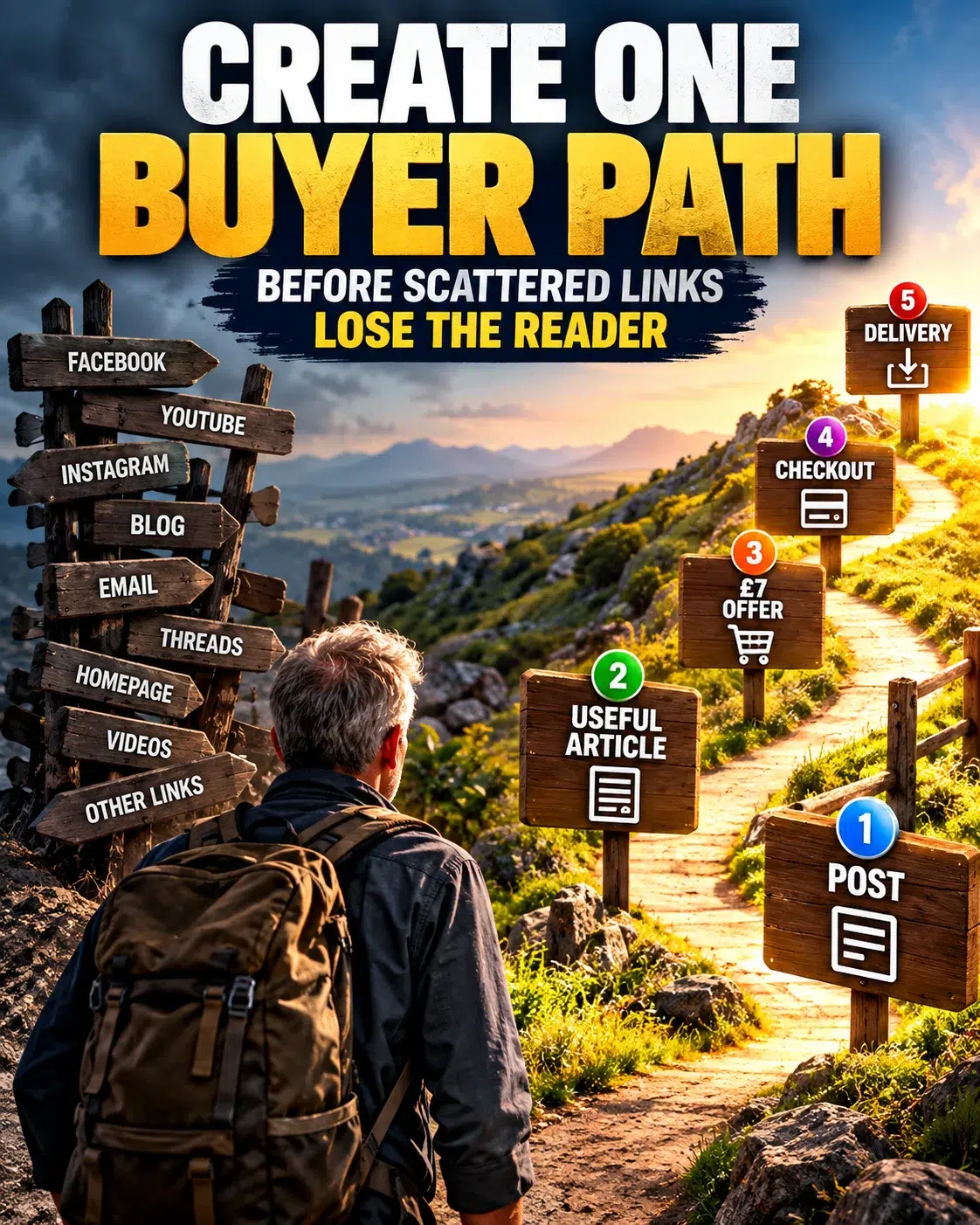
Create One Buyer Path Before Scattered Links Lose The Reader
Too many choices can make a useful route harder to follow.
Create One Buyer Path From Attention To One Useful Destination
The next click should continue the thought that earned the first one.
Create One Buyer Path You Can Walk, Test, And Improve
A simple route makes weak hand-offs easier to find and repair.
Create One Buyer Path Before You Chase More Traffic. More places to post do not automatically create more buyers. One understandable route gives the reader somewhere useful to go next.
Twelve Open Doors Can Be More Confusing Than One Clear Entrance. The buyer shouldn’t have to inspect your entire digital workshop to discover where you want them to go.
Create One Buyer Path You Can Actually Follow And Inspect. When the route is simple enough to draw in one line, it becomes simple enough to test, repair, and eventually multiply.
Paragraph 1: Picture the typical online workshop after some years of activity. There is a Facebook page here, a YouTube channel there, a website full of articles, an email form on another page, perhaps Threads and Instagram, and half a dozen accounts opened when a YouTube influencer declared that this was the platform everyone should use before Thursday. None of these elements is necessarily wrong. Individually, they can all perform useful functions. The problem appears when a prospective buyer arrives and finds every door in the building open at once.
That is why today’s job is to create One Buyer Path. Not a giant funnel. Not a map containing every website, social account, email sequence, and digital asset we have ever created. We want one understandable route that begins where the person already is and carries them towards one useful destination. The idea sounds almost too simple until you remember what we have actually built during this apprenticeship. We chose one useful outcome. We packaged the experience. Our promise became clearer. Here is one safe step. Our team built the sales page. We put the offer live and checked that somebody could find it, understand it, pay for it, and receive it. The machinery now exists. Today’s question is different: how does the right person reach that machinery without getting lost among everything else we own?
More Links Can Create More Decisions Instead Of More Opportunity
Creators naturally like options because options feel generous. If somebody lands on your Facebook post, why not give them the website, YouTube channel, email list, latest article, and product page? Surely one of those links will suit them. That makes sense from the creator’s side of the desk because we know what every destination contains. We understand why the blog exists, which video explains the idea, and where the £7 product fits. The visitor doesn’t have that map in their head. Every extra option creates another decision before they have decided whether they care enough to continue. Choice has quietly become work.
Imagine a retired reader sees one of our Facebook posts saying that something learned over forty years of work, family life, or a serious hobby could be turned into a small, useful digital product. That thought catches them because it feels familiar. They have often thought, “I know a thing or two about that.” Right now, they aren’t asking to see our entire digital estate. They are asking one question: “What could something I know actually become?” The best next destination is therefore something that answers that question. Today’s teaching article may be the answer. It may be a practical worksheet. Perhaps, once enough understanding already exists, it is the £7 offer itself. The right next step isn’t determined by which page we most want people to visit. It is determined by what the person naturally needs to understand next.
That gives us one of the most useful rules in the whole buyer-path job: the next click should answer the question created by the previous step. If a Facebook post raises curiosity about turning experience into digital value, the next page should continue that thought. If the article then shows how one piece of experience becomes a simple product, the £7 offer can logically help the reader do that job for themselves. The movement feels natural because every stage belongs to the same conversation. Contrast that with sending the same reader from the Facebook post to a general homepage containing articles on AI tools, traffic, email marketing, video, passive income, and half a dozen other subjects. All of those things may eventually matter, but we have interrupted the thought that earned the click in the first place.The Buyer Path Is Really A Chain Of Hand-Offs
One Route Can Have Several Front Doors Later
Now we can bring the bigger Crew plan into the picture without making today’s job bigger than it needs to be. We already know one 4-word teaching unit can become a Fleet Street article, hero image, AI prompt, Follow-Along graphic, video, Facebook post, email, YouTube Community post, and other useful formats. That does not mean each asset needs its own unique sales system. Quite the opposite. Once one buyer path works, several pieces of content can become different front doors into the same underlying route.
For example, today’s Create One Buyer Path article might eventually be discovered from a Facebook post, a YouTube Community image or a short video. Those are three entrances. Once the person arrives, the same useful destination can continue the journey. That is much easier to understand than building a separate maze behind every platform. The Crew can multiply the content without multiplying the confusion. This is what makes our new 7-day multiplication system practical rather than merely busy. One teaching unit keeps appearing in different useful forms, but the person does not get thrown into a different commercial universe every time they meet it.
That distinction also makes measurement easier. If three front doors eventually feed the same article and offer, we can compare which entrances actually move without changing the rest of the route every time. We are beginning to separate traffic from conversion, content from hand-off, and interest from buying action. Those sound like marketing terms, but underneath they are simply workshop questions: Where did the person arrive? Where were they meant to go next? Did they get there?
Open to See This Video, And This Is What’s Already Built, Trained & Waiting For Your First Command.
Today’s Apprentice Task: Build One Front Door
The danger with twelve social accounts is not having twelve social accounts. We already have them. The danger is feeling obliged to invent twelve different journeys because they exist. That is how digital work grows arms and legs. One Facebook link points to one article. YouTube points to a homepage. Threads points to another landing page. An old bio sends people to something we stopped promoting six months ago. An email footer contains an affiliate link nobody remembered was still there. Before long, the system looks active but nobody, including the owner, could draw the intended buyer route without opening six browser tabs and making a pot of tea.
So today’s rule is deliberately restrictive:
Do not multiply what you cannot yet explain. If you can say, “Facebook post to useful article to £7 offer to checkout to delivery,” we have a route. Suppose we can walk it ourselves; even better if another human can follow it without instruction; better still. At that point, adding YouTube as another front door may make sense. Adding an email may make sense. Putting the article into our seven-day multiplication calendar makes sense because we know what those assets are feeding.
Do Not Multiply A Route You Cannot Explain.
This is also the difference between distribution and scattering. Distribution takes one useful idea and places it where more of the right people can encounter it. Scattering throws links everywhere and hopes somebody eventually wanders into the right room. Our new Crew system should be designed for distribution. One 4-word phrase creates the lesson. The lesson creates the assets. The assets create entrances. The entrances feed a route we understand. The route leads towards a useful offer. That is a system the Apprentice can copy because the logic remains visible.
Now perform the simplest diagnosis of the day. Start with the entry point and imagine one real person moving through the route. Did they see enough reason to leave the social platform? If yes, move to the article. Does the article continue the same thought? If yes, find the offer hand-off. Does the offer feel like the logical next action, or does it arrive like a salesman jumping out from behind a hedge? If it feels logical, continue to the sales page. Is the price visible? Does the promise match what brought them here? Can they reach checkout? Can they receive the product?
The instant you reach a stage where you have to say, “Well, they should probably know what to do,” circle it. That is today’s weak hand-off. The Apprentice does not have to repair every conceivable problem. Repair the first meaningful break in the route. Then walk it again. This is the same working principle we have already used with AIOSEO and our sales pages: make the smallest repair that solves the actual problem, then retest before rebuilding the rest.
The Buyer Path Test: Where Did The Person Stop Moving?
And if the complete path works? Leave it alone long enough to learn from it. A system that has finally become testable should not be redesigned every morning because another clever idea arrived overnight. Good ideas can go on the shelf. Today’s route has earned the chance to produce evidence.
Take one piece of paper or open a blank document. Write your route in one line. Nothing fancy. For example: Facebook Post → Useful Article → £7 Offer → Checkout → Delivery. If your real route begins somewhere else, use that. The important thing is that these are genuine pages and links you can use today, not things you hope to build someday. Then begin at the first point and walk the path exactly as a stranger would. Click every link. Read every transition. Notice every decision. Test the route on your phone and, where possible, on your computer.
At each hand-off, ask two questions. First: “Why would I take the next step?” Second: “Does the next page continue the thought that brought me here?” If both answers are clear, move on. If either answer is weak, make a note. Do not immediately add more content. First decide whether the problem is the message, the link, the destination or the number of choices being offered.
When you reach delivery, draw a tick beside the route. You have now created something you can observe rather than imagine.
Today’s Apprentice Job: Draw One Route And Walk It
This is where today’s work connects directly to the new direction we are building. The Crew won’t create endless content just because AI makes endless content possible. Each 4-word teaching unit can become several useful pieces, but those pieces need a job. Some attract attention. Some teach. Some answer a question. Some demonstrate. Some invite the next step. And when appropriate, several of them can feed the same tested buyer path.
That means our twelve social accounts no longer look like twelve separate jobs. Over time, they can become twelve possible places where somebody first encounters one useful idea. The underlying logic remains the same: one thought, one sensible next step, one route.
Draw it. Walk it. Find the weakest hand-off. Repair that one connection before adding another traffic source.
By the end of today’s job, the Apprentice should not have a giant funnel diagram. They should have something better: one route another person can genuinely follow.
Because once somebody reaches the offer, another practical question appears immediately. Buying should not suddenly become the hardest part of the journey.
Create One Buyer Path: 5 Powerful Steps To Sales: Create One Buyer Path From Attention To One Useful Destination
The next click should continue the thought that earned the first one.
Create One Buyer Path You Can Walk, Test, And Improve
A simple route makes weak hand-offs easier to find and repair.
 Creators naturally like options because options feel generous. If somebody lands on your Facebook post, why not give them the website, YouTube channel, email list, latest article, and product page? Surely one of those links will suit them. That makes sense from the creator’s side of the desk because we know what every destination contains. We understand why the blog exists, which video explains the idea, and where the £7 product fits. The visitor doesn’t have that map in their head. Every extra option creates another decision before they have decided whether they care enough to continue. Choice has quietly become work.Imagine a retired reader sees one of our Facebook posts saying that something learned over forty years of work, family life, or a serious hobby could be turned into a small, useful digital product. That thought catches them because it feels familiar. They have often thought, “I know a thing or two about that.” Right now, they aren’t asking to see our entire digital estate. They are asking one question: “What could something I know actually become?” The best next destination is therefore something that answers that question. Today’s teaching article may be the answer. It may be a practical worksheet. Perhaps, once enough understanding already exists, it is the £7 offer itself. The right next step isn’t determined by which page we most want people to visit. It is determined by what the person naturally needs to understand next.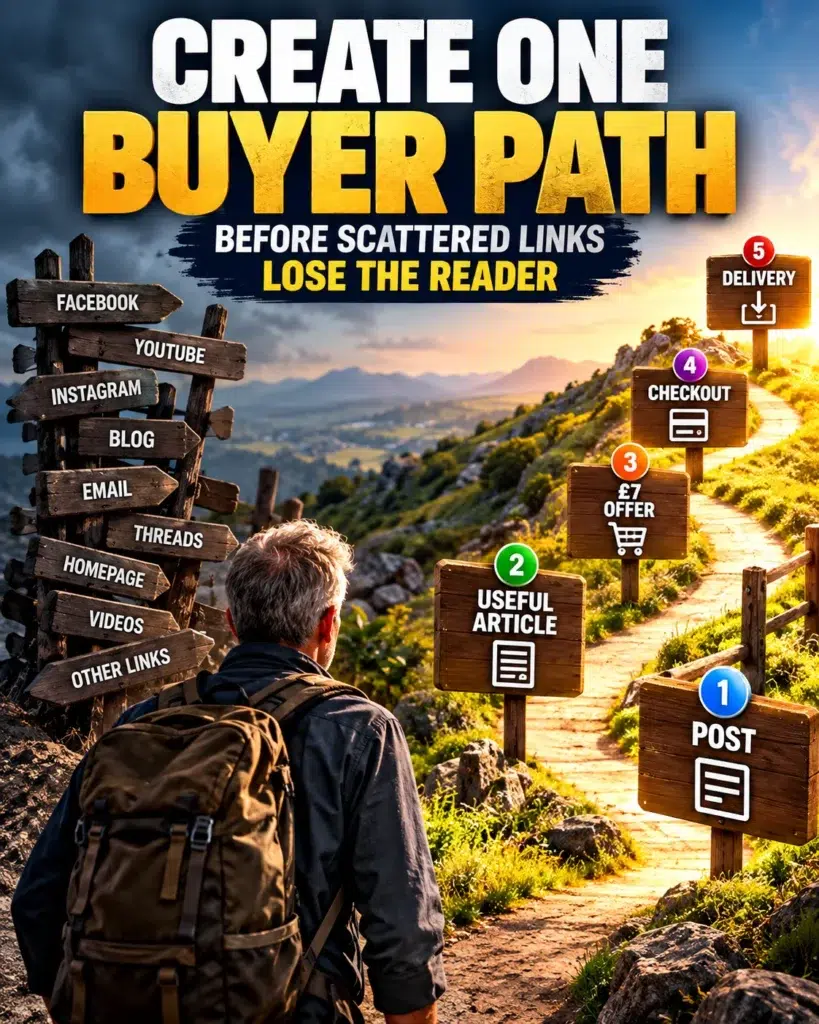


No comments:
Post a Comment