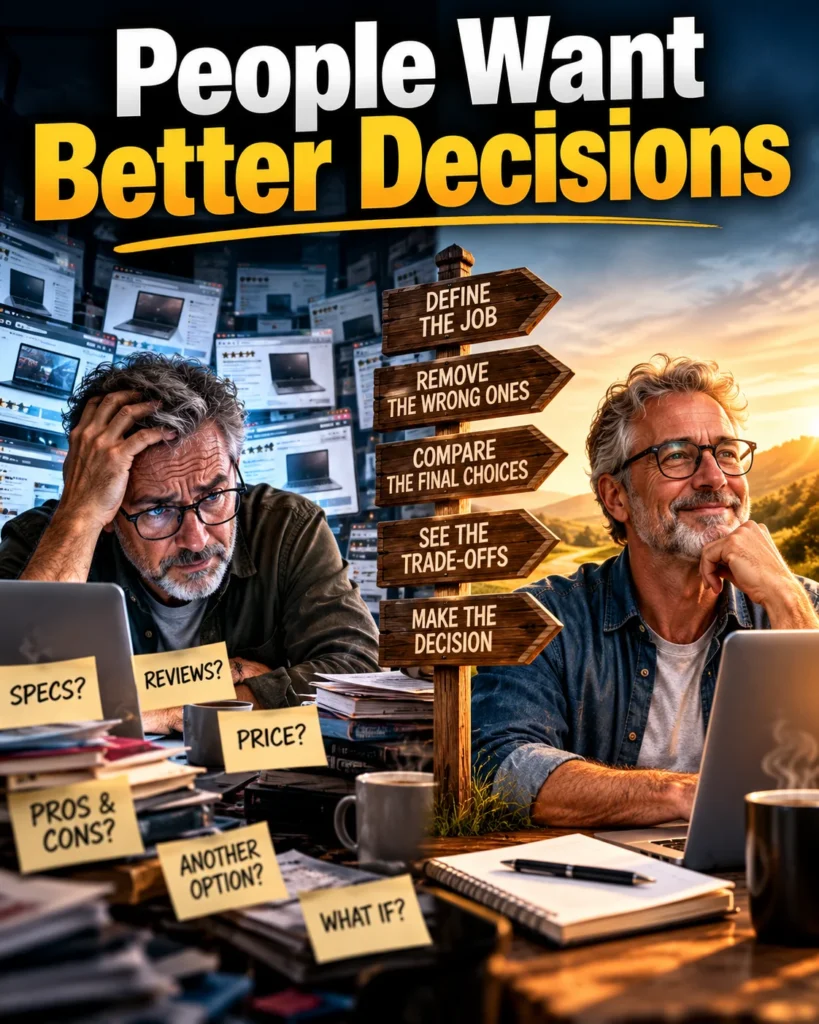
People Want Better Decisions, Not More Information. Why?
More facts can increase confusion when the real problem is unresolved uncertainty.
People Want Better Decisions When Too Many Choices Create Doubt
Narrowing the field makes it easier to compare what actually matters.
People Want Better Decisions When The Tradeoffs Become Clear
A useful choice becomes easier when the gains, drawbacks and next step are visible.
Why People Want Better Decisions Instead Of More Information
More information can help, but real relief often comes when someone finally feels confident enough to stop searching and choose.
People Want Better Decisions When Too Many Choices Create Doubt
The internet can answer almost any buying question, yet too many answers can leave the buyer less certain than when they started.
People Want Better Decisions Because Information Alone Does Not Finish the Job. A useful digital assistant should help narrow the field, highlight the key trade-offs, and guide the person toward a decision they can understand and act on.
A familiar scene plays out in homes every evening. Somebody sits down after tea intending to spend ten minutes choosing a new laptop, booking a weekend away, comparing broadband or finding a decent local tradesman. An hour later, the tea has gone cold, twelve browser tabs are open, three YouTube reviewers disagree, and the person who started with a simple question now knows far more than they ever wanted to. They have processor numbers, star ratings, contract lengths, prices, special offers and opinions coming out of their ears. What they still lack is a decision. That’s where the modern internet reveals one of its strangest weaknesses. It is exceptionally good at providing information. It isn’t automatically good at helping a person know when they have enough.
That matters because People Want Better Decisions, not an endless supply of additional facts. A search engine can return another hundred pages. A retailer can offer another twenty alternatives. A review site can display another comparison chart. None of those things guarantees that the buyer feels any closer to choosing. In fact, the opposite can happen. A new option can bring another regret. Every extra feature raises another question. Every recommendation makes the buyer wonder whether the recommender noticed something the previous reviewer missed. The search keeps moving because the buyer assumes the unfinished feeling means they have not researched enough. Yet very often the research is already sufficient. What remains unfinished is the uncertainty. Once you see that distinction, the job changes completely.
A man looking for a laptop for ordinary home use does not need to become a part-time computer engineer. Suppose he wants email, online banking, Facebook, Zoom, photographs and some writing. His budget is around £700, and he prefers a larger screen because it is easier on his eyes. Those are useful facts. Yet after half an hour online, he may compare graphics processors, refresh rates, storage technologies and specifications designed for games he will never play. The industry has given him more information, but much of it is about jobs he doesn’t need the machine to do. The real breakthrough comes when somebody asks a much simpler question: What does this laptop actually need to do for you? That one question can remove half the market before another review is opened.
This is where a useful AI assistant earns its keep, not by producing a longer list, but by narrowing it. When the buyer expects the computer to sit mostly on a desk, extreme portability matters less. When gaming is irrelevant, move the expensive graphics power down the list. If photographs matter, storage matters more. If a larger display reduces eye strain and makes everyday use easier, screen size becomes more valuable than shaving a few hundred grams off the weight. Notice what has happened. No magical new information appeared. The assistant connected the facts that mattered to the human being making the decision. That is the difference between information retrieval and decision support.
Riley’s Wisdom Drop #14: More Information Is Not Always More Progress When the buyer already understands the main options, another page of facts may add noise instead of confidence. Progress begins when the information is connected to the job the person actually needs done.
The easiest way to spot the problem is to watch the questions change. At the beginning of a search, somebody asks useful factual questions. What is the price? How large is the screen? How long is the contract? Does the hotel have parking?
The Decision-Finished Test
This is where the process earns its finish line. Before searching again, run the decision through four checks.
First: Do I understand the main options? If not, more research may be justified.
Second: Do I know what matters most to me? If not, the problem is not lack of product information. The priorities need clarifying.
Third: Can I explain the main trade-off between the final choices? If not, compare the survivors more carefully.
Fourth: Is there any missing fact that could realistically change my choice? If not, the research phase is probably over.
That final question is the brake pedal. It stops curiosity disguising itself as necessity. There is always another article to read, another review to watch, another product to discover or another opinion to collect. The internet has no natural finishing point. The buyer has to create one.
Imagine a retiree choosing between three laptops after narrowing the market. It costs £579 for Laptop A and offers the largest screen plus adequate performance. Laptop B costs £649, has more storage and slightly better battery life. Laptop C costs £749 and is considerably more powerful. The buyer mainly works at home, prefers a larger screen, stores photographs but also uses cloud backup, and does not play games. At this stage, another review of processor benchmarks probably will not change the decision. The real choice is between saving money, paying more for storage and battery life, or buying performance that may never be used. Once framed that way, the decision becomes understandable.
A useful AI assistant might say: “I would choose Laptop A. It performs the work you described, gives you the larger screen you value, and avoids paying for power you are unlikely to use. Laptop B is worth considering if local photo storage matters more than the extra £70. Laptop C appears unnecessary for the job you described.” That is a much stronger answer than a generic ranking because it connects the recommendation directly to the buyer’s priorities. If the buyer suddenly says, “Actually, I am starting video editing next month,” the recommendation can change. That new fact genuinely changes the job. Good decision support remains flexible when the circumstances change.
This is exactly where AI should be useful without pretending to be infallible. The assistant can organise information, expose trade-offs, narrow the field and explain its reasoning. The human still decides whether the priorities are correct and whether the recommendation feels right. That division of labour matters. People Want Better Decisions, but they do not need to hand over responsibility for their choices. AI’s useful role is to reduce unnecessary complexity and make the reasoning easier to inspect. Humans still know what matters in their own lives.
There is another advantage. Once the buyer can explain why they chose something, the decision becomes less fragile. Without clear reasoning, a new advert tomorrow can reopen the whole process. A competitor drops the price. A reviewer praises another model. A friend says they bought something different. Suddenly the buyer starts doubting again. But if the decision was built around clear priorities and visible trade-offs, the new information has to pass a higher test. Will it change the job? Does it change one of the important criteria? Does it expose a serious drawback we missed? If not, you can keep the decision closed.
Riley’s Wisdom Drop #17: A Finished Decision Has Reasons If you can explain why the choice fits your job, another shiny option has to bring genuinely new evidence before it deserves to reopen the case.
This principle reaches far beyond buying products. It works when choosing a traffic source, deciding which AI tool should join a digital crew, selecting a blog topic, planning a holiday, comparing a local service or deciding whether an online offer is worth pursuing. The pattern is the same. Define the job. Remove what clearly does not fit. Compare the survivors against personal criteria. Make the trade-offs visible. Check for one decision-changing missing fact. Then choose. The subject changes. The thinking process survives.
That is why today’s four-word phrase has more weight than it first appears. People Want Better Decisions because information has become cheap and abundant. The scarce part is judgment. People can open another tab. Anyone can ask for another list. Anyone can collect more specifications, recommendations or opinions. The useful person, tool or Digital PA is the one that helps turn those facts into a clear next move.
Today’s Apprentice Task: Build One Front Door
Open to See This Video, And This Is What’s Already Built, Trained & Waiting For Your First Command.
Today’s Apprentice Task: Finish One Real Decision
Choose one decision you are currently delaying. It could be something you want to buy, a piece of software you are considering, a service you need, a holiday choice, a traffic platform, or even a small business decision.
Do not begin by searching again.
Write down the job the choice needs to perform. Remove anything that clearly fails that job. Reduce the remaining options to the strongest three.
Choose up to five things that genuinely matter to you.
Look at the main trade-off between the finalists. Then ask one final question: What information am I still missing that could realistically change my decision? If you can name something important, find that fact.
If you cannot, stop searching. Make the decision. Because the internet will always offer you another option. A better decision begins when you know you no longer need one.
People Want Better Decisions Make Choices With Confidence
 That matters because People Want Better Decisions, not an endless supply of additional facts. A search engine can return another hundred pages. A retailer can offer another twenty alternatives. A review site can display another comparison chart. None of those things guarantees that the buyer feels any closer to choosing. In fact, the opposite can happen. A new option can bring another regret. Every extra feature raises another question. Every recommendation makes the buyer wonder whether the recommender noticed something the previous reviewer missed. The search keeps moving because the buyer assumes the unfinished feeling means they have not researched enough. Yet very often the research is already sufficient. What remains unfinished is the uncertainty. Once you see that distinction, the job changes completely.