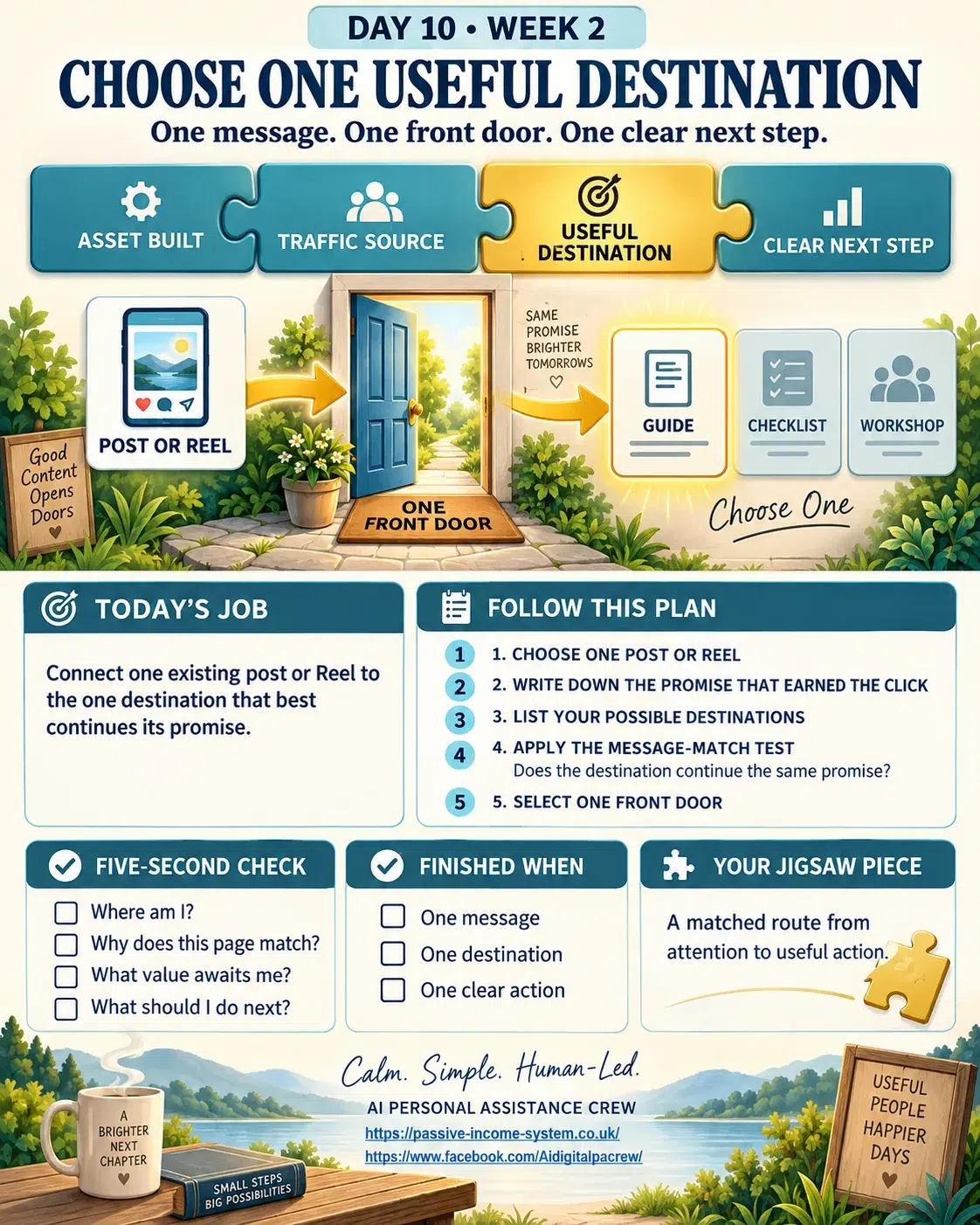
Thursday, September 24, 2026

Build Your Sales Page Before Buyer Confusion Costs The Sale

Build Your Sales Page Around Decisions, Not Decorations

A sales page is not a digital brochure. It is a guided decision.

Build Your Sales Page By Answering The Buyer’s Next Question

Every section should remove one doubt and earn the next scroll.

Build Your Sales Page So The Button Feels Like The Natural Next Step

The page should earn the click before the button asks for it.
Picture the scene. You finished the £7 product and the guide sits ready. The cover looks respectable, the prompts work, and the checklist does what it should do. You spent days tightening the promise, making sure the offer does not claim to rebuild someone’s entire financial future before lunchtime. Now you face the part that often trips up first‑time digital sellers: building the sales page. Do not rush to a page template with a headline here, a picture there, and a green button. Resist the urge to add a testimonial box before you have a real one, and avoid listing features to look good. The result is a page that looks busy and polished but still begs the central question: why should the right person keep reading? Keep the focus tight and answer that question clearly to guide readers toward taking action.
The page should guide buyers, not just list information. Often, content is stacked in the creator’s preferred order rather than in the order that best serves the buyer’s needs. The reader wants to know what matters and why, in the sequence that helps them decide. The aim is guidance, not persuasion through layout. That is the difference between a brochure and a guided decision. A brochure says, “Here is everything we have.” A sales page should quietly say, “You have a question. Let me answer it.” And if another question comes, answer that too.

Build Your Sales Page One Buyer Question At A Time

Build Your Sales Page Before Buyer Confusion Costs The SaleSuppose an Apprentice creates a simple £7 guide for retirees. It helps turn one useful life experience into a first digital product. The temptation is to open with a long list. Fourteen pages, five worksheets, three AI prompts, and a bonus checklist. All of it can be true, but the buyer hasn’t decided its value. Before anyone cares what is inside, they must see why it belongs here. A stronger opening serves one clear purpose. It shows how experience becomes value for others. This guide helps retirees turn it into a simple idea. Then the reader can decide if it is right for them. Aye, this might actually be for me.
That first answer naturally creates the second question: “All right, but what will I have when I finish?” Good. Now the next section has a job. Explain the useful result. The reader may finish with one clear product idea, one person it could help, and a simple outline showing what should go inside. Once that is understood, another question usually appears: “Can I really do this if I am not good with technology?” Excellent. That gives the third section its job. Explain that the process begins with what they already know, not complicated software. Show the simple steps. Give them a small example. Address the doubt while it is still fresh, rather than hoping they reach a giant FAQ cemetery at the bottom of the page.
This is how we build your sales page as a decision chain rather than a collection of copy blocks. The page follows a natural route: Is this for me? What result will I get? Can I do it? What exactly do I receive? What might stop me? After payment, what happens? Am I ready to act? That sequence gives every paragraph, image, example, and button a reason to exist. It also gives the Gaffer something far more useful than a page template. He has an inspection drawing. When a section cannot answer one of those questions, we can ask why it is taking up space. If answering one question creates three new doubts, the hand-off needs repair. If two sections do the same job, one may be unnecessary. Suddenly we are not decorating a sales page. We are installing a route.


▶ Watch Today’s Video

Every Section Must Earn The Next Scroll

This is where one simple rule becomes worth keeping beside the laptop: every section must earn the next scroll. Refrain from shouting. Not by adding fake urgency. Not by promising the moon because the page feels a bit flat. It earns the next scroll by resolving enough uncertainty that the reader wants the next answer. If they reach the end of the opening and still don’t know whether the offer suits them, we haven’t earned section two. Even if they understand who it is for but cannot picture the useful result, we have not earned the product-details section. If they reach the price before knowing what happens after purchase, the checkout button is being asked to do work the page has not yet completed.
Think of it like one of those old jobs where every trade depended on the previous one leaving the work ready. The plumber cannot sensibly finish the connection if the pipe has been left six inches short. The decorator cannot rescue a wall that was never properly prepared. Digital selling is no different. Each section hands something to the next. Recognition hands to result. Result hands to belief. Belief hands to content. Content hands to value. Value hands to action. When that chain is clean, the page feels easy. When the hand-offs are poor, even attractive copy starts to feel like hard work.
That gives us Apprentice’s first inspection test today. Open the rough sales page, or even a blank piece of paper if the page does not exist yet, and stop asking, “What section should come next?” Instead ask: “What is the buyer likely to need answered next?” Write that question down. Then write one section that answers it properly. When you have finished, ask what uncertainty remains. That becomes the next section. Keep going until the buyer reaches the point where taking action no longer feels like being suddenly asked for money, but like the sensible next step in a conversation that has already answered the important questions.

Answer Buyer Doubts Before You Start Decorating

When you build your sales page around the doubts a real buyer may have, each section gets a clearer job and the whole route becomes easier to follow. Another trap appears once the decision chain is clear. The page builder tempts with visuals: colours, fonts, buttons, boxes, borders. A smiling photo of someone earning money while the keyboard stays idle may appear. Don’t decorate until you address the buyer’s core doubts about the offer. For the £7 retiree guide, identify the natural uncertainties that would stop a buyer from proceeding. Questions like: Is this for someone my age? Do I need technical skills? What exactly will I make? Seven pounds—what value does it offer? What happens after payment? These are not annoyances; they point to the next steps.
Once those doubts are visible, the page becomes much easier to build because each one needs a home. When readers worry about technology, address it before discussing the price. If they wonder what the finished result looks like, show a simple example. Address concerns that readers worry they are buying into a sprawling online business
program by showing that this small product does one job and doesn’t pretend to do the whole lot. If they are wondering what happens after checkout, tell them plainly. There is no prize for making the buyer guess. In fact, one of the most useful habits an Apprentice can learn is to address doubts as they arise. Do not save everything for the bottom of the page and hope the reader survives long enough to reach it.

Let The Button Arrive After The Decision

Build your sales page so the buyer reaches the button after the important questions have already been answered. This is where the famous Buy Now button starts behaving differently. Beginners often treat the button as though it has magical powers. They make it larger. Then greener. Then orange because somebody said orange converts better. They add a button halfway down, near the price, and one at the top for readers who haven’t understood yet. But a button cannot repair missing decisions. If the reader doesn’t know whether the product is for them, doesn’t understand the result, cannot see what they receive, and doesn’t know what happens after payment, the button is merely a brightly coloured interruption.
A much better rule is this: the page should earn the click before the button asks for it. By the time the reader reaches the main call to action, most of the important thinking should already have happened. They should be able to say, “This is for someone like me. I understand what it helps me do. Readers can see what they receive. I know what it costs. You understand what happens next. At that point, the button is no longer shouting “BUY SOMETHING!” It is simply giving the reader a place to act on a decision they have already reached.
That also changes how we write the words on and around the button. We do not need fake urgency, countdown clocks, or breathless warnings that the internet may close in seven minutes. For a small first offer, calm clarity can do far more useful work. “Get The £7 Guide” tells the reader what happens. “Start With Your First Product Idea” can connect the action back to the promise. A short line underneath might confirm that they receive immediate access after payment, if that is genuinely how delivery works. The point is not to make the button clever. The point is to remove the final uncertainty between understanding and action.

Build Your Sales Page As Version One Of A Working Installation

The aim when you build your sales page is not to force the sale, but to give the right buyer enough clarity to make their own decision. This matters because our job isn’t to push everybody through checkout. Some people should decide the offer is not for them. That is not failure. A clear sales page helps the right reader understand the offer and helps the wrong reader move on without confusion. Both outcomes are better than creating a page so vague that nobody quite knows what they are being asked to buy.
That’s the real difference between persuasion and guidance. Persuasion often gets interpreted as finding stronger words. Guidance asks better questions. What should this person understand next? What uncertainty can I remove? Which evidence should I present? Which information belongs here instead of three sections later? When you work that way, the page begins to feel less like selling and more like good workmanship.
Today’s Apprentice Task: build the first working version of your sales page. Do not spend the day polishing colours. Put the buyer decisions in order first. Give every section one job. Answer the real doubts. State what the buyer receives, what it costs, and what happens after payment. Then add one clear call to action at the natural end of the decision.
APPRENTICE CTA: BUILD THE WORKING PAGE TODAY
Promise → Recognition → Result → Belief → Contents → Doubts → Price → Action
If every section helps the buyer make the next decision, Version One is doing its job.
Do not wait for perfect. Save the page, inspect every hand-off, and get the working installation ready for the next job.

Build Your Sales Page With A Buyer Walk-Through Before You Publish

One final job is worth doing before you call the page finished, and it is probably the cheapest inspection you will ever do. Stop looking at the page like the person who built it. Look at it like the person who has just arrived. That sounds obvious, but it is surprisingly difficult because you already know where everything is. You know what the product does. You know why the price is £7. Customers learn what happens after payment. That button halfway down the page leads to the checkout, as you know. The buyer knows none of that. So before you build your sales page into something bigger, perform a buyer walk-through from top to bottom and pretend that every section has to introduce itself properly.
Start at the headline and ask what the reader knows after ten seconds. Do they know who this is for? Should readers understand the small, useful result? Do they know whether they should keep reading? Then scroll down one section at a time. At each point, ask a simple question: “What does the buyer know now that they did not know ten seconds ago?” If the answer is nothing, that section may only be taking up room. If the answer is something useful but it belongs much earlier, move it. If the section raises a question that isn’t answered until half a page later, bring the answer closer. This is not glamorous work, but neither is checking a joint before turning the water back on. The customer rarely sees the inspection. They experience a job that works.

Open to See This Video, And This Is What’s Already Built,
Trained & Waiting For Your First Command.

Today’s Apprentice Task: Build One Front Door

Make The Next Step Obvious

One of the easiest ways to lose clarity is to assume the buyer knows what to do next. We do this because we have been staring at the page for hours. The button looks obvious to us. The delivery process feels obvious. The price sits exactly where we put it, so naturally we know where to find it. But a stranger may still wonder whether clicking commits them to something else, whether the guide arrives by email, whether they need special software, or whether they will suddenly find themselves in a monthly subscription they never asked for. If none of those things apply, say so plainly where it helps the decision. Good selling does not create mystery around ordinary facts.
For our £7 Apprentice offer, the hand-over could be remarkably simple. The reader reaches the buying section and sees what the product helps them do, what they receive, the price, and what happens immediately after purchase. No treasure hunt. No hunt for the small print. There is no need to interpret a button labeled with some clever phrase that sounded wonderful at midnight. The buyer should be able to think: “I understand this. I know what happens next. I can decide.” That is a much healthier finish than trying to force somebody across the line with another burst of persuasion.
This buyer walk-through also gives you a useful way to separate a sales problem from a product problem. If the page promises one thing but the product delivers another, that is a product-or-promise issue. If the product is sound but the reader cannot understand what it does, that is a page issue. Provided everything remains clear up to the payment step, the checkout may reveal a weak connection. Finding the problem matters because beginners often react to any poor response by rebuilding everything. New headline. Fresh product. A new image appears. Price updated. Updated page. New panic. A Gaffer does not work like that. He finds the fault before ordering another boiler.
Build Your Sales Page Before Buyer Confusion Costs The Sale
So before you finish today’s job, walk the route one last time as a stranger. Read the promise. Follow the sections. Find the price. Locate the action. Imagine making the payment. Ask what happens next. If at any point you have to rely on knowledge that only the creator possesses, put that missing piece onto the page. The final inspection rule is simple: the buyer should never have to guess what you already know.
Once that test is passed, stop decorating. Version One has earned the right to leave the workshop.
#BuildYourSalesPage, #GuideYourBuyerDecision, #AnswerRealBuyerQuestions, #RemoveBuyerDoubtsEarly, #CreateOneClearRoute, #ExplainYourOfferClearly, #EarnTheNextScroll, #BuildBuyerConfidenceNaturally, #GuideReadersTowardAction, #ClarifyYourBuyingProcess, #ImproveYourSalesPage, #CreateClearBuyerHandOffs,

Build Your Sales Page Before Buyer Confusion Costs The Sale: A sales page is not a digital brochure. It is a guided decision.

Tuesday, September 22, 2026

Make Your Promise Clear Before Confusion Costs Your First Sale

Make Your Promise Clear Before You Add Another Word

If somebody needs a paragraph before they understand what you are selling, the problem may not be the product.

Your Buyer Should Not Have To Finish Make Your Promise Clear

A clear promise tells the right person what useful job the offer will do for them.

Start With One Person, One Useful Make Your Promise Clear Outcome

That simple test can rescue an offer before another page, bonus, or button gets added.
Picture the scene. You sit at the kitchen table with a cup of tea cooling beside the laptop, and, for once, you feel pleased with yourself. You have actually made something. Not just thought about making it, not bought another course, and not left seventeen tabs open while vowing to return tomorrow. You have finished a small digital product: twelve pages, five checklists, three AI prompts, a few examples, perhaps even a cover you are proud of. Then somebody passes by, glances at the screen, and asks the simplest question imaginable: What does it do? You begin to explain the contents, the background, why you made it, where the idea came from, what the prompts are for, and how useful the checklist might be once they understand the rest. Five minutes later they nod politely, and you realize you still haven’t answered the question.
Now is the moment to clearly spell out your promise. The product is not faulty, and the creator is not inexperienced. On the contrary, the creator often knows more than is needed. Years of practical knowledge back up the product, so every feature feels important. The twelve pages carry meaning because you wrote them. The five checklists saved an afternoon, and the prompts save work. A first‑time viewer has none of that history, so they are not yet admiring the workmanship. Their question is whether this helps someone like them do something difficult. If they cannot find the answer quickly, they must finish part of the missing thinking themselves.

The Ingredients Are Not The Promise – Make Your Promise Clear

Make Your Promise Clear Before Confusion Costs Your First SaleThat is where small digital offers become muddled. We start describing what went into them rather than what should come out the other side. “Twelve pages, five checklists and three prompts” might be perfectly useful information later. It tells the buyer what they receive. It makes the product tangible. This reassurance shows buyers that they are not paying seven pounds for two vague paragraphs and a cheery goodbye. But ingredients answer a different question. They answer, “What is in the box?” The promise answers the question, “What job will the box help me do?” Confusing those two questions leaves the buyer holding a list of components and wondering why any of them belong in their life.
A retiree has spent forty years solving problems that others still find tough. She knows how to organize household paperwork so nothing important is misplaced. For a long career, he maintained equipment and learned simple checks that prevent expensive mistakes. Many people have spent years baking, gardening, bookkeeping, teaching, repairing, caring, selling, or organizing. What seems ordinary to them could save a beginner many frustrating weekends. They decide to turn that experience into a £7 guide. Their first instinct is to list every effort that went into it: the pages, worksheets, templates, prompts, and bonuses. Yet a clearer promise emerges: turn one useful thing you know into your first simple digital product. The guide keeps its materials intact; the checklists and prompts remain, but they now have a real reason to exist.
This is one of the most useful distinctions an Apprentice can learn because it does more than improve a headline. It improves the product itself. Once you make your promise clear, you can look at every page and ask whether it helps deliver the promised result. If it does, keep it. If it does not, you have found either a distraction or material for another job. Suddenly the promise stops being advertising decoration and becomes the Gaffer’s job sheet. It tells Derek what needs building, Peter what needs explaining, and Freddy what needs to be put in front of the right people. Most importantly, it tells the person at the top of the job whether the work is actually finished.


▶ Watch Today’s Video

Make Your Promise Clear With The Stranger Test

There is a wonderfully cheap inspection method for this that requires no additional software. Imagine someone has arrived who doesn’t know you, has never read your previous posts, and has no idea what you meant when you used your favourite bit of shorthand. Give them the main promise and ask whether they can work out three things without a guided tour: Who is this for? What will it help them do? Why should that result matter? That is the Stranger Test. A phrase such as “Unlock your digital potential with an AI-powered transformation system” may sound impressive after three hours staring at a sales page, but a stranger can still reasonably ask all three questions after reading it. The words are polished. The job remains hidden.
Now compare that with: “Help retirees turn one useful piece of lifetime experience into a simple £7 digital offer.” The second promise does not try to carry the reader to the far end of their financial future before breakfast. It identifies the person, names the immediate job and gives the result a shape. That smaller promise is not necessarily worth less. It is simply easier to understand, easier to judge and, crucially, easier for the product to keep. And that brings us to the next piece of today’s job, because one of the quickest ways to weaken an otherwise useful first offer is to promise the whole journey when you’re really only selling the next useful step.

Do Not Promise The Whole Future When You Are Selling The Next Step

Open the small offer you have been building through this apprenticeship and find the sentence you currently use to explain it. Do not polish it yet. Read it exactly as a stranger would. Then ask three questions: Who is this for? What useful result does it help them get? Why should that result matter to them? If any answer is missing, vague, or buried inside a list of features, rewrite the promise until those three things become obvious. Then read the new sentence against the actual product and make sure the product can honestly do what the sentence says.
Next, walk the promise through the route. Look at the social post or image that will introduce it. Examine the sales page. Look at the checkout wording. Look at the first page or screen the buyer receives after payment. You are not looking for identical wording. You are looking for the same job. When the job changes halfway through, restore alignment. If the promise exceeds the product, shrink the promise. If the product includes a useful feature that doesn’t contribute to the promised result, move it to the “later” pile rather than forcing it into today’s installation.
By the end of today’s job, you should have something much more useful than a clever headline. You should have one sentence that tells the right person what this offer helps them do and gives the Crew a standard for inspecting the entire job. That sentence can sit at the top of the product page, become the center of tomorrow’s sales page, guide the image, shape the social post, and keep every stage of the buyer’s journey pointing in the same direction.
That’s the real reason to clarify your promise. You are not simply improving the wording. You are deciding what job the product has been hired to do.
Today’s Job Test: Can a stranger understand who the offer is for, what useful result it helps them achieve, and why that result matters without needing you beside them to explain it?
If the answer is yes, stop adding words.

Clarity Also Tells The Buyer What Happens Next

One more reason to make your promise clear is that its impact grows when a reader shifts from casual to a follower. A clear promise does more than describe a result; it gives readers confidence to take the next small step. Too many offers keep readers in the doorway, unsure what happens after they click. They are promised transformation, freedom, automation, opportunity, or a brighter financial future, yet no one explains what they will do on Tuesday morning. A smaller, clearer promise earns its keep by outlining today’s specific task and the expected result.
That is how this apprenticeship is being built. We are not asking anyone to believe that seven days of reading will magically generate income. We are giving them a sequence of jobs in which each finished piece becomes the starting material for the next. Yesterday’s useful outcome becomes today’s promise. Today’s promise becomes tomorrow’s sales page. The sales page becomes the destination for the next traffic job. The checkout leads to delivery. Delivery leads to follow-up. None of those individual jobs need to pretend they are the whole business. Its responsibility is to hand the right finished piece to the next stage. That is exactly why the promise matters so much. If today’s hand-off is vague, tomorrow’s work begins with confusion. If today’s hand-off is clear, the Apprentice starts tomorrow with something solid already sitting on the bench.
Another benefit becomes obvious once you start working this way. Clear promises make it easier to tell when you’re finished. Many beginners keep improving products because they have never defined the job well enough to know when it’s complete. They add another chapter, another graphic, another prompt, another bonus, and another afternoon of work because “better” has no finishing line. A clear promise creates one. If the product promises to help somebody choose one useful idea and turn it into a first product outline, then inspect that result. Can they do it? Is anything essential missing? Is anything getting in the way? If the job is done, Version One can leave the workshop. You can improve it after real people have had the chance to use it.

Your Next Step Is To Write The Sentence Before You Build The Page

Open to See This Video, And This Is What’s Already Built,
Trained & Waiting For Your First Command.

Today’s Apprentice Task: Build One Front Door

So before you disappear into colours, buttons, page builders and sales-page templates, write the sentence that tomorrow’s page must carry. Keep it beside you while you work. One person. One useful outcome. One reason to care. Do not let the page promise more simply because there is space to fill. Don’t hide the useful result under a mountain of features. And do not assume the reader can see what you can see after living with the idea for a week. Write your promise now. Read it aloud as if you had never seen the product before. If you immediately understand who it is for, what it helps them do, and why that small result matters, today’s job is complete. And if you are following this apprenticeship with us, keep that sentence somewhere safe. You’ll need it for the next job, because tomorrow we cease discussing the offer and start putting it somewhere a real buyer can understand.
Make Your Promise Clear Before Confusion Costs Your First Sale
APPRENTICE CTA: DO THE JOB TODAY
Write your one clear promise. Test it against the product. Keep only what helps deliver that promise. Then carry the finished sentence into tomorrow’s job.
Next Job: Build Your Sales Page.
The promise is ready for tomorrow’s job: Build Your Sales Page.
#MakeYourPromiseClear, #CreateOneClearPromise, #NameOneUsefulOutcome, #ChooseOneClearResult, #ExplainYourOfferSimply, #MatchPromiseToProduct, #ReduceBuyerConfusionFast, #ClarifyYourProductPromise, #BuildBuyerConfidenceNaturally, #KeepYourMessageConsistent, #TestYourOfferClarity, #GuideBuyersTowardAction,

Make Your Promise Clear Before Confusion Costs Your First Sale: Make Your Promise Clear Before You Add Another Word If somebody needs a paragraph before they understand what you are selling, the problem may not be the product. Your Buyer Should Not Have To Finish Make Your Promise Clear

Friday, September 18, 2026

Build Your Selling Roadmap For A Smarter First Sale

Build Your Selling Roadmap Before You Build Another Product

A useful product is only one room in the house. Make sure the buyer has a clear route to it.

Map The Buyer Journey Before You Add More Digital Assets

Every post, page, and button should move the reader towards a single, clear next step.

Build The Route Before You Decorate The Workshop

Movement matters more than adding another bonus, graphic, or clever tool.

From Apprentice To Tradesperson Starts With One Visible Route

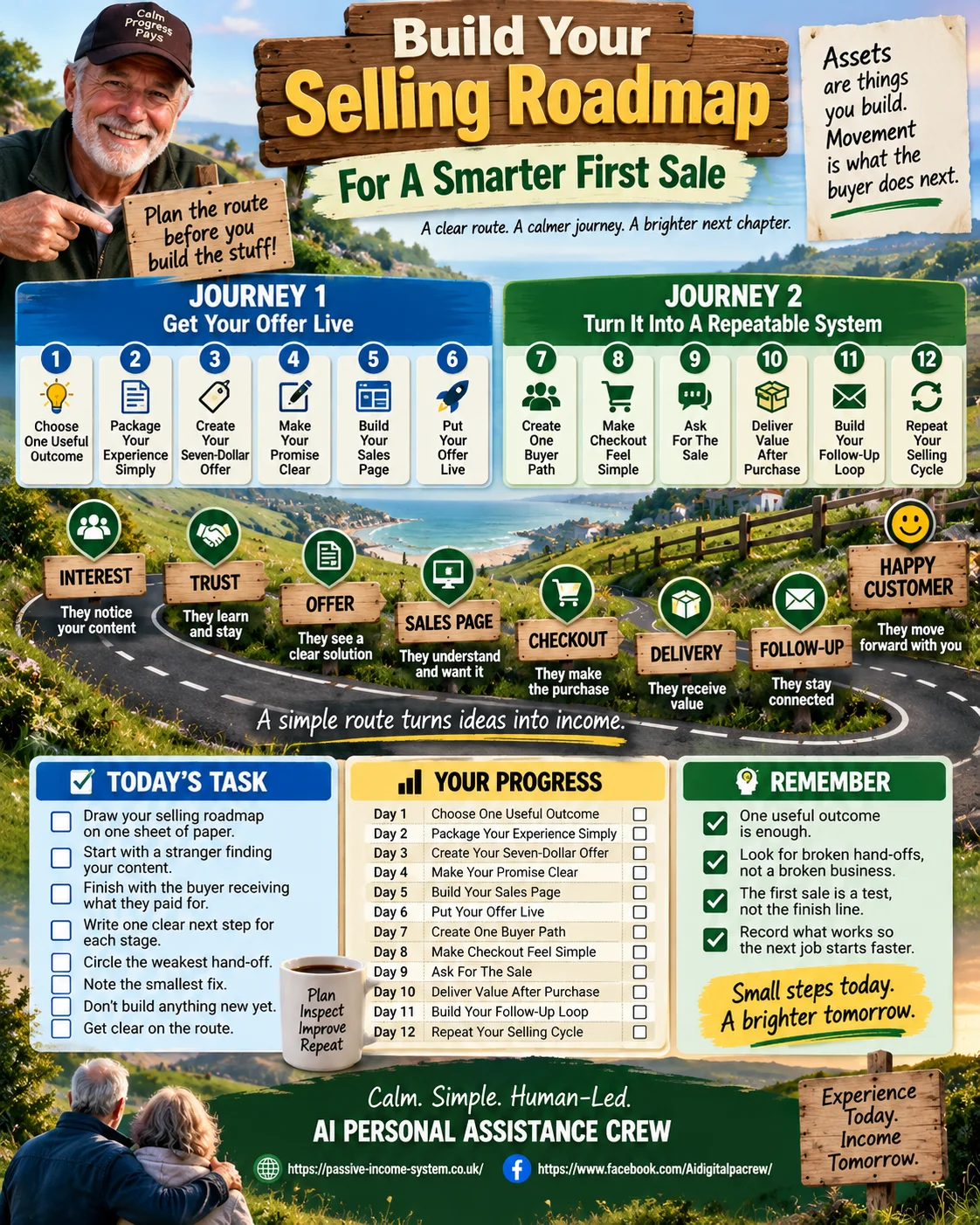
The next twelve working days are not twelve unrelated lessons. They are two connected journeys designed to leave the reader with a real selling system they can inspect, improve, and use again.
There is a distinctly British moment when you discover a project has failed. After days of effort, tea, and sharper language, you notice the door is missing. Digital business repeats this pattern: we build the ebook, design the cover, and create three graphics. You open a Facebook page, write seven emails, and buy another clever AI tool; YouTube says it will change everything. By Friday, the workshop is full of finished parts. Yet a stranger asks how to move from interest to purchase. That is why today’s job is to build your selling roadmap. Before we build another bloody thing. The goal is clarity and momentum, not noise.
One lesson took time to recognise online because I understood it elsewhere. As a heating engineer, you did not install the upstairs radiator first because it looked impressive. You traced the route: boiler, pipework, controls, radiators. Each part had a purpose and passed value to the next.

Build Your Selling Roadmap Around One Paid Destination

Beginners are urged to keep expectations modest at the start. The material stresses a gradual path rather than pursuing grand dreams. The material notes a product ladder, upsells, memberships, webinars, email automation, and affiliate offers, but none of them guarantee success if an ordinary person cannot move from interest to a small paid decision. A staged approach is therefore advised, with a focus on early traction.
The six‑day plan begins with narrowing, not widening. Choose One Useful Outcome, because a product is easier to explain with a single clear job. Then package Your Experience, shaping what the Gaffer knows into a form others can use. After that, create Your Seven-Dollar Offer, turning a free idea into a real paid proposition.

The Second Journey Begins Where Most First-Sale Advice Stops

Build Your Selling Roadmap For A Smarter First SaleOur roadmap becomes more interesting than the common advice to create a product and launch it. Getting an offer live ends the “nothing” phase; it lets us inspect something real. A boiler fitter would not stay popular if the flame lasted only three seconds. We test the system by asking questions such as: Does hot water reach the tap? Does the downstairs warm up?
Is there an airlock somewhere? Has someone fitted a valve backward while insisting it looked right at the time?
The last two roles reveal the beginnings of residual-income thinking. We will build your follow-up loop so a buyer who found something useful does not vanish because no one planned what happens next. On the final day of the month, we repeat your selling cycle.
The goal is to create continuity, not a one-time sale, and to document what works for future steps. When you build a selling roadmap, you document a method that can carry the next product, and the one after that, without starting from scratch each Monday.
A trade is not a hobby with expensive stationery; it is a process. A tradesperson keeps the drawing, knows which tools worked, where delays occurred, and which parts can be reused or changed for the next customer.


▶ Watch Today’s Video

Build Your Selling Roadmap From Movement, Not More Stuff

That distinction should guide us through September. Assets are what we build to support outcomes. Movement describes what the buyer does next after engagement. An insightful article that leaves readers stuck is an asset lacking movement. A compelling sales page that nobody visits is an asset without movement. A useful product buried three menus deep remains an asset without movement. Over the next twelve days, we must reconnect the steps. We seek a practical outcome to offer. Move from offer to sales page, then to checkout. From checkout, deliver the product and follow up. Each phase should give a willing reader a clear next step. A business thrives when customers see the logical path forward, not when momentum ends in silence.

Today’s Apprentice Task: Draw The Route And Circle The Weakest Join

Take the simple roadmap you drew in Section 1 and review every handoff between stages. Useful content to trust. Trust to offer. Offer to sales page. Sales page to checkout. Checkout to delivery. Delivery to follow-up. Beside each join, write one sentence describing exactly what the reader should do next. If you cannot write that sentence clearly, circle the join. That is not failure. That is the job revealing itself. Do not build anything new today to hide it. Do not add another tool. Avoid redesigning the entire website because one connection looks untidy. Build Your Selling Roadmap, find the weakest hand-off, and write down the smallest repair that would make the next movement obvious.
Tomorrow, we stop staring at the drawing and begin the first six-day build. One useful outcome. One real piece of experience. One small paid destination. The road is now visible. The apprentice finally knows where the tools are going.

Open to See This Video, And This Is What’s Already Built,
Trained & Waiting For Your First Command.

Today’s Apprentice Task: Build One Front Door

Before You Build Another Product, Build Your Selling Roadmap

A useful product is only one room in the house. Before you choose the curtains, make sure there’s a hallway leading someone to the front door.

Before Filling The Workshop With Assets, Map The Buyer’s Journey

The first sale becomes much easier to understand when every page, post, and button has one clear job in moving the reader forward.
Build Your Selling Roadmap For A Smarter First Sale

#BuildYourSellingRoadmap,#MapYourBuyerJourney,#CreateOnePaidDestination,#BuildOneBuyerPath,#FixBrokenSalesHandOffs,#MakeCheckoutFeelSimple,#CreateClearBuyerMovement,#BuildYourFirstOffer,#TurnInterestIntoAction,#InspectYourSellingRoute,#RepeatYourSellingCycle,#BuildRepeatableSalesSkills,

Build Your Selling Roadmap For A Smarter First Sale: Build Your Selling Roadmap Before You Build Another Product A useful product is only one room in the house. Make sure the buyer has a clear route to it. Map The Buyer Journey Before You Add More Digital Assets

Thursday, September 17, 2026

Choose One Trust Signal Before Suspicion Stops The Sale

Choose One Trust Signal And Replace Claims With Proof

Choose One Trust Signal Before You Ask For The Click

One visible piece of evidence can reduce more doubt than another paragraph asking the reader to trust you.

Let Real Evidence Answer The Reader’s Next Doubt

Show the product, process, or next step instead of piling on vague reassurance.

Put Proof Exactly Where Uncertainty Appears

The best trust signal sits beside the decision it is helping the reader make.

The reader does not need another promise. They need one small reason to believe the next step is safe enough to take. Trust Grows Faster When The Reader Can See Something Real. A genuine example, a visible process, or a clear explanation often does more work than another paragraph about how trustworthy you are. Put The Evidence Where The Doubt Actually Appears.
The strongest trust signal usually answers the reader’s next unanswered question just before they hesitate. On almost every small business website, there’s a moment when the owner loses nerve. He has explained the product, described the benefit, and perhaps survived the effort of placing the button. Now the reader is only inches from acting, like clicking. Yet the page shows a barrage of badges and guarantees. “Buy with confidence.” “We pride ourselves on quality.” “Your satisfaction matters.” “Trusted service.” The reassurance arrives by the shovel load. Online trust works better when readers can reach the reassuring conclusion for themselves.
Today’s four‑word idea, Choose One Trust Signal, earns its keep by focusing on a single credibility point. Instead of trying to decorate the entire page, identify the exact moment the reader may hesitate. Ask a smaller question: What is this reader likely to doubt here? Avoid broad, long-term worries or generic marketing checklists. Pinpoint the next doubt to address clearly.

The Reader Does Not Need To Trust Everything Yet

Choose One Trust Signal Before Suspicion Stops The SaleSmall online sellers often miss a crucial point. We treat trust as one enormous locked door, and readers must hand us the keys to proceed. In practice, most people face a smaller decision and need only enough confidence to take the next sensible step. Imagine a retiree arriving at one of our pages for the first time. They do not know Alan or Riley. They may not have heard of the AI Personal Assistance Crew, Derek, Peter, Freddy, or half the characters wandering around this digital workshop. Asking them to believe we can transform retirement right away would be overly ambitious. Showing them a real worksheet titled Build Your First AI Crew Job lets them examine the questions and decide if it makes sense. We have reduced the leap; trust signals should do the same by inviting measured belief.
Years ago, when I entered a home to assess a heating problem, I did not start by touting my trustworthiness. I looked at the job, explained what I thought was happening, and showed the failed part. I pointed to the pipe and described what we would do next. Modern marketing has made trust harder to earn. We hide the product preview below the checkout button. We insist that the guide be simple, rather than showing a simple page. Then we wonder why a glowing paragraph fails to repair trust. If you choose a trust signal for the next doubt, its place becomes obvious. Put the evidence where uncertainty appears.


▶ Watch Today’s Video

Big Claims Borrow More Belief Than Small Evidence

Overly bold promises can trap the reader. If you claim this system could change their financial future, the reader bears the burden of trusting the system, you, the mechanism, and their own ability to achieve the result. That is a substantial unsecured loan on first contact.
That does not mean we shrink every offer until it sounds as exciting as a council tax reminder. It means we align our trust signal with what we can genuinely demonstrate. A new retiree-led website may not have 400 testimonials, national newspaper logos, or a celebrity on the homepage. No need to manufacture them. We show the work, explain the process, and clearly present the product contents. We can tell readers exactly what happens next and what the offer does not do. Sometimes the calmest page in the market becomes the most believable because it avoids screaming twelve promises at once. Before adding another badge or another paragraph beginning “You can trust us,” apply one simple rule: choose one trust signal that addresses the closest doubt about the next action.

Trust Is Strongest When The Reader Reaches The Conclusion

An important distinction is that claimed trust asks readers to believe. Demonstrated trust offers something you can inspect and verify. The latter reduces pressure on the reader and invites independent judgment. This approach fits the online workshop we are building, where transparency matters more than hype.
So today’s Apprentice Task is pleasantly small. Open one page where you currently ask the reader to click, subscribe, download or buy. Stop immediately before that action and read the page as though you had landed there for the first time. Ask yourself: “What would I still want to know before I did this?” Then resist the urge to answer with six testimonials, three badges, and a paragraph about your commitment to excellence. Choose One Trust Signal. Show one example. Explain one process. Reveal one useful detail. Put it beside the doubt and let the reader reach the reassuring conclusion without being told what to think. That is how a trust path begins to feel less like marketing and more like somebody quietly showing you the work.
Aye Gaffer, **Section 2 in proper Fleet Street mode**, carrying straight on from Section 1 without turning into margarine-on-toast copy. Big newspaper paragraphs, one story moving through the lesson, and **Choose One Trust Signal** worked into the copy naturally rather than rammed into every bloody sentence.
The same principle belongs on an affiliate page. If somebody is about to click through to AI Agents PLR, they may want to know what the product actually contains. That is not the moment for another paragraph about how exciting artificial intelligence has become. Show them the product contents. Fifteen ready-to-use AI business agents. Ebook creation. Courses. Websites. Sales pages. Emails. Services. PLR rights. Let them see enough of the real offer to decide whether the next click is worth making. Then label the button honestly so they know where it will take them. We aren’t trying to complete the vendor’s entire sales job before they leave our site. We are simply trying to make the hand-off understandable. Choose One Trust Signal, position it just before the commitment, and let it answer the question most likely to stop the click.

The Smallest Believable Proof Often Does The Heaviest Work

Something wonderfully unfashionable about small evidence. Marketing loves enormous outcomes because enormous outcomes create enormous headlines. But the reader may trust a modest, visible fact long before they trust a magnificent promise. “This worksheet contains seven questions” is easy to verify. “This system could transform your life” is not. “Here are the fifteen AI agents included” is concrete. “Everything you will ever need to succeed online” carries more baggage. Every time we enlarge the claim, we enlarge the amount of belief we need to borrow from somebody who may have met us thirty seconds ago. Small evidence works differently. It gives the reader a piece of ground they can stand on before taking another step.
That is why our trust path should not be built like a courtroom defense. It should feel more like somebody walking through a workshop and being shown what is actually happening. Here is the job. This is the tool. That is what it produces. Here is what happens next. Here is the person behind it. Nothing magical. Nothing hidden behind seven layers of copywriting mist. The reader does not have to trust the entire future. They only need enough evidence to make the next sensible decision. And once that decision proves worthwhile, the next trust signal does not need to work quite so hard, because experience has begun to replace reassurance.

Open to See This Video, And This Is What’s Already Built,
Trained & Waiting For Your First Command.

Today’s Apprentice Task: Build One Front Door

Today’s Apprentice Task: Choose One Trust Signal

Open a page on your website that asks visitors to take an action. It might be clicking an affiliate link, joining an email list, downloading something or buying a small product. Ignore the rest of the page for a moment and move directly to that decision point. Then ask yourself one question: “If I had never met me before, what would I still be uncertain about right here?” Write down the first sensible answer. Perhaps you would want to see the product. You may want to know what happens after the click. Perhaps you would want one genuine example. Perhaps you would want to know who is behind the page.
Then Choose One Trust Signal that answers that doubt. Do not redesign the website. Avoid adding six testimonials because somebody on YouTube says social proof converts. Do not disappear into another afternoon of buying plugins. Add one piece of visible evidence exactly where the uncertainty appears. Then look at the page again. If the next step now requires less blind belief than it did ten minutes earlier, the trust path has improved. And that is the whole point: not telling a reader they can trust you, but quietly giving them one more reason to reach that conclusion for themselves.
Choose One Trust Signal Before Suspicion Stops The Sale

#ChooseOneTrustSignal, #ShowRealTrustEvidence, #ReduceReaderDoubtNaturally, #BuildTrustWithEvidence, #AnswerTheNextDoubt, #PutProofBeforeCommitment, #UseClearTrustSignals, #MakeNextStepsClearer, #ShowWhatBuyersReceive, #ReplaceClaimsWithEvidence, #BuildCalmBuyerConfidence, #MakeTrustFeelNatural,

Choose One Trust Signal Before Suspicion Stops The Sale: Choose One Trust Signal And Replace Claims With Proof Choose One Trust Signal Before You Ask For The Click. One visible piece of evidence can reduce more doubt than another paragraph asking the reader to trust you.

Tuesday, September 15, 2026

Build Your AI Crew And Stop Drowning In New Tools

Build Your AI Crew Around Real Jobs, Not More Tools

Your experience decides the job. AI handles the repetitive digital graft.

Build Your AI Crew By Starting With The Job

Useful crews know what they receive, what they produce, and where the work goes next.

Keep Human Judgment At The Heart Of Every Job

The Gaffer supplies the experience. The Crew supplies the digital labor.
Once you accept that fifteen capabilities do not require fifteen people, the next temptation is to swing too far the other way. You have three lads, each carrying five trades, so the clever move is to deploy all fifteen skills and extract real value. Yet that path turns a simple job into a three‑day committee meeting. Anyone who has worked around trades recognises the danger. Give a bloke a new tool, and problems start looking like reasons to use it. Digital work follows the same pattern. Buy a course creator, and suddenly every useful thought demands twelve modules. Discover webinars, and a humble Monday checklist gains a 47‑slide presentation by Wednesday. Before long, the workshop generates more work for itself than for the customer. So Billy, our Crew Leader, needs a very unfashionable skill in this AI era: to say, “Leave that bloody thing in the box.”
That is where our Job Before Tool Test earns its keep. Before Derek, Peter, or Freddy uses anything, we ask three ordinary questions.  Which function does this tool fulfill? From the Gaffer, what does it require? Which finished item must it hand back? There is no magic in those questions, which is precisely why I like them. If we cannot explain the job, we do not use the tool. If we cannot explain what we need from the AI, we should not complain when it gives us generic porridge in return. And if we cannot describe the finished handoff, the odds are we are about to create another file destined for the folder marked “Might Be Useful One Day.” The test is less about controlling the AI than controlling ourselves. It stops enthusiasm from becoming clutter and keeps every bit of work attached to a purpose.

A Vegetable Patch Can Explain The Whole System

Build Your AI Crew And Stop Drowning In New ToolsImagine a retired gardener who spent thirty years watching beginners repeat the same mistakes each spring. They buy too many seeds and gadgets, and try to turn half the back garden into Kew before Easter Monday. Our gardener sees a calmer path. Start with one small patch and grow a few things you will actually eat. Learn what the soil is doing. He does not need SEO, slides, or an online course. Instead, Derek could need only two of the five tools.
The gardener supplies the material AI cannot honestly manufacture. The neighbour who planted enough courgettes to feed a small regiment remains in his memory. The gardener knows which expensive gadget has been rusting behind the shed for three years. A nervous beginner often needs permission to start small more than they need another twenty gardening facts. Derek’s job is to capture that knowledge without polishing the personality out of it. His finished handoff is not “some ebook content.” It is something concrete: a complete, beginner-friendly guide, based on the gardener’s experience, organized into practical sections and ready for the next stage. That sentence matters because now Peter knows what is arriving on his bench. Peter is not reopening the case and interviewing the gardener from scratch. The job information travels with the work.


▶ Watch Today’s Video

Build Your AI Crew Around Clean Hand-Offs

This may be the most overlooked difference between using several AI tools and operating an AI crew. A collection of tools keeps asking you to start again. Tell me your audience. Tell me your tone. What is your product? What result do you want? Describe your customer. By the fourth tool, you have become the administrative assistant for the machines that were supposed to be helping you. A crew works differently. The Gaffer gives the brief once. We are building this thing. This is who it is for. This is what I know. I want the finished product to achieve this. Derek receives it. His finished work goes to Peter. Peter receives both the original job and Derek’s result. Freddy receives the same foundation plus whatever Peter created. Information moves forward instead of continually returning to the starting line.
That is familiar territory to anyone who has ever seen a proper job run well. If one trade finishes something that another trade must immediately rip apart because nobody explained what came next, the problem is rarely lack of skill. It is the handoff. Digital work suffers the same waste, only it hides behind screens and impressive-looking documents. Derek may create a lovely ebook whose message bears little resemblance to Peter’s sales page because Peter never saw the original intention. Freddy may optimise the page around phrases that attract the wrong person completely because nobody told him what problem the product really solves. Each piece can look competent, but the installation as a whole fails to heat the house. So we define finished before the work begins. Derek knows what Peter needs. Peter knows what Freddy needs. Billy watches the joins. The Gaffer watches the whole thing.

Five Tools In The Box Does Not Mean Five Tools On The Job

This is why the five-tool rule matters. Derek owns five trades: prompts, lead magnets, ebooks, courses, and services. Peter has sales pages, websites, email, presentations, and messaging. Freddy carries SEO, infographics, branding, Etsy, and Amazon/KDP. Those are capabilities, not a daily to-do list. On one job, Derek might use two, Peter three, and Freddy one. Another job may require a completely different combination. When a product has no business on Etsy, Freddy does not create an Etsy listing to justify his existence. When a £7 product can be clearly explained on one page, Peter avoids constructing a webinar because someone claimed webinars convert well. A twelve-page guide can do the job perfectly, but Derek does not inflate it into a course simply because Daniel’s old course-building instructions are sitting somewhere in the machinery.
That restraint hides a quiet commercial advantage. Every unnecessary asset costs attention. It needs checking, storing, updating, explaining and connecting. More output can actually create less movement because the important path disappears under all the extra furniture. A retiree building a modest digital business does not need the internet equivalent of Heathrow Terminal Five. Often we need one useful thing, one clear route to it, and one next action. If that works, then we can add something because the job calls for it, not because our software subscription is making us feel guilty.

Build Your AI Crew Without Losing The Human Gaffer

A retired gardener spent thirty years watching beginners repeat spring mistakes. They buy many seeds and gadgets, trying to turn half the back garden into Kew before Easter Monday. Our gardener offers a calmer path: start with one small patch, grow a few crops you will actually eat, and learn what the soil is doing.
The gardener supplies the material AI cannot honestly manufacture. The gardener recalls a neighbour who planted enough courgettes to feed a small regiment. Aware of the gadget that spent three years rusting behind the shed, he knows which. He knows that a nervous beginner often needs permission to start small more than they need another twenty gardening facts. Derek’s job is to capture that knowledge without polishing the personality out of it. His finished handoff is not “some ebook content.” It is something concrete: a complete beginner-friendly guide, based on the gasupplied experience, organised into practical sections and ready for the next stage. That sentence matters because now Peter knows what is arriving on his bench. Peter is not reopening the case and interviewing the gardener from scratch. The job information travels with the work.

A Crew Is Built Around Hand-Offs

This may be the most overlooked difference between using several AI tools and operating an AI crew. A collection of tools keeps asking you to start again. Tell me your audience. Tell me your tone. What is your product? What result do you want? Describe your customer. By the fourth tool, you have become the administrative assistant for the machines that were supposed to be helping you. A crew works differently. The Gaffer gives the brief once. “Here is what we are building. This is who it is for. What I know is this. Here is what I want the finished thing to achieve.” Derek receives it. His finished work travels with it to Peter. Peter receives both the original job and Derek’s result. Freddy receives the same foundation plus whatever Peter created. Information moves forward instead of continually returning to the starting line.
That is familiar territory to anyone who has ever seen a proper job run well. If one trade finishes something that another trade must immediately rip apart because nobody explained what came next, the problem is rarely lack of skill. It is the handoff. Digital work suffers the same waste, only it hides behind screens and impressive-looking documents. Derek may create a lovely ebook whose message bears little resemblance to Peter’s sales page because Peter never saw the original intention. Freddy may optimise the page around phrases that attract the wrong person completely because nobody told him what problem the product really solves. Each piece can look competent, but the installation as a whole fails to heat the house. So we define finished before the work begins. Derek knows what Peter needs. Peter knows what Freddy needs. Billy watches the joins. The Gaffer watches the whole thing.

Five Tools In The Box Does Not Mean Five Tools On The Job

This is why the five-tool rule matters. Derek owns five trades: prompts, lead magnets, ebooks, courses, and services. Peter has sales pages, websites, email, presentations, and messaging. Freddy carries SEO, infographics, branding, Etsy, and Amazon/KDP. Those are capabilities, not a daily to-do list. On one job, Derek might use two, Peter three, and Freddy one. Another job may require a completely different combination. When a product has no business being on Etsy, Freddy does not create an Etsy listing to justify his existence. When a £7 product is clear on one page, Peter avoids webinars because they are said to convert well. If a twelve-page guide does the job perfectly, Derek does not inflate it into a course simply because Daniel’s old course-building instructions are sitting somewhere in the machinery.
That restraint carries a quiet commercial advantage. Every unnecessary asset costs attention. It needs checking, storing, updating, explaining, and connecting. More output can actually create less movement because the important path disappears under all the extra furniture. A retiree building a modest digital business does not need the internet equivalent of Heathrow Terminal Five. Often we need one useful thing, one clear route to it, and one next action. If that works, then we can add something because the job calls for it, not because our software subscription is making us feel guilty.

Open to See This Video, And This Is What’s Already Built,
Trained & Waiting For Your First Command.

Use The Five-Tool Rule To Build Your AI Crew

There is one responsibility I would never casually hand to any of the lads. Final judgment belongs to the human. AI may tell me a headline is stronger. It may polish the paragraph. It may give three arguments for recommending a product. But if I do not genuinely believe the recommendation, the Crew does not get to manufacture my belief. The same goes for experience. An AI can help a retired nurse explain what decades on a ward taught her about speaking to frightened families. It cannot truthfully acquire those decades by pretending. A retired builder may know instantly when a supposedly clever shortcut is asking for trouble because he has seen what happens six months later. That judgment is not inefficiency to be automated away. It is the valuable bit. That is the practical way to Build Your AI Crew: begin with the finished job, then bring only the digital trades onto the bench that genuinely help complete it.

The Gaffer Still Signs The Job Off

That leaves us with a working rule simple enough to put above the desk: Job first. Human judgment second. Tool third. Begin tomorrow with one real piece of work small enough to finish. Write down what you want at the end. Decide which part requires your experience and which part is repetitive graft. Then let Billy take only the necessary tools from Derek, Peter and Freddy’s boxes. When the job comes back, do not ask whether the AI used every clever capability you bought. Ask the question tradesmen have always understood: “Does the bloody thing do the job?” If the answer is yes, you have not merely used AI. You have trained the Crew on another real installation. And the drawing for the next one has just become a little better. That is how you Build Your AI Crew without turning yourself into the secretary for a dozen different AI tools.
Build Your AI Crew And Stop Drowning In New Tools

#BuildYourAICrew, #GiveAIClearJobs, #OrganiseYourDigitalWorkshop, #KeepHumanJudgementFirst, #DelegateRepetitiveDigitalTasks, #UseFewerAITools, #CreateUsefulDigitalAssets, #BuildSimpleAISystems, #TurnExperienceIntoAssets, #ChooseToolsForJobs, #TrainYourAICrew, #SimplifyYourDigitalWork

Build Your AI Crew And Stop Drowning In New Tools: Build Your AI Crew Around Real Jobs, Not More Tools Your experience decides the job. AI handles the repetitive digital graft. Build Your AI Crew By Starting With The Job Useful crews know what they receive, what they produce, and where the work goes next. Keep Human Judgment At The Heart Of Every Job