Happiness is not something you postpone for the future; it is something you design for the present.
Jim Rohn
Sunday, November 08, 2026
Build Your AI Confidence: 7 Powerful Lessons For Beginners
Build Your AI Confidence With Seven Powerful Discoveries
Build Your AI Confidence through seven practical discoveries that help retired beginners understand artificial intelligence, use everyday language and build confidence without mastering complicated technology.
Discover How Simple AI Instructions Make Everyday Tasks Easier
Artificial intelligence becomes more useful when you give it clear instructions, ask for simpler explanations and apply your lifetime of experience to practical problems.
Build Your AI Confidence One Small Discovery At A Time
Our AI Personal Assistance Crew shows beginners how to ask better questions, check results, learn from mistakes and create something useful while staying firmly in control.
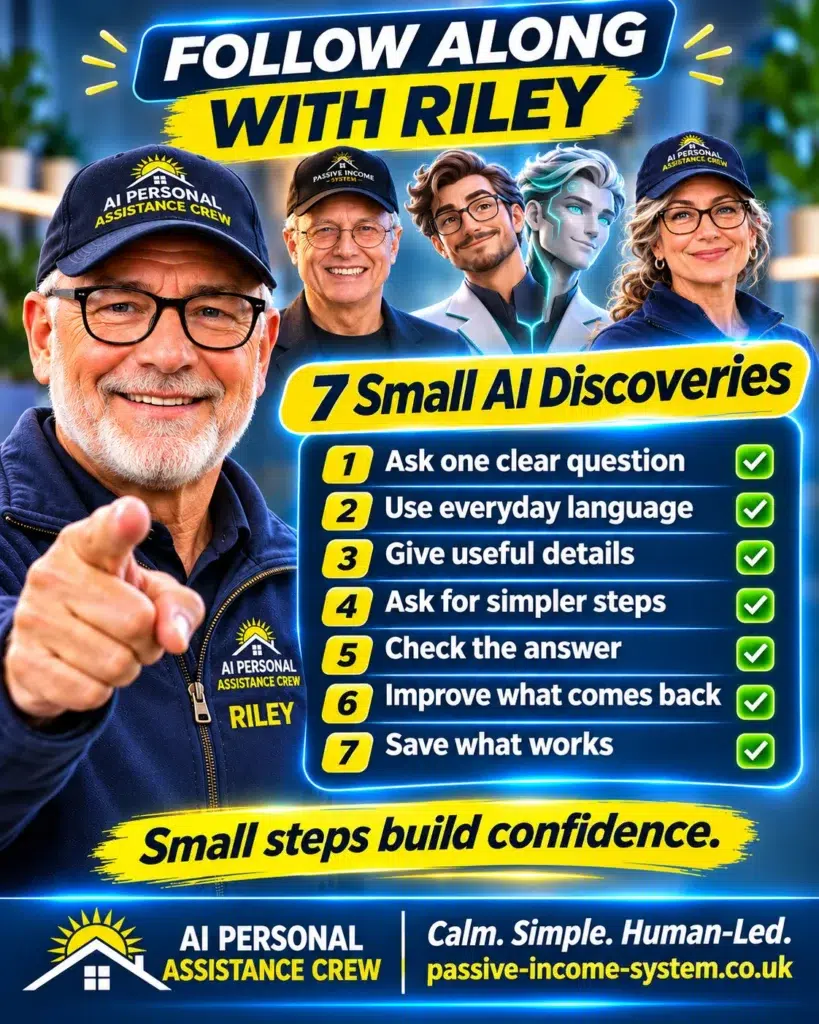
LESSON 2: Seven Small Discoveries Can Change How You See AI Forever
Build Your AI Confidence Without Knowing Everything
One reason people hesitate to try unfamiliar technology is the fear of looking foolish. They imagine everybody else understands the terminology, knows which buttons to press and has already mastered a collection of sophisticated tools. The truth is that experienced people encounter unfamiliar situations throughout their working lives. Every new system begins as something we don’t yet understand. The difference lies in how we approach it. If we expect to learn everything before doing anything, the task can become unnecessarily intimidating. If we begin with one small problem and use the result to guide the next action, progress becomes easier to recognise. This is particularly relevant to artificial intelligence because ordinary conversation can replace many traditional technical instructions. You can describe a problem, ask for an explanation and request simpler language when the first answer doesn’t help.
Our approach starts with an outcome rather than a collection of features. Instead of asking which AI platform has the most impressive abilities, we ask what we would genuinely like to accomplish. Perhaps the task is organising an old collection of notes, preparing clear instructions, planning a sequence of articles, or finding a more manageable way to explain a complicated subject. The technology becomes relevant because it helps with an identifiable job. This is the first small discovery: you don’t have to learn the entire system before gaining something useful from it. Just as someone can learn to drive without understanding how an engine is manufactured, a beginner can learn a practical AI workflow without understanding the mathematics behind the software. The limitations still matter, but they can be discovered through careful use rather than fear.
Experience AI Evolution by starting with something you already understand, rather than searching for an impressive new application. Imagine a retired railway enthusiast who has collected notes about local stations for years. He doesn’t need to ask AI to invent a history lesson or explain a subject he knows nothing about. He can begin with one photograph, a short memory and a question about how to organise his information for a younger reader. The assistant might help write a simple caption and flag details that need checking. Our enthusiast then examines the result, corrects anything misleading and saves a useful explanation. No complicated business model is involved, and there’s no need to build a website before making the first discovery. He has learnt something about the technology while producing a small resource connected to a genuine interest. That’s a much more satisfying beginning than spending another afternoon comparing software he may never use.
Asking For Simpler Instructions Is A Strength, Not A Weakness
The second discovery is that artificial intelligence can adjust its explanations when we tell it what isn’t working. Suppose a response contains unfamiliar terminology, several complicated stages and instructions that assume considerable computer knowledge. In the past, a beginner might have abandoned the task or spent an afternoon searching for explanations of the explanations. With conversational AI, we can request an entirely different approach. We might ask for ordinary British English, fewer steps, a practical example or one instruction at a time. We can also explain which part of the answer is confusing.
This doesn’t guarantee that every revised response will be correct, but it changes the relationship between the person and the technology. Instead of struggling silently with unsuitable instructions, we can challenge the presentation and ask for something we can also explain: which part of the answer is confusing. That principle has become particularly important in our own Crew. We work with the rule ALAN AI CLICKS LESS, because an efficient system shouldn’t create unnecessary work for the person who is supposed to benefit from it. If a task can be organised into a clear sequence, there’s little value in burying it beneath twenty unnecessary decisions. If a paragraph can explain something clearly, it doesn’t need six paragraphs filled with technical vocabulary. The third discovery follows naturally: good instructions save effort, but clear instructions must still be tested against the actual task. A beautifully written answer isn’t useful if it sends the reader to the wrong part of a website or skips an essential step. We want explanations that people can follow, question and verify. That’s a far more practical ambition than asking the technology to sound clever.
Build Your AI Confidence With The Right Helpers
The fourth discovery involves understanding that different tasks may benefit from different kinds of assistance. Someone who has managed a workplace will recognise the principle immediately. A person skilled at explaining complicated subjects isn’t necessarily the best choice for designing illustrations. A careful proofreader may notice problems that an enthusiastic writer overlooks. A researcher may excel at finding background information but still need someone with practical experience to interpret its relevance. Modern AI tools can support these different activities, although their capabilities, costs and limitations vary. Our own Crew uses assigned roles to keep responsibilities clear. Alan remains the human decision-maker, while Riley coordinates production and other digital helpers contribute according to their designated tasks. The structure doesn’t make the technology infallible. It makes the work easier to organise.
The fifth discovery is that the instructions we give matter more than the titles attached to the helpers. Calling something a research assistant doesn’t guarantee accurate research. Calling something a proofreader doesn’t guarantee a flawless article. Each assignment needs a clear purpose, relevant source material and a definition of what a satisfactory result looks like. If we’re producing a guide for beginners, the reader’s ability to follow the instructions becomes an essential quality test. If we’re preparing an illustration, the image needs to represent the intended subject accurately. If we’re checking factual information, the claims should be supported by appropriate evidence. These simple expectations help prevent the common mistake of treating an attractive AI response as a completed job. An assistant is useful because it helps achieve an outcome, not because it has an impressive name.
The Sixth Discovery Is That Mistakes Can Improve The Method
If you already use artificial intelligence, try the same exercise with a task that has frustrated you before. Instead of starting a completely new conversation, explain what you disliked about the earlier result and describe what success would look like. Perhaps you need fewer clicks, a clearer example, better formatting or a more natural tone. Compare the new answer with the old one and decide whether the change genuinely improved the work. You may discover that giving precise feedback is more valuable than searching endlessly for another clever prompt. Seven discoveries have brought us to one practical conclusion: useful AI work begins when the human understands the job and communicates it clearly. Now it’s time to move beyond asking questions and begin assigning meaningful work.
Open to See This Video, And This Is What’s Already Built, Facebook Master Class, Learn How To Run Ads Like A Pro
Build Your AI Confidence by preserving the useful results of your experiments. When an assistant helps you understand a problem, don’t automatically close the conversation and forget what you’ve learnt. Give the improved explanation a meaningful title and save it somewhere you can find again. A gardener might keep a short seasonal checklist, a former office worker might save instructions for organising household paperwork, and a retired tradesperson might preserve a beginner-friendly explanation of a lesson learnt on the job. Check that the information is accurate and remove any private details you wouldn’t want shared. The document doesn’t have to become a product or a public article. Its immediate value is that you’ve created something useful from one ordinary conversation. Tomorrow, you can improve it, add an example or use it as the foundation of another small project. That’s how individual discoveries begin to form a personal learning library.
Build Your AI Confidence: 7 Powerful Lessons For Beginners
The Seventh Discovery Is That You Already Understand Teamwork
Build Your AI Confidence: 7 Powerful Lessons For Beginners: Build Your AI Confidence With Seven Powerful Discoveries
Build Your AI Confidence through seven practical discoveries that help retired beginners understand artificial intelligence, use everyday language and build confidence without mastering complicated technology.
Discover How Simple AI Instructions Make Everyday Tasks Easier
Artificial intelligence
 The second discovery is that artificial intelligence can adjust its explanations when we tell it what isn’t working. Suppose a response contains unfamiliar terminology, several complicated stages and instructions that assume considerable computer knowledge. In the past, a beginner might have abandoned the task or spent an afternoon searching for explanations of the explanations. With conversational AI, we can request an entirely different approach. We might ask for ordinary British English, fewer steps, a practical example or one instruction at a time. We can also explain which part of the answer is confusing.


No comments:
Post a Comment