Make Existing Posts Work: Best Opportunities For Retirees
Your Best Digital Opportunity May Already Be Written
Make Existing Posts Work Before Starting Again
Discover how an overlooked piece of content can become a helpful resource, attract interested readers and support your next practical step.
One Useful Article Can Open Several Doors
You don’t need hundreds of followers or expensive advertising. Begin with one genuine problem, one helpful answer and one reader who needs it.
The Article That Nobody Thought To Revisit
You may not need another product idea. Something useful could already be sitting in your collection of articles, notes or saved answers.
Imagine a retired heating engineer sitting at his kitchen table on a Saturday morning. He’s spent much of the week wondering what to write next for his little website. Notebooks sit beside the laptop, half-finished ideas in a folder, and several articles he published months ago. One explains how to recognise a common heating problem before calling a tradesperson. Another offers sensible questions to ask when getting a quotation. Neither article attracted much attention when it first appeared, so he assumes their useful life has passed. Yet somewhere, a homeowner is struggling to understand precisely the problem those articles explain. The difficulty isn’t necessarily that the engineer needs more ideas. It’s that his existing answer hasn’t found the person who needs it. Learning to Make Existing Posts Work begins with recognising that difference.
It’s a familiar situation for anyone who has spent years collecting practical knowledge. A retired secretary may have explained how to organise important household documents. A former shopkeeper may have written about handling difficult customer conversations. Someone who spent decades caring for a garden may already possess clear instructions for growing vegetables in awkward soil. None of these examples guarantees a business. Their value begins with whether the information is accurate, understandable and genuinely useful to somebody else. The internet hasn’t removed the need for experience. It has simply given ordinary people new ways to organise and share what they know. For a retiree exploring digital income, that is encouraging news. You needn’t arrive with a clever invention or an impressive list of qualifications. Start by looking at the questions you’ve already answered well.
Make Existing Posts Work By Finding The Reader’s Problem
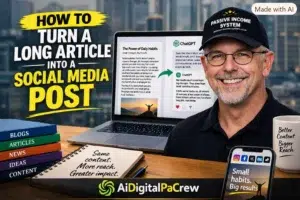 The first opportunity is to look at old material through somebody else’s eyes. Writers naturally remember the time spent creating an article. Readers don’t know or care how long it took. They want to understand whether it helps them solve the problem that brought them to the page. An article called “My Thirty Years In Plumbing” might be an interesting memoir, but a short guide explaining which questions to ask before replacing a boiler offers a more immediate benefit.
▶ Watch Today’s Video
The first opportunity is to look at old material through somebody else’s eyes. Writers naturally remember the time spent creating an article. Readers don’t know or care how long it took. They want to understand whether it helps them solve the problem that brought them to the page. An article called “My Thirty Years In Plumbing” might be an interesting memoir, but a short guide explaining which questions to ask before replacing a boiler offers a more immediate benefit.▶ Watch Today’s Video
The original experience remains the foundation. Only the presentation changes. Before editing a single sentence, write down the question the article answers. If the question is hard to identify, the content may be trying to do several jobs at once. That doesn’t make it worthless. It suggests that one useful section might deserve its own clearer introduction and a practical takeaway.
Consider another example. Margaret spent forty years working in an office and became the person colleagues approached whenever paperwork went missing. After retirement, she wrote a detailed article about keeping records organised. She assumed readers would appreciate its thoroughness, but the article attracted little visible interest. Looking again, she noticed a practical section explaining how to create a simple folder for household guarantees, appliance instructions and renewal dates. That small section could help somebody today. Margaret doesn’t need to invent a new subject. She can improve the existing material, turn the instructions into a printable checklist and explain when the checklist might be useful. However, she must also check whether any advice remains current, particularly if it involves laws, official records or financial matters. Repurposing useful content is not permission to repeat outdated information.
The Difference Between An Article And An Invitation
The danger with a large content library is that several articles may explain the same idea in slightly different language. A workshop assembled without inspection can therefore feel repetitive. Imagine receiving three daily lessons that all tell you to identify your hidden skills, with none explaining what to do afterwards. The reader may wonder whether the course has any real direction. Before choosing lessons, write down the specific achievement each one supports. If two articles perform the same job, select the clearer one. The remaining article can provide additional reading or be improved for a different purpose. There’s no need to force every published post into a course. A short, coherent sequence is more useful than an impressive collection that repeatedly returns to the beginning. When we Make Existing Posts Work, we should connect distinct pieces of teaching, not repeat the same explanation.
That principle also helps identify where a suitable commercial offer belongs. Somebody who has learnt to create a useful checklist may later appreciate a well-designed template, a more comprehensive guide or software that saves time. Another person may not need any of those things. A responsible business explains who an offer suits, what it includes, what it costs and any important limitations. Affiliate relationships should be disclosed clearly, and a recommendation should be based on relevance rather than the commission available. The first sale, if one happens, is not proof of dependable passive income. Products may require updates, customer support, refunds, promotion and continuing work. The goal is to develop something valuable that could support repeatable earnings over time, not to persuade beginners that publishing a PDF automatically produces money while they sleep.
Today’s Apprentice Task <=> Give One Old Article A New Job
For today’s activity, choose one article, guide or set of notes you’ve already written. Read it once, then complete four short sentences in your notebook. First: “This helps someone who is struggling with…” Second: “After reading it, they can…” Third: “The smallest useful action they could take today is…” Fourth: “The next piece of help they might appreciate is…” These sentences are not advertising slogans. They’re a way to test whether you understand the resource from the reader’s point of view. If you struggle with an answer, return to the article and find the most practical section. Don’t attempt to redesign your website, write an email campaign or launch an advert today. One clear reader benefit and one achievable action are enough for a meaningful first improvement.
Open to See This Video, And This Is What’s Already Built,
Trained & Waiting For Your First Command.
If you’d like AI assistance, ask it to examine the article and identify its most useful practical lesson. Check the answer against your experience. AI may overlook important details, misunderstand the audience or invent information that sounds convincing. Your judgement remains essential. Once you’ve selected the strongest lesson, consider whether a short checklist would make it easier to use. If the answer is yes, sketch the checklist before choosing software or designing a cover. If the answer is no, improve the article’s introduction and next-step invitation instead. That’s how you can Make Existing Posts Work without turning a sensible improvement into another enormous project. You finish the day with something clearer, more usable and easier to share. Tomorrow, you can decide whether it’s worth taking further.
The retired engineer at our kitchen table didn’t need to invent a new trade, learn every AI tool or create another website. He needed to look at his experience from the reader’s side. Margaret discovered that an overlooked section of an old article could help somebody organise an everyday problem. Phillip learnt that attracting visitors matters less if the destination doesn’t deliver what was promised. Their examples point towards the same practical principle: useful knowledge becomes more valuable when it’s organised around a real question, presented clearly and made easy to act upon. That doesn’t guarantee an audience, subscriber or sale. It gives those outcomes a better foundation. Before asking what to create next, open something you’ve already finished. Make Existing Posts Work by finding the person it can help and giving them one worthwhile next step.
Your final question for today: Which piece of your existing knowledge deserves a second chance?

Make Existing Posts Work: 7 Hidden Opportunities For Retirees Discover how to Make Existing Posts Work by turning your knowledge into free resources, attracting readers and exploring digital income opportunities.
Spread The Love For Marketing Online
#MakeExistingPostsWork #TurnKnowledgeIntoIncome #DigitalIncomeForRetirees #CreateUsefulDigitalProducts #ShareYourLifetimeExperience #FindYourIdealReaders #BuildTrustBeforeSelling #ReuseYourExistingContent #StartYourDigitalJourney #FreeDigitalLearningWorkshop #UseAIWithConfidence #HelpBeforeYouSell


No comments:
Post a Comment